
Thousands of U.S. countertop workers could have damaged lungs, safety expert says
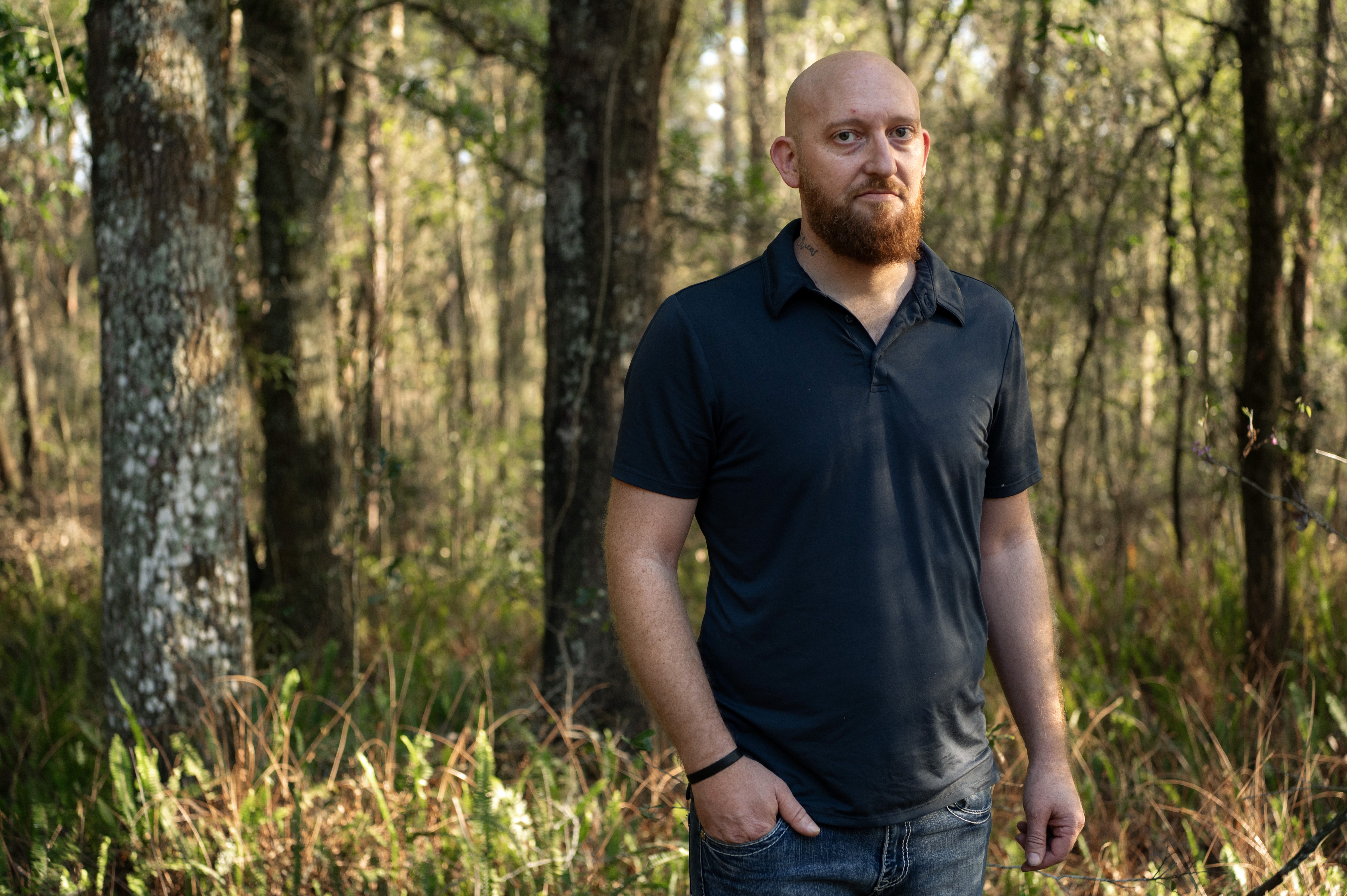
Over 550 men in California have fallen ill after cutting natural or factory-made stone countertops. But epidemiologists say this isn't just a California problem. (Image credit: Tina Russell for NPR)
Wade Hanicker poses for a portrait at his home in Brooksville, Fla., on March 23. Hanicker was diagnosed with silicosis after years of cutting quartz countertops. Tina Russell for NPR hide caption
Wade Hanicker lives near Tampa, Fla., and he started making countertops about 15 years ago. He used saws and other power tools to cut and polish big, heavy slabs of raw stone so that they'd fit perfectly into customers' kitchens and bathrooms, and wore simple face masks to help protect himself from any dust.
"We were more worried about getting crushed by slabs or getting cut with blades and stuff like that," he says, "not getting a lung disease."
Shots - Health News
Young men making quartz countertops are facing lung damage. One state is taking action
He says he made some countertops out of granite, but mostly he cut "quartz," a popular composite made by factories that take bits of quartz mined from quarries and mix it with binders and pigments. Compared to granite or marble, manufactured quartz contains far more of the mineral silica — and silica dust can cause lung damage if you breathe it in.
That danger has become dramatically clear in California, where officials have been grappling with an epidemic of silicosis, an irreversible lung disease. They've tracked over 550 sickened countertop workers, almost all Hispanic men, with most of the cases emerging over the last few years. Over 30 workers have died, and more than 50 have had lung transplants, according to a public dashboard where the numbers keep going up.
On May 21, a workplace safety board in California will vote on whether the state should ban the cutting of high-silica quartz countertop material, as a group of doctors has petitioned the state to do. Those doctors say the severity of workers' disease suggests that it's caused by exposure to toxic ingredients in addition to silica, like pigments or resins.
Business
How a CEO and Trump donor is weaponizing tariffs against his rivals
Rebecca Shult, a lawyer for the major quartz company Cambria, said in a March hearing that her company objected to the idea that any one subset of silica-containing products was to blame. "For this reason, we take issue with the very nomenclature of 'engineered stone silicosis'" used on California's disease-tracking dashboard, she said.
Meanwhile, other states — like Hanicker's home state of Florida — haven't reported seeing large numbers of countertop workers getting sick.
"Please keep in mind, there is only a handful of silicosis cases in the other 49 states," Shult told lawmakers in Congress during a hearing earlier this year.
Silicosis In U.S. Countertop Workers
But David Michaels , an epidemiologist with George Washington University and an expert on workplace safety, says California is seeing a large number of sick workers because it's been actively and thoroughly looking for cases, unlike other states.
Thousands of countertop workers across the country likely have unrecognized lung damage, says Michaels.
"We could easily have 10,000 workers here with silicosis and possibly far more," he says, noting that an estimated 100,000 people work in this industry in the U.S., and studies done in Australia found lung disease in over 10% of the countertop workforce there.
"This is life-changing"
Many doctors aren't familiar with silicosis, says Michaels, and they don't always ask about a person's job. So workers who do seek medical help often get misdiagnosed.
Shots - Health News
'There's No Good Dust': What Happens After Quartz Countertops Leave The Factory
That's what happened to Hanicker about five years ago, when he developed a knot of pain under his shoulder. He took ibuprofen and powered through. When the pain started creeping around his chest, his wife worried about his heart and insisted that he seek emergency care.
Erica and Wade Hanicker rest together on the couch after putting their two children to bed. Erica Hanicker was the one to insist her husband visit the emergency room when his pain worsened. Tina Russell for NPR hide caption
"We didn't think," he says, "that it could be, you know, work-related, from the dust."
The doctors took an X-ray, diagnosed pneumonia, and sent him home with antibiotics, which didn't help. Next, he had a CT scan. It found nodules in his lungs, and a biopsy showed silicosis. He remembers breaking down and crying with his wife.
"We realized that, hey, this is life-changing. There is no cure for this," says Hanicker, 39, who suffers from pain, weakness and shortness of breath. Doctors say he'll eventually need a lung transplant, and he also has a silica-related autoimmune disease.
Shots - Health News
Workers Are Falling Ill, Even Dying, After Making Kitchen Countertops
"The two biggest things that hurt me is how it affects my marriage and not being able to be a father the way I want to with my kids," he says, saying he can't play sports with his young children or run along beside them to teach them to ride a bike. He's sued the makers and distributors of quartz slabs.
Quartz manufacturers like Cambria point out that breathing in dust while cutting any high-silica material — such as the natural stone quartzite — can be dangerous. They maintain that their products are safe if the fabrication workshops that cut the slabs use sufficient precautions such as vacuum systems and water sprays to control the dust.
"Workplace safety is a huge thing," says attorney Khaled Taqi-Eddin , who represents Cambria. "If you don't have good workplace safety practices, whether it's a quote-unquote 'natural' stone or whether it's a quartz stone, you are going to end up having people continuously getting sick."
Wade Hanicker experiences hip pain while trying to give Nova Hanicker, 3, a piggyback ride while Cash Hanicker, 4, watches. He says the thing that affects him most is he cannot be the father he always pictured he would be. He can't run with his children. He gets tired very easily. Tina Russell for NPR hide caption
Occupational health experts who have petitioned California to ban quartz, however, say this material "is too toxic to fabricate and install safely, and education and enforcement alone will not be sufficient to curtail the escalating occupational health emergency caused by this product."
A few weeks ago, in the first quartz and silicosis lawsuit to come to trial outside of California, a jury in Colorado awarded damages to an injured worker named Tyler Jordan, finding that actions by several companies led to his illnesses.
Jordan, in an interview with NPR, said he'd started working in his family's small countertop shop as a teenager and worked full time after graduating from high school. After about a decade, he was diagnosed with silicosis. Shocked, he struggled to believe it was real.
"I felt like I was too young. It felt like there was going to be some sort of mistake. It felt wrong," says Jordan, who had hoped to take over the family business but now can't work anywhere near silica. He developed silica-related kidney failure and had to go on dialysis and have a kidney transplant from his father.
"The worst situation"
One of Jordan's doctors is Cecile Rose , an occupational pulmonologist with National Jewish Health and the University of Colorado in Denver. She was part of a team that reported on some of the first cases of severe silicosis in young U.S. countertop workers.
Back then, in 2019, she'd seen seven cases in Colorado — including a couple of women who worked as cleaners and got exposed when they swept up silica dust. The severity of the disease and the young age of the victims alarmed Rose.
Now, she and other doctors have seen about 20 cases in their state, she says. And she and her colleagues created a voluntary registry where doctors can share their experiences.
"We have cases from Illinois, from Missouri, Montana, New Mexico, South Carolina, Wyoming," says Rose, adding that this effort is scattershot, because physicians hear about it through word of mouth.
James Nevin, an attorney whose firm represents both Jordan and Hanicker, says he and his colleagues represent other workers in about 25 states, and there are reasons why countertop laborers wouldn't want to talk to reporters, lawyers, or doctors. "They're terrified of losing their jobs, if they are still able to work. They're terrified of being deported," he says. "They're afraid to come forward."
In December, Massachusetts made headlines when that state announced its first case. Since then, state officials have found two more.
New York Department of Health officials, meanwhile, told NPR that they knew of only four cases in their state. Officials in Washington state similarly knew of four cases of silica-related lung disease that occurred across three different businesses handling quartz. At one countertop-maker in Chicago, federal inspectors found several cases.
"I'm 100% sure that there are many more cases in Florida, and New York, and probably every state in this country," says Rose.
"This is the worst situation I've seen affecting a workforce in my 35 years," says Kurt Hegmann , director of the Rocky Mountain Center for Occupational and Environmental Health in Utah.
He says sick workers have started showing up in clinics in his state and that although no one knows how many cases there are in Utah because it's not being systematically tracked, "we know that in a case of one of the fabricators, that 38% of the workforce is affected."
"I believe that California is actually leading the country, correctly, in how to address this problem," says Hegmann.
Coverage from 1 source
Coverage by lean
- Unknown1
Comments
Sign in to join the discussion.
Sign in with SpryLogin