
Read the transcript: President Donald Trump interviewed by NBC News’ ‘Meet the Press’ moderator Kristen Welker
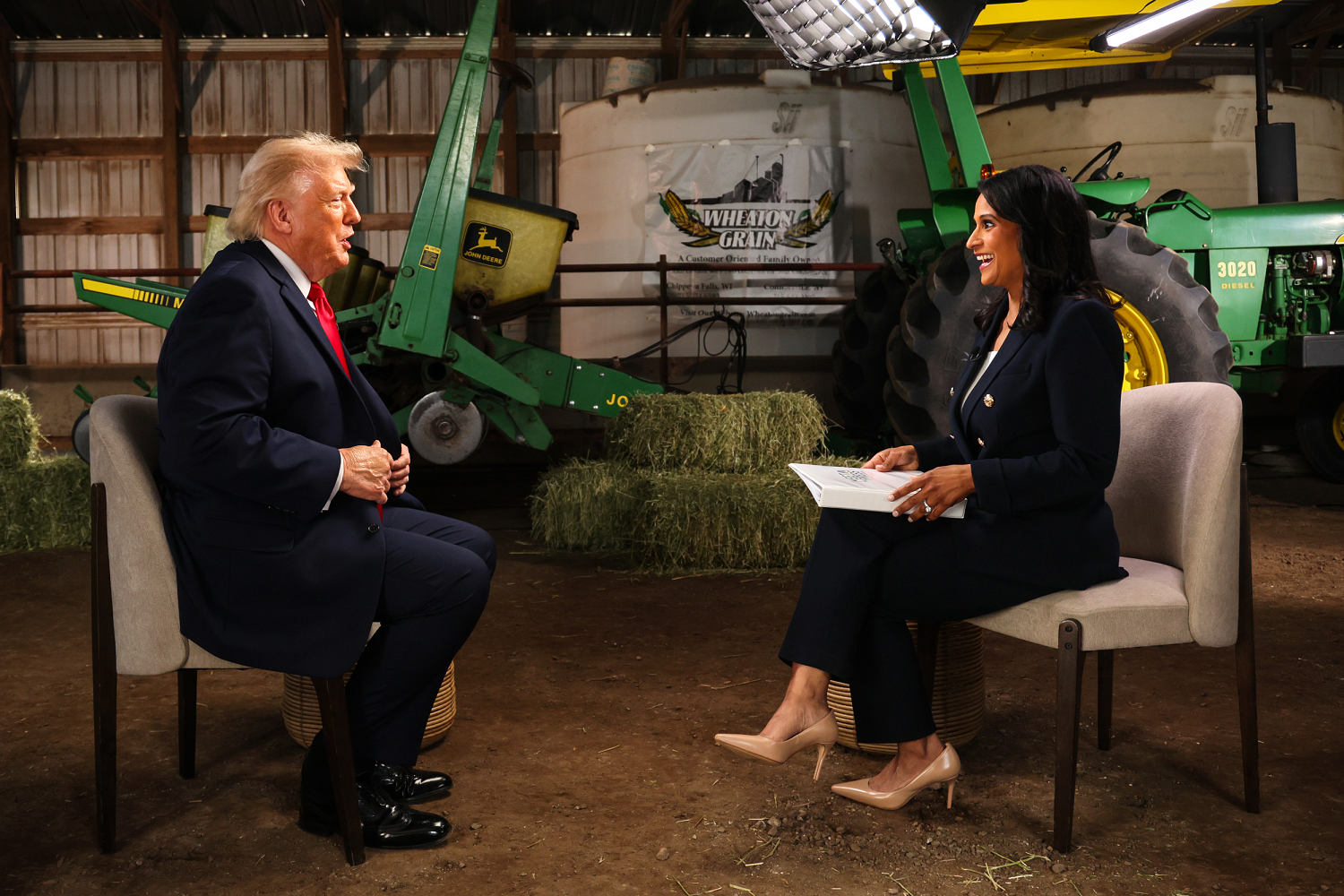
"Meet the Press" Host Kristen Welker interviews President Donald Trump on June 5 at Custer Farms in Chippewa Falls, Wisc.
Get unlimited access to ad-free articles and exclusive content.
President Trump, welcome back to Meet the Press.
Thank you so much for being here. We are going to talk about your visit, why you’re here in Wisconsin. But I’d like to start off by talking about the major issue that you are focused on every day which is Iran. Sunday will mark 100 days since the first strikes. Your secretary of state, Marco Rubio, said that the war had concluded. And yet, just this week, Iran attacked U.S. allies in the region, calling it retaliation for a set of U.S. air strikes. Is the United States at war with Iran?
Well, they’ve been largely decapitated. And I call it a military exercise because people would rather have it called that. It’s not a big war for us. It’s not. We have the most powerful military in the world. I built it, frankly. I built it in my first four years. And I’m using it a little bit in my second four years. Their navy is gone. Their air force is gone. Their anti-aircraft is gone. They might’ve built it up a little bit over the last four weeks during this little ceasefire that we did at the request of some very good people, very, very fine people from — actually from numerous places, as you know. You know, there are a lot of people involved. But from Pakistan in particular, the field marshal and the prime minister. And we’re very close to having a deal. And if we don’t have a deal, we’ll do it one way or the other. Either way, we win.
I do want to talk about the terms of any potential deal --
– in just a moment. But let me just follow up with you. You did post on social media just this week, “My final negotiations to end the war with the Islamic Republic of Iran.” There is a naval blockade in place –
– which technically is an act of war under international law. So is this a war as long as there’s a naval blockade in place?
Well, we have a blockade. It’s been extremely effective. And the reason we have it is they tried a blockade, and now we blockaded them. And, as you know, they’re losing $400-500 million a day. It’s not sustainable for them. They have an economy that’s shot, in addition to everything else. Their leaders are gone. Their generals are gone. Their first tier and second tier are gone. Much of their third tier is gone. But they put up a blockade and so we blockaded them. And we have the ultimate blockade. I don’t consider that a war, but if you want to define it as such, I guess you can.
I don’t define it at all. I don’t think about it. I just do what I have to do.
But if you’re not specifically calling it a war, would you consider sending some of the troops who are stationed there, who were sent because of Operation Epic Fury there home?
You mean boots on the ground? Are you talking about –
No. Would you consider sending them home if it’s not technically a war?
We don’t need as many troops. I think it’s just like it’s on the — to err on the side of caution. We have a lot of people there. They’re very safe. You know, if you think, we beat Venezuela. We lost nobody. Took over the whole country. We lost nobody. We have a great relationship, by the way, with Venezuela. Venezuela’s doing very well. But we lost nobody. We’ve lost 13 people here and that’s a lot. Thirteen people, too many. But, if you look at Vietnam, where hundreds of thousands of people were killed, if you look at any one of the last seven or eight wars where many, many people were killed, we lost 13. And again, 13 is too many. I don’t want to lose any. But 13 is less than anybody’s ever even envisioned. I think we’re doing a great job.
But so are you saying you would consider sending some of the troops home, sir? Some of the 50,000 troops who were sent there as a part of Operation Epic Fury?
I would say this. It costs us very little to keep them there. I don’t consider them in danger. We have the best defense anyone’s ever seen. We have the best offense anyone’s ever seen. So I don’t consider it danger. I would say it would be foolhardy to do that because maybe we may use them. It’s unlikely. But I think we’ll keep them there until such time as we have a completion. And when we have a completion, you will see things like you’ve never seen. The oil will go down. The stock market already, as you know, it’s at an all-time high. Even in the midst of it, it hit all-time highs. We had 73 all-time highs in the short period of time that I’ve been in office, which is a record, by the way. And, you know, we’re doing very well. But the main thing is we cannot let Iran have a nuclear weapon, can’t do it.
Now, you just referenced the 13 Americans who were killed.
And I want to know what your red line is. What would trigger you to restart military action? Would it be Iran killing more American citizens?
Well, certainly, that would be something that I would think about very seriously. But my red line would be if I think I wasn’t going to make a deal, or if I wasn’t going to make a deal fast enough. So we’re having very good negotiations with the people that are leading the country now. It’s the third group that we’ve been dealing with. And they are different. And you could say it’s regime change actually because these are very different people. I find them to be more rational, very smart.
More from NBC News' interview with Trump
Who — who is that? Who’s leading the country?
Well, I don’t want to go into names. But you know who they are. They’re leaders. They’re respected, respected by the people that have to respect them. They are calling the shots. We know that because we see it through various tests that we’ve given. It’s a little bit strange because you have leaders that have been there for a long time, and they get wiped out. Then you have leaders that you also know, the second tier, and they get wiped out. All of a sudden, we’re dealing with different people. But no, I think that we’ll either have something done fairly quickly, or we’ll finish it out militarily.
Are you talking about the son of the Supreme Leader?
What is his status? Have you talked to him directly?
– I do believe they have great respect for him. I see it. I mean, they want to get his concurrence. They’ve said to me, they’ve said to others, that they’re looking for approval. And he is part of the approval process. Absolutely.
Have you spoken to him directly? You said --
No, I have not. I would if he’d like to, but I have not spoken to him directly.
Yeah. They do pay homage to him. I would tell you if they didn’t. They seem to — based on what I see, they seem to respect him a great deal.
Do you know where he is? Do you know how he is doing physically?
I don’t want to say whether or not I know where he is. But there’s a good probability that I do.
Okay. He is the son of the last Supreme Leader –
– who was obviously a hardliner. Is this younger Khamenei any better for the United States than his father was?
Younger. I think more rational. Injured. He’s pretty badly injured. So there’s a certain bravery there. A lot of people, if they were injured that badly, they wouldn’t be talking about, you know, “How are we doing with the United States?” They’d have other things on their mind. So there’s a certain bravery there. But he is very seriously injured. Yeah.
What is the status of talks exactly in this moment? How close are you to making a deal? Are we talking about days, weeks, months, Mr. President?
I mean, I think we’re very close. We have a couple of points. They don’t even seem like big points. They’ve conceded the fact that they will not have nuclear weapons. We had a clause in there that we will not develop nuclear weapons. And everybody was very happy with it except me. And I said, “Well, what happens if they, not develop, but they go out and purchase, they acquire?” I want to put the word, if they buy, or purchase, or acquire. You know, you’ve got to have that in there too because that’s not developing. So they don’t have the right to develop or purchase, acquire, or buy.
Have they pushed back against that? Is that one of the sticking points?
Okay. You have been saying for months, Mr. President, that Iran is begging to make a deal.
If they are so desperate to make a deal, why haven’t they made a deal with you yet?
Because they — it’s a very hard thing for them. They’ve had great independence. They’ve dealt with very weak and ineffective leadership on behalf of the United States and other countries, frankly, that were — that allowed them to get away with murder. And I don’t — I think they can’t believe they’re in the situation where they’ve been virtually decapitated.
But if they’re so desperate, Mr. President, why haven’t they said “yes” to the terms you’re proposing?
Because they’re strong. They’re proud. There are things they never thought they’d be doing that they’re going to have to do. They’ve got no choice. And it takes a little while. You know, you’re talking about 47 years of getting away with whatever they wanted. I mean, we should — this should’ve been done long ago. This should’ve been done by other presidents, or other countries. Doesn’t have to be us. Other countries. But they were very close to having a nuclear weapon twice. That was when I terminated the Iran nuclear deal, which was a path -- that deal, the JCPOA, that deal was tantamount to giving them a nuclear weapon. It was a horrible deal, given by Barack Obama. And really penned by him. It was a horrible deal. It was — you know, it expired long ago. Had I not — I terminated it. But had I not terminated it, it expired long ago. It was a short term deal. It was a road to a nuclear weapon. They would’ve had a nuclear weapon five years ago.
But, Mr. President, I’m curious because when you were campaigning, you said you would rip up the Iran nuclear deal, but negotiate –
Why didn’t you negotiate a better deal at the time, because after it was ripped up —
— there weren’t guardrails, and they escalated their production--
Excuse me. It takes years to do these things. These people have been fighting for 47 years. They’ve been killing Americans, they’ve been taking off their legs and their arm, and their faces have been hurt so badly and so horribly. I’m moving very fast. I’m into three months. You know, Vietnam lasted 19 years. I’m into my third month, and all I do is say, whoa, when are you going to end? If I were a Democrat, nobody would be talking that way. But it doesn’t matter to me. I’ve gotten so used to it. Look, we have totally destroyed their military. They have some missiles left. They have some drones left.
But they have some left. No. But they have — I know almost to the number. And we know where they are too. And we know where their drones are. And we know where their drone factories are. Most of the drone factories have been knocked out, most of the launching pads have been knocked out and most of the missile manufacturing areas have been knocked out. But they still have capacity. They have some missiles. They have some drones. I would say, percentage-wise, maybe 21, 22 percent of their missiles. It’s a lot of missiles. But it’s not what it was when we first attacked.
So you’re saying they have 21, 22 percent of their missiles left?
Okay. Let’s talk about what specifically you are demanding as a part of this short-term deal. Will the United States agree to a deal with Iran that doesn’t explicitly and immediately give up its nuclear enrichment program on the front end?
Well, you know, depending on when you say “immediately.” Look, it is buried under mountains because our B2s were incredible. The pilots of our B2s were unbelievable. And it’s buried. They can’t get it. The only two countries that could take it, that have the equipment to take — you have to understand three mountains have fallen in on them, right? So you understand that, because the fake news was going around saying, “Oh, maybe they didn’t hit their target.” One o’clock in the morning, pitch black, no moon, no nothing, and every one of those bombs went right down those chutes, blew up. They can’t get it no matter what. I mean, they can get it I guess with years of work. But the only two countries that can get it are us and China because we’re the only two with the equipment that’s capable of doing that kind of work. And it would take weeks, weeks of digging. So, the answer is yeah, we’re going to do it immediately. We’re going to start looking very quickly. And we’ll do it with them. If we make a deal, we’ll do it with them.
No, no. We’re going to do it with the Iranians. So if we make a deal, that means we’ll be friendly, we’ll do it with the Iranians. If we don’t make a deal, we may do it, or we may just watch it. You know, we have cameras on it, all over it. If anybody walked there, if you walked over there, I would be able to read your first name on your lapel. And these are cameras up in space. It’s pretty amazing technology. Space Force. We have cameras all over the site. We know if anybody goes there. If anybody went there, any digging mechanism, any truck, any tractors, anything, anybody went there, we would know. We will take care of it. Is that wind or what?
This would be the first of multiple interruptions due to weather. Rain on the metal roof making it difficult for both of us to hear each other.
Coverage from 1 source
Coverage by lean
- Unknown1
Comments
Sign in to join the discussion.
Sign in with SpryLogin