
Will the new student loan limits actually drive down tuition? Economists weigh in
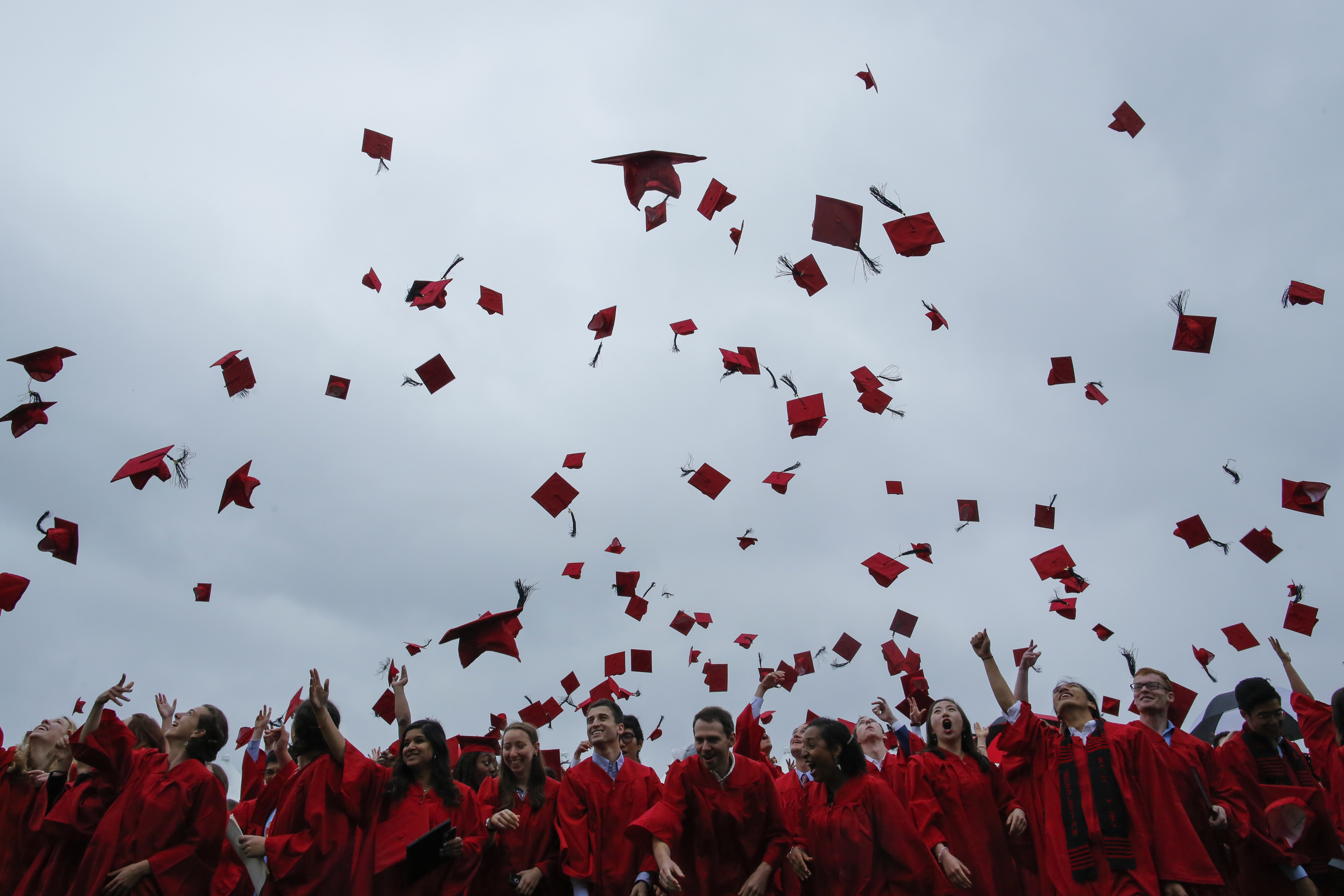
The idea that there's a connection between federal student loans and what colleges charge dates back almost four decades. But it's unclear that link can lead to lower costs. (Image credit: Eduardo Munoz Alvarez)
Students toss their mortarboards in the air at a 2018 commencement ceremony at Wesleyan University in Middletown, Conn. Eduardo Munoz Alvarez/Getty Images hide caption
For the past two decades, graduate students have been able to take out an unlimited amount of federal student loans to cover the full cost of their education.
If they needed $60,000 a year, they could borrow $60,000 a year, year after year.
The Trump administration has a plan to change that by capping graduate school loans for many students at $20,500 a year, and $100,000 overall — effective July 1. (A federal court temporarily blocked a small piece of that plan, but the U.S. Education Department confirmed to NPR that loan limits will indeed begin July 1.)
In a year packed with changes to higher education policy, this new loan limit is one of the biggest, and one of the most controversial.
Education
July 1 brings big student loan changes. Here's what you need to know
U.S. Secretary of Education Linda McMahon says the endgame is to force colleges to slash their tuition prices.
"College costs are just exorbitant. Students are burdened with debt…" McMahon told the House education committee in May . "We really have to do something to bring down the cost of college."
With that goal in mind, Republicans used last year's One Big Beautiful Bill Act to scuttle the program known as Grad PLUS and limit graduate loans. The thinking goes: Borrowers will choose cheaper programs, and expensive schools will have to cut prices to compete.
But many economists aren't so sure it will do what Republicans say it will.
A decades-old idea
The idea that there's a connection between federal student loans and what colleges charge dates back almost four decades, to Feb. 18, 1987.
That's the day then-Education Secretary William Bennett, under President Ronald Reagan, penned a scathing opinion piece for The New York Times , titled " Our Greedy Colleges ."
In it, Bennett excoriated schools for tuition increases that outpaced inflation, and he argued that increases in federal student aid "have enabled colleges and universities blithely to raise their tuitions, confident that Federal loan subsidies would help cushion the increase."
His idea took hold, and economists have dubbed it "The Bennett Hypothesis."
"The Bennett Hypothesis essentially says that, if you provide greater federal aid to schools, they will respond by increasing the price," says Phillip Levine, a professor of economics at Wellesley College.
Almost 40 years later, Republicans are dusting off the Bennett Hypothesis to justify severe limits to student borrowing.
Graduate school is fueling the explosive growth of student debt
To be clear, current limits on undergraduate loans aren't budging – and haven't budged in years. One reason: According to Levine, the net price for undergraduate programs – what families actually pay – has been pretty stagnant lately.
"We've seen at the undergraduate level for at least the last five years or so that college costs have actually been fairly flat," says Preston Cooper, who studies higher education policy at the conservative-leaning American Enterprise Institute (AEI).
Education
States sue over new student loan limits on certain nursing and healthcare degrees
But the cost of graduate school has increased considerably .
"We're at a point where almost half of the borrowing right now is among graduate students, despite them being a much smaller share of the overall population," says Robert Kelchen, a professor of higher education at the University of Tennessee, Knoxville.
Which brings us to Grad PLUS, which the Trump administration plans to shut down on July 1.
For two decades, Grad PLUS has worked as an add-on to the traditional loan program, allowing graduate students to effectively borrow as much as they needed – no limits or guardrails.
Cooper says it's not a stretch to think Grad PLUS helped fuel a rise in graduate school costs.
"Up to this time, it has been a very easy answer [for schools] to basically increase revenues a little bit every year by just raising the cost of graduate school tuition because they know that the federal government is going to have to give their students a loan for those extra costs."
What the research shows
"Having essentially uncapped loans, I think, is not a great policy," says Jeff Denning, an economist and professor at the University of Texas at Austin.
Denning was part of a team of researchers who studied the Grad PLUS program – to put the Bennett Hypothesis to the test. They wanted to know if, in Texas, the suddenly limitless font of Grad PLUS loans that began in 2006 contributed to graduate programs hiking their prices.
The researchers wrote that, for every additional dollar students received in loans, graduate schools increased their prices by $0.64 (after accounting for grants they gave out).
Republicans often cite Denning's work as justification for ending Grad PLUS, arguing: If schools increased their prices nearly as much as federal aid increased, why wouldn't the opposite be true? Less aid should lead to lower prices.
Education
The U.S. Education Department fired thousands of workers. Now, it's on a hiring spree
But it's not that simple, says the University of Tennessee's Kelchen, who has also researched the impact of Grad PLUS, specifically on business, medical and law schools.
"I did not find evidence" of a direct connection between federal aid and prices, Kelchen says.
Even Denning, when asked if the Bennett Hypothesis is true, says "it depends. I think there's some evidence that this happens in certain circumstances, and there's evidence that it doesn't."
The Bennett Hypothesis is "a logical conclusion," according to Kelchen, "if you think that these graduate programs are massive profit centers." Some are, he says. Some aren't.
Medical school, for example, "is wildly unprofitable" for schools, Kelchen says. "It can take a million dollars of resources to produce one medical degree. So limiting borrowing is not going to reduce that cost."
Overall, he adds, evidence backing the Bennett Hypothesis "is largely mixed."
Levine says much of the increase in the cost of higher education over the years is attributable to a phenomenon known as "cost disease." What's that?
Well, over time, most businesses tend to become more efficient, Levine says, which helps them contain costs while boosting wages. But higher education doesn't work that way.
"Since wages rise elsewhere, colleges need to keep pace to attract workers who could work elsewhere. In the end, costs rise to produce exactly the same product."
The half-dozen economists and higher education experts NPR spoke with did agree on one thing: Whatever its impact on prices, the Grad PLUS program, as a policy, was flawed.
"I think there was broad consensus that the idea of letting graduate students borrow basically infinite amounts of money was not a good idea," says Sandy Baum, a senior fellow at the Urban Institute, a nonpartisan think tank.
But, of the Bennett Hypothesis, Baum is skeptical: "There's been lots of study of what causes increases in college prices and of the effects of increases in student aid. And most of them find that in some cases… in particular for-profit institutions, it's true. But mostly it's not true."
Instead, Baum argues, price hikes have been driven by a host of factors, from "cost disease" and student loans, to the rising costs of insurance, technology – even the cost of living.
Coverage from 1 source
Coverage by lean
- Unknown1
Comments
Sign in to join the discussion.
Sign in with SpryLogin