
One U.S. visa program is growing rapidly. No one is happy with it.
One U.S. visa program is growing rapidly. No one is happy with it. Farmers say it's time to expand the H-2A visa for seasonal agriculture labor The Trump administration is focused on an immigration crackdown. But agriculture employers and some moderate Republicans want to start negotiating at least one aspect of legal immigration: expanding a visa program that brings foreign workers to America's farms. Dozens of farmers — including dairymen and blueberry, apple and peach growers — and lobbying p
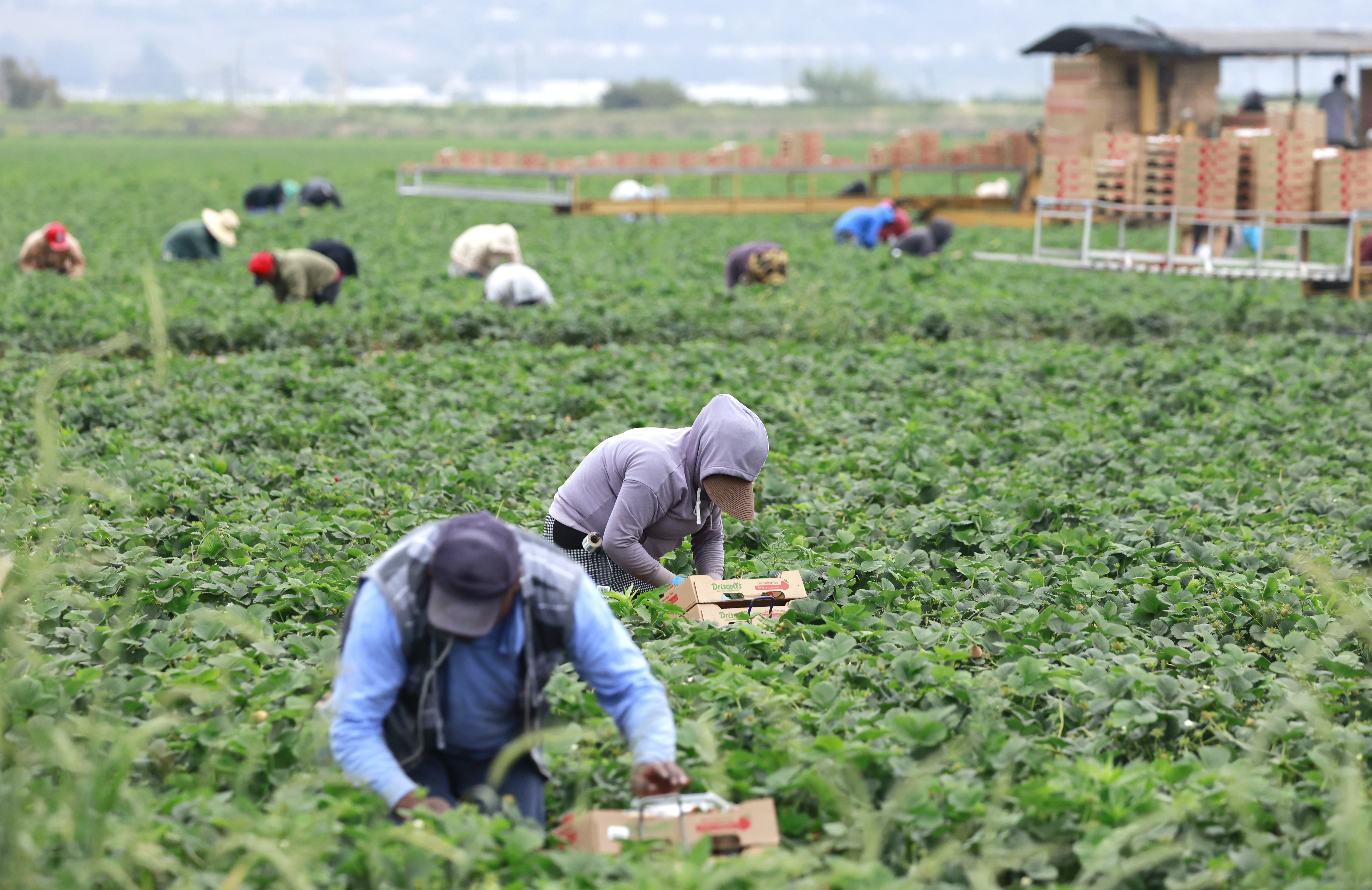
Farmworkers harvest strawberries in a field on Farmworkers Day on March 31 near Oxnard, Calif. Mario Tama/Getty Images hide caption
The Trump administration is focused on an immigration crackdown . But agriculture employers and some moderate Republicans want to start negotiating at least one aspect of legal immigration: expanding a visa program that brings foreign workers to America's farms.
Dozens of farmers — including dairy farmers and blueberry, apple and peach growers — and lobbying powerhouses like the American Farm Bureau Federation took to Washington this month to advocate for their labor needs. At the center of discussions is a bill introduced by House Agriculture Committee Chairman Glenn "GT" Thompson that would expand access to the H-2A visa for seasonal agricultural labor.
"While this may not be in our jurisdiction, it is certainly in the interest of the farmers and ranchers, and foresters that we represent," Thompson, R-Pa., told reporters and gathered farmers. He nodded to the fact that the House Judiciary Committee, not his, must approve any bill related to immigration and visas.
The H-2A visa program provides workers, primarily from Mexico, for farms that need someone to pick, fertilize and prune crops on a seasonal and temporary basis. Historically, farms with year-round needs such as dairies have been excluded from the program. But use of H-2A visas has jumped more than 500% since 2012 — from 62,743 to nearly 400,000 in 2025, in part because other programs have strict caps and other limits.
Immigration
Inside the coordinated strategy to radically reshape U.S. immigration
Despite its growing popularity and farmers' reliance on the program, employers, labor advocates and both political parties agree that it is far from perfect. But there are strong ideological and practical differences on what needs to be changed.
Labor organizations and conservatives are skeptical of any program that expands the use of foreign labor. Labor groups have long criticized the H-2A program for the potential of workplace abuses, and conservatives take issue with any program that could grandfather in workers currently working in the U.S. illegally.
Farmers and other businesses warn of immediate consequences to their labor supply without expanding the program, given the administration's deportations and continued record-low crossings at the southern border .
"Now that the administration has secured the border, it's time to address the rest of our immigration system," said Martin Durban, senior vice president of the U.S. Chamber of Commerce, citing a Congressional Budget Office report that predicts a drop in the working-age population. "You can't grow the economy with a shrinking workforce."
National
As Supreme Court expands Trump's immigration power, experts warn of steeper U.S. population decline
Farmers argue that if the administration continues to push for mass deportations, they need a legal pathway to get workers. About half of all crop farmworkers are working without authorization, according to the latest estimates from the Agriculture Department .
The administration acknowledges challenges between strict immigration enforcement and farm labor supply. The Labor Department last year warned that increasing resources for immigration enforcement risks supply chain disruptions and food supply problems.
"Unless the Department acts immediately to provide a source of stable and lawful labor, this threat will grow as the tools Congress provided… to enhance enforcement of the nation's immigration laws are deployed," it wrote in a related Federal Register notice.
H-2A program grows as farmers ask for changes
First established in the 1980s, the H-2A program allows agricultural employers to request foreign farmworkers on a temporary and seasonal basis, provided they cannot find enough workers in the U.S., among other requirements.
Florida is the top state for use of H-2A visas, followed by Georgia, California, Washington and North Carolina. Those states make up just over half of all H-2A visa certifications.
"We estimate using about 55,000 guest workers this past year, not because the program works well, but because growers have no other choice," said Mike Joyner, president of the Florida Fruit and Vegetable Association.
But growers are unhappy with the program's provisions, such as wages that regularly increase and other costs, including responsibilities to pay for housing, transportation and medical care for each worker.
Last fall, the Labor Department issued a rule that would take housing costs out of workers' paychecks and change the way wages are calculated — effectively lowering guest workers' pay and making the program cheaper for farmers.
But farmers say more changes are needed, which is impossible without action from Congress.
Politics
ICE is now funded through end of Trump's term, raising worries about oversight
Dairy, cattle and pork producers want access to the visa program. And some said they would like their current workers, who may be working illegally, to be able to access the visa.
For those who don't have access to visas, like in the dairy industry, more than half of workers are undocumented, according to some estimates . State-level estimates in places like Idaho and Wisconsin are even higher.
Last month, U.S. Citizenship and Immigration Services issued a memo clarifying that some dairies could access H-2A visas if they proved "seasonal" labor needs. This caught the attention of the dairy industry, which is among the groups advocating for an expansion of the visas.
"A lot of us are still trying to figure out exactly what that meant," said Cricket Jacquier, a dairy farmer in Connecticut and National Milk Board of Directors member, about the memo. "For me, it really raised dairy to the top and recognizes that there's a serious problem in the dairy industry and they want to do something about that."
Jacquier and other farmers said they want any changes or clarifications codified into law. Others, like Sydney Allison, who runs Wild Goose Farms in Florida, want workers for longer and more predictability in wage costs.
Politics
Conservatives and liberals oppose H2A visa changes for immigrant farm workers
"We couldn't get the labor and so we were pushed to use this program," she said. Labor accounts for up to half of the production cost for blueberries she sells across the Eastern Seaboard.
She credits the H-2A program as the reason her farm exists, but warns it's not enough.
"We can't continue to expand. We honestly will probably shrink," she said.
The bill introduced by Thompson would remove the seasonal requirements of the visa while keeping it temporary, at a maximum 350 days a year. It would ensure other sectors like forestry, aquaculture and livestock would get access to the program. And it would provide a process for existing unauthorized workers to access the H-2A program. The bill does not provide any pathway to legalization.
Politics
Trump works to woo farmers in aftermath of Iran war
Opposition to H-2A expansion comes from all sides
From the other side, labor groups representing farmworkers and supporters of the president's hard-line immigration agenda oppose any H-2A expansion.
Teresa Romero, president of the United Farm Workers (UFW) union, said her group would not support a measure without a pathway to legalization for those already in the U.S.
"We have workers who are legal residents. We have workers who are citizens, and we have workers who are undocumented workers. And many of these workers who are citizens are being harmed by these changes," Romero said. "[Employers] preferred to bring these workers, pay them less, have more control over them, and displace the workforce that is here right now."
UFW has many members in some of the states that have seen highest use of H-2A visas, such as California and Washington. Romero and other labor groups also worry that the H-2A program doesn't do enough to protect workers. Workers who come on these visas are tied to a specific employer, making them particularly vulnerable to exploitation .
Stories of Change From America's Farms
America's farms are desperate for labor. Foreign workers bring relief and controversy
The AFL-CIO, the largest labor organization, also opposes any expansion.
"We have long-standing positions in support of reform rather than expansion of our work visa programs," said Shannon Lederer, immigration policy director at the national AFL-CIO. "Systems that create an underclass of workers who can't exercise their rights are bad for all workers."
Simon Hankinson, senior research fellow at the conservative Heritage Foundation, agrees with agriculture employers that the current system is too complicated.
"It kind of is the worst of both worlds for employers who are trying to do the right thing, and I suppose for employees who are trying to do the right thing as well," Hankinson said. But he also opposes expanding access.
Coverage from 2 sources
Coverage by lean
- Unknown2
Comments
Sign in to join the discussion.
Sign in with SpryLogin