
Trump's team says 'no children' died from USAID cuts. Consider these 3 cases
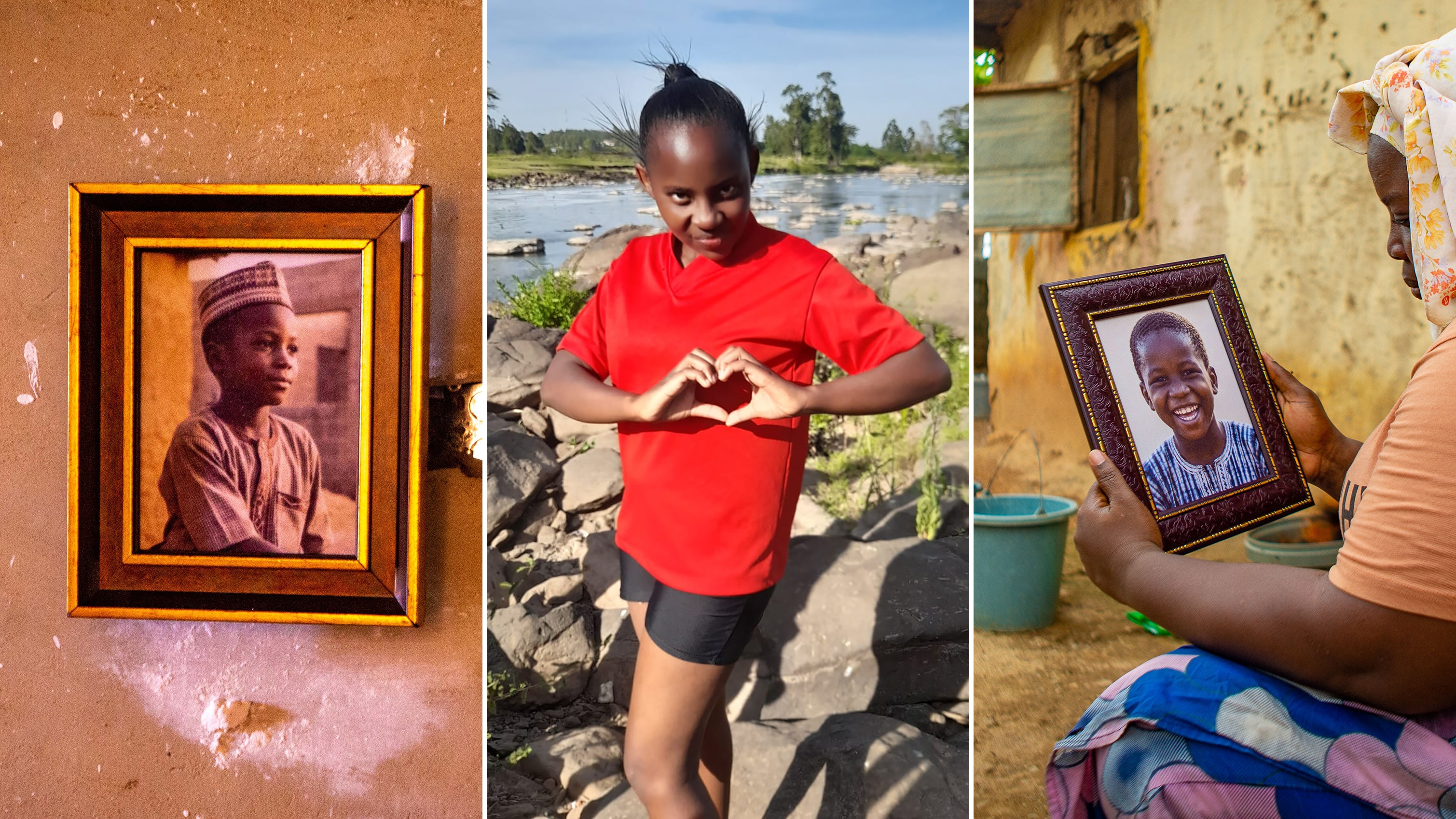
Both Marco Rubio and Elon Musk, who led the effort to sunset the foreign aid agency, have said that no deaths have been linked to the cutting of its funding. These parents tell a different story. (Image credit: From left: David Augustine, Lameck Nyagudi and Kazeem Olawale Nasiru for NPR)
These three children died in the wake of the cutoff of funding from the U.S. Agency for International Development. Their parents say that the loss of medical services supported by these funds played a role. From left: Abdullahi Ibrahim of Nigeria, age 10, suffered a fatal asthma attack. Purity Wamboi of Kenya, 16, contracted tuberculosis. Ibrahim Garba of Nigeria, 8, succumbed to typhoid. From left: David Augustine, Lameck Nyagudi and Kazeem Olawale Nasiru for NPR hide caption
Abdullahi Ibrahim developed asthma when he was 5. Over time, it became increasingly serious.
"Sometimes he would wake up suddenly, gasping for air," recounts his father, Ibrahim Musa, through an interpreter. "I feel very, very scared. We usually rush him to the hospital."
They would take the motorcycle Musa uses as a taxi driver, Abdullahi sandwiched between his parents.
Those visits, plus the drugs and inhalers, were usually free, says Esther Agbo, a nurse at Mucciya Primary Health Care who often interacted with the family living in the north of Nigeria, in Sabon Gari. She says that the costs had been offset by USAID — the United States Agency for International Development.
"Because of that support," says Musa, "people like us who don't have much could still get treatment."
Last year, when he was 10, Abdullahi had an especially severe asthma attack. "He told me, 'Daddy, I can't breathe well,'" says Musa. "He was just lying there, helpless. We rushed to the clinic."
He says the clinic told them the drugs were no longer free of charge. "USAID stopped supplying the treatment [for] free," says Agbo, who was not on duty there at the time. "The cost of the medication was too much for the parents," she says.
Fatima Ibrahim sits alongside a portrait of her son, Abdullahi, in the family's one-room home in Sabon Gari, Nigeria. David Augustine for NPR hide caption
Abdullahi died from that final asthma attack, says his father. "If there was still help coming from USAID," says Musa, "I'm very sure my child would still be alive today."
Naming names
In May of last year, Secretary of State Marco Rubio testified before Congress about the termination of USAID. He said, "No children are dying on my watch."
As recently as June 28 and 29 of this year, Elon Musk wrote on X that deaths in Africa went down after funding to USAID was cut and that those who indicate otherwise " cannot cite a single name of someone who died out of the 'millions' they falsely claim have died. Not a single name!" Last year, as head of President Trump's Department of Government Efficiency, Musk presided over the shutdown of the agency, noting that he was "feeding USAID into the wood chipper."
Abdullahi Ibrahim is one name. And there are others. NPR worked with photojournalists who are part of a global consortium called The Everyday Projects to identify the names of children whose deaths over the past year and a half had a strong connection to the cutback in services provided by USAID funding.
In this story, we are looking at the deaths of Abdullahi and two other children.
In each instance, we interviewed a parent of the child and a health worker familiar with the case.
NPR reached out to the U.S. State Department to ask for comments on the cases of these three children in Nigeria and Kenya. The department didn't address the specifics of their deaths.
In its response, the department pointed to the Trump administration's signing of 32 bilateral global health memorandums of understanding, including with the Kenyan and Nigerian governments, as proof of a different type of foreign assistance commitment.
It is difficult to say for sure what would have happened had USAID remained, says Brooke Nichols , an infectious disease modeler and health economist at Boston University, but the agency had been in Africa enabling a range of treatments.
Nichols created the Impact Counter to tally the number of projected deaths likely associated with reductions in U.S. foreign aid starting in March 2025. "Over the course of one year," she says, "we estimate more than 700,000 people have died from the abrupt stopping of USAID, including more than half a million children."
These deaths occurred largely in low- and middle-income countries, with the vast majority in sub-Saharan Africa — including the three deaths described here.
Purity's mother: "I could see her shivering"
Last August, in central Nairobi, Kenya, 16-year-old Purity Wamboi was home on a school holiday. She loved to read and was happy to help wash clothes and do other chores around the house.
Her mother, Rachael Wanjiru, noticed something was off in her girl.
Rachael Wanjiru, 43, holds a photo of her 16-year-old daughter, Purity Wamboi, who died from tuberculosis-related complications after missing her medication. Lameck Nyagudi for NPR hide caption
"She wasn't feeling too well," Wanjiru says through an interpreter. "She used to cough severely. She had chest pains. Sometimes I could see her shivering. And therefore I asked her to take a break."
Purity tried to keep the discomfort to herself. "I would ask her what was it that she was hiding," recalls Wanjiru. "She understood that I didn't have money, and she didn't want to stress me." (Wanjiru had developed a goiter, so she wasn't working at the time.)
She got Purity some painkillers, which helped.
Her younger brother, 14-year-old James Gitau Mwai, remembers thinking, "I thought Purity was going to get well and be able to be like she was before."
Pages from Purity's journal. Lameck Nyagudi for NPR hide caption
But after she returned to school, the chest pain came back even stronger.
Over the next three weeks, things deteriorated quickly. Purity's family raced to figure out what was wrong — amid a lapse in USAID funding that they say undermined their urgent search.
When Wanjiru brought Purity in for a checkup at the Tumutumu Community Medical Centre in Nairobi, the medical staff explained that she had pneumonia. But she didn't respond to the treatment.
A couple of weeks passed before Tabitha Mugweru bumped into Wanjiru and Purity on the road. She's a close family friend and a community health promoter — a role that involves visiting households, making medical referrals and supporting the health needs of underserved communities.
"They were coming from a private hospital," says Mugweru. "I saw Purity was very weak. Purity was not doing well at all."
So Mugweru referred the family to Mwiki Health Centre, a governmental facility, which sent Purity to a different hospital for a chest X-ray. The scans revealed that Purity didn't have pneumonia at all. She was suffering from tuberculosis.
Purity received new medications, but "the TB was diagnosed very, very late," says Mugweru. This meant that the bacterial infection had already consumed a portion of her lungs.
Mugweru says there had been a more extensive team of community health promoters who once fanned out across Kenya, visiting families in their homes, where they may have caught something like Purity's tuberculosis sooner. These workers were paid with funds that came from USAID, according to Mugweru.
So when the Trump administration shuttered the agency last year, Mugweru says, that money dried up.
"Most of them stopped working when USAID withdrew their support," she explains. "They could have reached Purity earlier during [a] home visit."
The TB treatment wound up coming too late for Purity — who at that point didn't even want to take all the pills because she felt they were causing unpleasant side effects. Then came the day when she asked to sit in the sunshine and have a cup of porridge.
Purity's mother, Rachael Wanjiru, and her 14-year-old brother, James Gitau Mwai, sit outside their home in Nairobi, Kenya. Lameck Nyagudi for NPR hide caption
It was later, after Purity went back inside, that things got bad. "She started shaking," says Mugweru, who was there. "And then her eyes were wide open. And they turned white."
The family called an Uber to take her to the hospital. But she didn't survive the trip.
"Purity died when I was holding her," says Mugweru. "We didn't think that Purity was going to die, no. We thought everything was going to be good. Then all of a sudden, boom, Purity was no more."
Her younger brother says he has felt lonely without having Purity as a playmate.
Ibrahim's father: "He would just look at me and tell me, 'Baba, I am tired'"
In early 2025, in central Nigeria, a cheerful 8-year-old named Ibrahim Garba contracted typhoid fever. It's a dangerous bacterial infection that his father, Yakubu Garba, says he likely picked up from the drinking water.
"It started like a normal sickness," says Garba. "He had fever, weakness and was not eating well."
Ibrahim Garba's portrait hangs inside his family's home. The boy had written, "God is with us" on the wall. Kazeem Olawale Nasiru for NPR hide caption
Coverage from 1 source
Coverage by lean
- Unknown1
Comments
Sign in to join the discussion.
Sign in with SpryLogin