
Trump allies could weaken historic preservation rules to fast-track federal projects
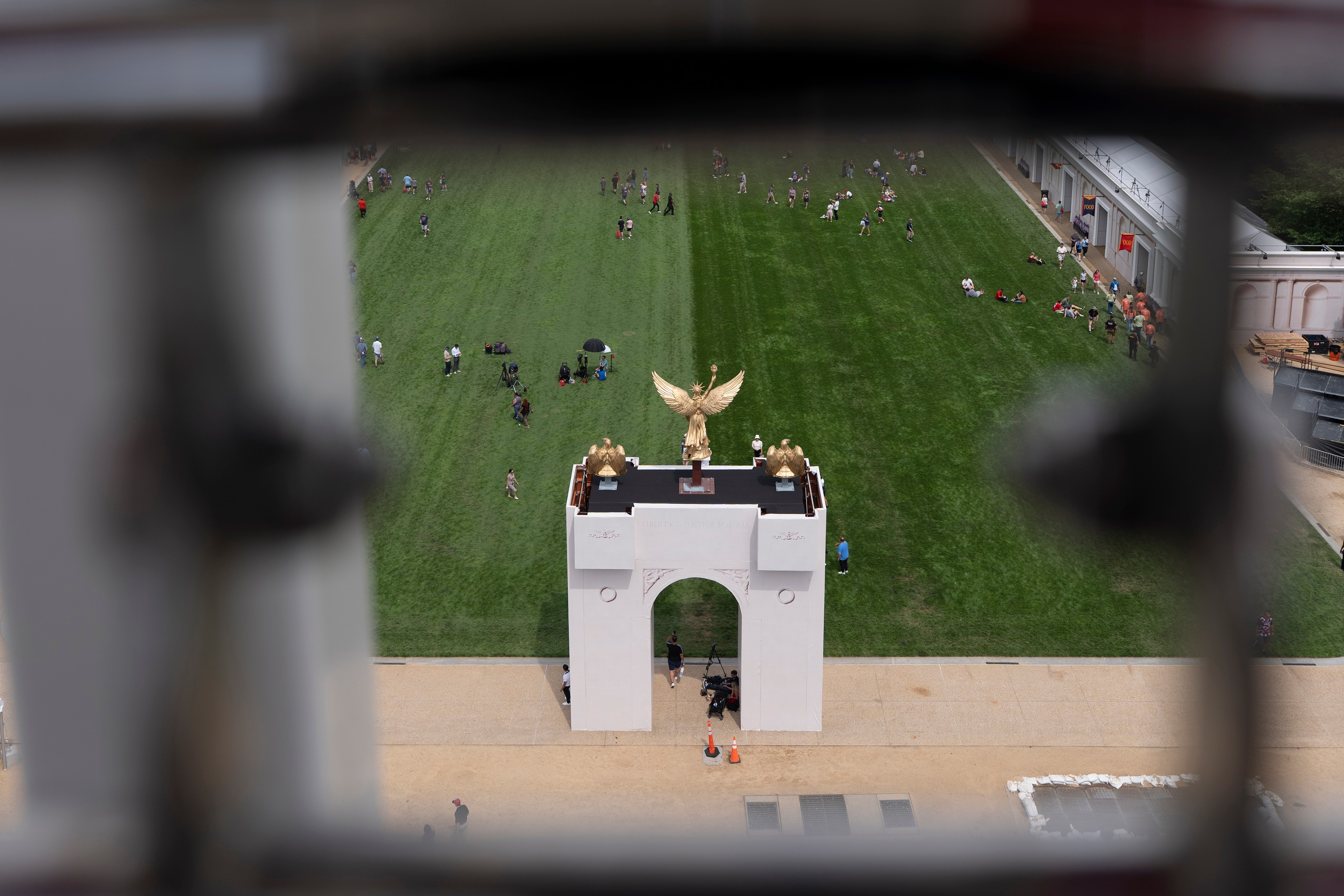
A council packed with Trump appointees is poised to rewrite historic preservation rules. Critics say that could help him build his D.C. arch faster — and endanger important sites across the country. (Image credit: Jen Golbeck)
A mock-up of President Trump's proposed triumphal arch, pictured during the state fair on D.C.'s National Mall in June. The real thing needs to undergo a historic preservation review before it can be approved. Jen Golbeck/AP hide caption
The Trump administration is eyeing a workaround for one of the procedural hurdles facing its proposed 250-foot arch : weakening federal oversight of all construction projects affecting historic sites.
Critics say that the move would not only clear a path for President Trump's controversial projects in D.C., but also endanger the preservation of historic and cultural places across the United States.
"Every American who has any place in their heart that is historic or culturally significant to them should be concerned about this attempt to gut historic preservation protections," said Greg Werkheiser, founding partner at the law firm Cultural Heritage Partners.
National
Trump's arch clears another hurdle, setting up a big debate: Do height limits apply?
The National Register of Historic Places contains over 100,000 properties, encompassing more than 1.8 million buildings, structures, sites, objects and districts. They take many forms, from a house to a burial ground, a shipwreck to a landscape, a single tree to an entire neighborhood.
"It's the thing that defines America," Werkheiser said. "The places that you go where your family has an attachment over generations … There are millions of these sites in this country, and all of them are made less protected by this effort by the Trump administration."
The White House and the Department of the Interior did not respond to NPR's request for comment.
Part of the National Historic Preservation Act of 1966, known as Section 106, requires federal agencies to evaluate how new construction projects would affect historic places.
History
This year's list of endangered historic places focuses on equality and erasure
Under the Section 106 review process , the federal agency overseeing a project must invite interested parties — like preservation groups and local and tribal governments — to weigh in. Currently, agencies are required to consider whether the project would cause "adverse effects" to a historic property and, if so, explore ways to "avoid, minimize, or mitigate" those harms.
The Advisory Council on Historic Preservation, the federal agency responsible for overseeing the Section 106 review process, is packed with Trump appointees. And now, 60 years after the law took effect, the council wants to water it down drastically.
"Because President Trump controls 21 of the 24 members of the Advisory Council on Historic Preservation, it's very likely that they will proceed with doing what the administration wants for them to do," said Sara Bronin, who served as the Senate-confirmed chair of the advisory council under President Biden.
Bronin is the most recent chair of the council, as that position is currently vacant. President Trump has yet to nominate a new one, instead appointing its vice chair, Travis Voyles, to serve in an acting capacity.
Last week, Voyles sent an email to council members asking them to vote on proposed revisions to the wording of Section 106. According to draft language obtained by NPR, those changes include redefining what kinds of properties can be considered historic in the first place, making public comment on new projects optional and removing the requirement to consult with Native American tribes.
National
People are watching the Reflecting Pool like reality TV. What does that say about us?
"What it means is that the federal government, in its own discretion, can decide whether — if ever — to tell an American community that it's about to do a major project that could harm or destroy a historic resource," Werkheiser said. "The public will be completely cut out of any conversation around the future of places that matter to them in this country."
Council members were given just one week to cast their votes, via email, by the end of Friday. The revision would need to clear several more steps of the federal rulemaking process , including a roughly 30-day public comment period, before it can take effect.
Werkheiser called the vote a "foregone conclusion," but said it sets the stage for a legal fight later.
"As sure as the sun rises and sets over Washington, D.C., there will be litigation in an attempt to stop this absurd gutting of protections of American history," he said.
The National Trust for Historic Preservation says "significant cultural landscape features" like the Grand Canyon would no longer be considered historic properties under the proposed new language. Scott Olson/Getty Images hide caption
Why does the Trump administration want these changes?
After World War II, an era of urban renewal and federal highway construction destroyed high-profile buildings like New York City's Penn Station, and devastated many historically Black neighborhoods.
The advisory council's memo describes that period as "one of the greatest, yet most destructive building streaks in American history." It prompted public outrage, and resulted in Congress passing the National Historic Preservation Act in 1966.
"Small wonder, then, that Congress enacted a requirement that all Federal agencies take into account historic preservation concerns in future Federal actions," the memo reads. "Consideration, however, was not the same thing as a mandate that historic preservation concerns trump all others."
National
Removing the highway is the easy part. Reconnecting the community is harder.
The memo says the current regulations under Section 106 "create confusion and uncertainty for both the public and regulated entities and contribute to agency delays." It cites a 2019 study that found consultation can take nearly seven years in extreme cases.
And it proposes revisions that it says would help "agencies strike a more appropriate balance between evaluating effects on historic properties and advancing critical federal projects."
The changes would limit the type and number of historic properties that will receive protection, ruling out "significant landscape features" like the Grand Canyon. Bronin says it would also change the type of actions that will be reviewed in the first place, with an "alarming number of exemptions," including for federally funded projects carried out by local authorities.
"Things like state highway widening, which in the past have been highly destructive of historic places, including not only whole neighborhoods but also burial sites … won't [undergo Section 106 review] under the new rules," she said.
The new wording would also narrow what is considered an "adverse effect" to anything that is directly and foreseeably tied to the project (as opposed to indirect or cumulative effects). And it allows agencies to condense much of the process into a written report, which they would then share with third parties for review instead of consulting them along the way.
"This change in consultation will have the effect of not surfacing the location, significance and effects on historic sites, meaning that they could have the potential to be destroyed at scale," she said.
National
The many ways Trump wants to change D.C., from buildings to statues to parks
The new wording would also remove requirements for public comment, eliminating the phrase: "views of the public are essential to informed Federal decisionmaking."
That stands out to Charles Birnbaum, the founding president and CEO of The Cultural Landscape Foundation, an education and advocacy organization based in D.C. He told NPR over email that he sees similarities between the revised law and the reason it exists in the first place.
"Consent of the governed is being replaced with my way or the highway," he wrote. "This is the same haughty, retrograde, and myopic attitude that resulted in urban renewal, which decimated cities with highways and destroyed countless neighborhoods nationwide, especially underserved communities."
The Cultural Landscape Foundation has already sued over the administration's repainting of the Lincoln Memorial Reflecting Pool, saying the National Park Service improperly used — by its own words — a "streamlined" Section 106 review. A judge has not yet ruled in the case, as the pool saga continues to unfold .
Trump's building projects in D.C., like the White House ballroom construction pictured on Wednesday, have prompted pushback and lawsuits from historic preservation groups. Allison Robbert/AP hide caption
What happens next?
Simplifying the Section 106 review process could help to fast-track some of the Trump administration's renovation projects in D.C.
The requirement for third-party consultation — which many historic and cultural preservation groups say is happening too fast or not at all — has been one of the few hurdles in the already fast-moving approval process for Trump's arch.
Bronin says under the proposed new language, near-constant construction noise near Arlington National Cemetery would not be considered an adverse effect, and the 250-foot arch's disruption of historic views would not be considered under the review process.
National
Trump wants a permanent fence around the D.C. park known for White House protests
Coverage from 2 sources
Coverage by lean
- Unknown2
Comments
Sign in to join the discussion.
Sign in with SpryLogin