
Sextortion: That's the threat for women who are simply trying to buy clean water
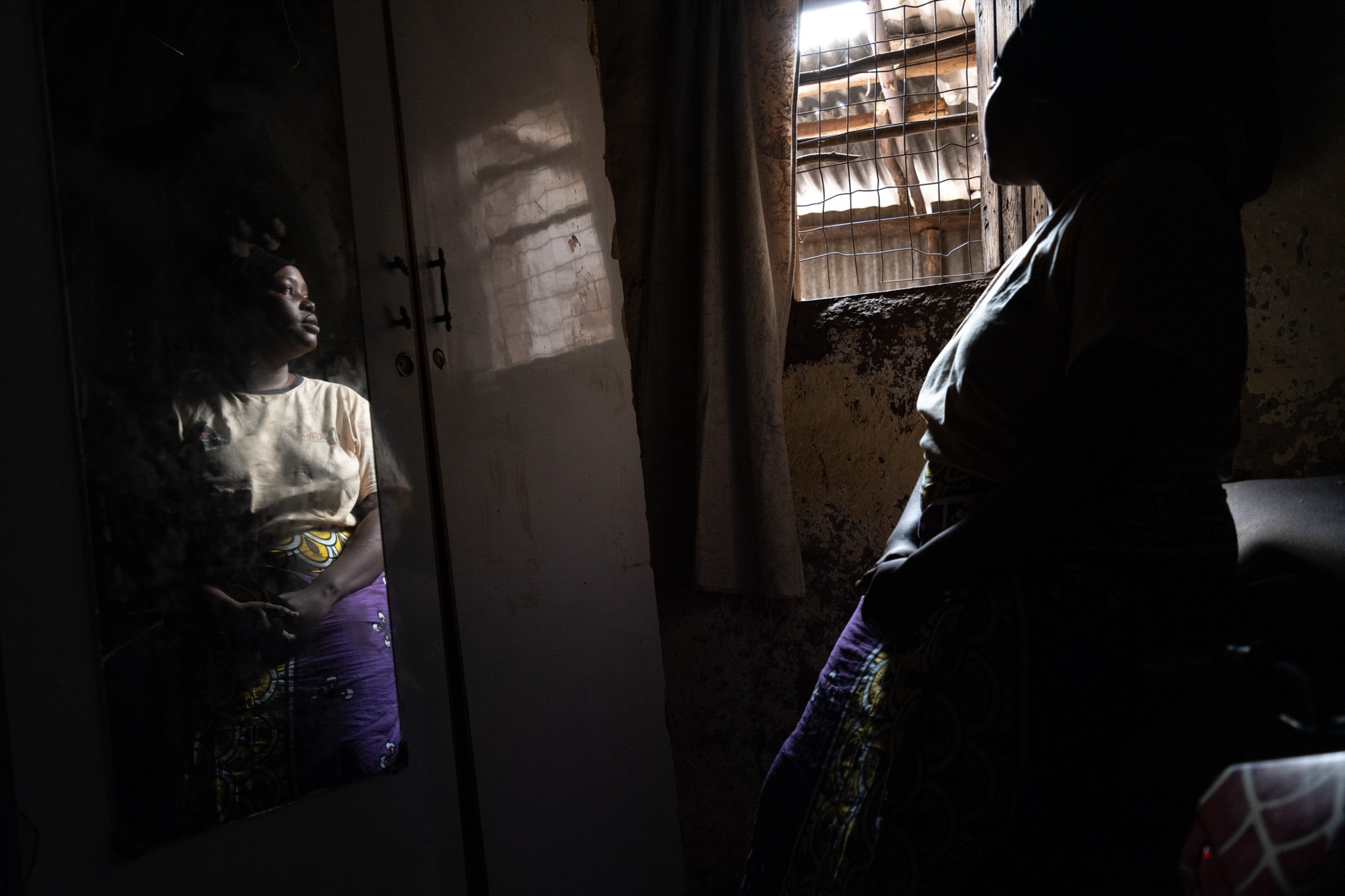
Water is often a scarce commodity in Nairobi's largest slum. The only source may be a local cartel — and with that comes the risk of sexual threats and attacks. (Image credit: Nick Parisse for NPR)
Zubedah Hassan, 32, at home in Kibera. She works as a champion for the Stop Sex for Water program, encouraging women and girls to speak out if they face sexual violence from water vendors or are groped or peeped on in public bathrooms. "The main problem is poverty," she says. "A girl tries to save money on water by doing favors for a vendor. Another challenge is drought. You find schoolchildren waking up very early to go and look for water and being raped along the small paths they take." Nick Parisse for NPR hide caption
Early one morning, Saly Amutwayi unlocks the door to her small hair salon. Inside, the walls are painted a faded blue, with posters of braided hairstyles curled at the edges.
The salon is in Kibera, the African continent's largest slum, just a few miles from central Nairobi, Kenya's capital and largest city.
Before clients arrive, Amutwayi speaks quietly with her friend Mariam Hassan. Like many women in Kibera, they are responsible for collecting water for their households — a task that can take hours each day. And like many women in Kibera, both say they have experienced sexual violence while trying to get it.
"When there is no water," Amutwayi says, "everything becomes dangerous."
In Kenya's informal settlements — densely populated neighborhoods where residents have no legal title to the land they live on, and which the state has largely left without formal infrastructure like piped water — residents rely on private vendors who control access to water and set prices. Rights groups say that in places like Kibera, this dependence has created conditions in which women who cannot afford water face harassment, assault or coercion — including pressure to exchange sex for water, a practice known as "sextortion."
Saly Amutwayi styles Mariam Hassan's hair. Both women have faced sexual assault as they tried to purchase water from a vendor. Hassan worries for her young daughter: "My baby girl is 8 years old. I will not send her to get water in the evening because of the experiences I have had." She hopes education will help their children and other young women in Kibera, a slum neighborhood in Nairobi, Kenya: "Our parents never taught us about sexual harassment, but we are teaching our young girls." Amutwayi wants to see men included in the conversations around sexual violence: "The boys need classes. All these lessons, most women understand, but men need to learn." Nick Parisse for NPR hide caption
After more than a decade of advocacy led by Kenyan water-sector groups, the issue reached Parliament in 2024. It was the first time lawmakers took up the issue. Campaigners describe it as a breakthrough for a form of gender-based violence that has long gone unaddressed.
A basic need — and a daily risk
Kenya's Constitution guarantees access to clean and safe water. But in Kibera, public water pipes rarely reach individual households. Instead, residents buy water by the jerrycan, yellow plastic containers that hold about a quarter-gallon, from kiosks, street carts or storage tanks, often at prices that fluctuate and can strain household budgets.
Billy Misuga, 25, works at a government-sponsored water kiosk in Kibera. "People are fighting for water. I let them fill even if they don't pay," he says. Nick Parisse for NPR hide caption
Water becomes scarcer and more expensive during shortages, which have become more frequent amid prolonged drought. Women who have experienced sexual violence in their efforts to obtain water and the advocates who work with them say that is when the risk of harassment and sexual violence increases.
During one such shortage, Amutwayi went to buy water from a vendor point on the street but did not have enough money to pay the full price. She says three men selling water began making comments about her appearance and then tried to force her into a nearby alley. She screamed, and neighbors intervened.
Amutwayi did not report the incident to police. The people who came to help, she says, told her to leave it, that since nothing had ultimately happened there was no report to file. "Nobody here has been held to justice," she says in retrospect.
Hassan describes a similar experience. A man at the water line offered to take her somewhere with shorter queues, she says. She followed him, but he led her to his home instead, got her inside, and tried to rape her. She says she escaped after neighbors heard her screams.
Both women say the fear has stayed with them. "I only told my brother," Hassan says. "I feared sharing it with my mother."
For stories about life in our changing world, subscribe to NPR's Global Health newsletter.
When water comes with strings attached
Local organizations say these accounts are not unusual.
The Kenya Water and Sanitation Civil Society Network, known as KEWASNET, runs a program called Stop Sex for Water. Launched in 2014, the program supports survivors and documents abuse linked to water access in informal settlements. Staff members say they receive frequent reports of sexual harassment, attempted rape and coercion related to water collection.
Women use public toilets during the day, but these facilities may lack privacy and safety measures, such as locks and lighting. At night, concerned about the threat of sexual violence, they may opt to use buckets or "flying toilets" — human waste put in plastic bags and thrown outside. Nick Parisse for NPR hide caption
In many cases, advocates say, women who cannot afford water are pressured to provide sex instead.
"We are educating women to seek justice," says Susie Njeri, 32, who is a champion for the Stop Sex for Water program, a nonprofit initiative to address sexual exploitation and violence related to efforts to obtain water in the slum community of Kibera, where the need for water creates a power dynamic that leaves women vulnerable to sextortion. Drought is exacerbating the problem, she says. "Because of the drought, water deliveries are more sporadic. You have to use your body to get ahead in line or to get more water." Nick Parisse for NPR hide caption
"Sextortion thrives where services are scarce and accountability is weak," says Joan Kones, a project lead at KEWASNET. "Water is a basic need. When access depends on informal systems, people become vulnerable to exploitation."
Why reporting is rare
Malesi Shivaji, CEO of KEWASNET, says that many survivors do not report abuse to police. In interviews, women and the advocates who work with them cited fear of retaliation, social stigma and a widespread belief that authorities will not act. Shivaji says water-related sex crimes "are part of the culture of survival in Kibera. It's so normalized that even survivors say they'll be perceived as villains if they talk about what happened to them."
Judith Shitabule, a community health promoter who works with survivors of gender-based violence in Kibera, says many women feel trapped by circumstance. "They wake up very early to look for water," she says. "They still have to cook, clean and bathe their children. When they cannot pay, they are pressured in other ways."
Posters, campaigns and educational meetings in Kibera encourage women and girls to report sexual harassment or assault. Nick Parisse for NPR hide caption
Shitabule says her work focuses on counseling and helping women understand their rights. "We tell them they can say no," she says. "But saying no is very hard when your family needs water."
A broader problem of scarcity
The situation in Kibera reflects a national challenge. According to Water.org, roughly 19 million people, about a third of Kenya's population, lack reliable access to clean water, with the largest gaps in rural areas and urban informal settlements.
In Kibera, residents told us supply is unpredictable and prices vary widely. During shortages, they say, vendors may ration water or stop selling it temporarily, forcing families to wait for hours or walk long distances in search of another source.
International research and rights organizations, including the U.N. Human Rights Office, the Brookings Institution and Transparency International, say this system concentrates power in the hands of those who control supply, creating conditions in which abuse can occur.
"When water is treated as a commodity rather than a public service," Kones says, "it opens the door to exploitation."
Global Health
A promising tale from Senegal of fish, rice .... and dangerous worms
Lawmakers consider a response
Inside Parliament, the issue has been raised but not resolved.
Kenya has no specific law against sextortion. In 2024, Nairobi lawmaker Esther Passaris petitioned Parliament to create one, on behalf of citizens and with the backing of water-sector advocates. Several lawmakers spoke to it, describing how women are coerced as they try to get water.
Kibera is walled off from the rest of Nairobi, blocking its population from basic public services, such as a supply of clean water. Nick Parisse for NPR hide caption
In October 2025, a parliamentary committee turned the petition down. A new law was unnecessary, it said, because the conduct could already be charged under the Sexual Offences Act, which covers people who hold public office or authority over someone in their custody or care, such as police, prison officers, and hospital and school staff.
But it cannot be used to charge an informal vendor who controls the water supply in a place like Kibera and demands sex for it.
Advocates have not dropped the issue. They are pressing Parliament to take it up again. A law alone would not be enough, they say. Without training for the police and courts, and investment in water, the conditions behind the abuse would remain.
"Passing a law would not be the success," Shivaji says. "Success is when this stops happening."
The power of the cartels
Wycliffe Otiala is the leader of a water cartel, one of 30 that operate a large-scale water distribution network throughout Kibera. "We sell 60,000 liters a week."
These groups are referred to as cartels by the local community, by Kenyan journalists and by academic researchers.
Wycliffe Otiala is part of a water cartel in Kibera that dispenses water for a fee. He's pictured here by one of his water tanks. The cartels, he says, dispense their own form of justice: "In case of any problems, you have to sort it out with our guys, or your life is in danger. The police don't do anything. They fear us." Nick Parisse for NPR hide caption
Otiala's cartel pulls water from different pipelines and distributes it to vendors, some of whom have kiosks while others sell from carts on the streets. "In other parts of the city, they receive water every day," says Otiala. "Here in Kibera, we don't get enough. The government is unfair." While Nairobi Water pipes and delivers water to wealthy and middle-class neighborhoods, Kibera and other informal settlements all report the same problem.
Otiala explains that the cartels tap into municipal pipes by paying off the people who run the water system. "There are people who work in the piped system who know that we do this. We pay them and they let us take the water," he says. "The police do nothing, because if they cut the supply, the community will have no water." Asked whether his vendors attack women who cannot pay, he does not deny it. "Yes, of course," he says. "That is the job. We know they do that. It is a business."
Coverage from 2 sources
Coverage by lean
- Unknown2
Comments
Sign in to join the discussion.
Sign in with SpryLogin