
Rand Paul released Fauci's pandemic-era 'diary.' Now they'll face off on Capitol Hill
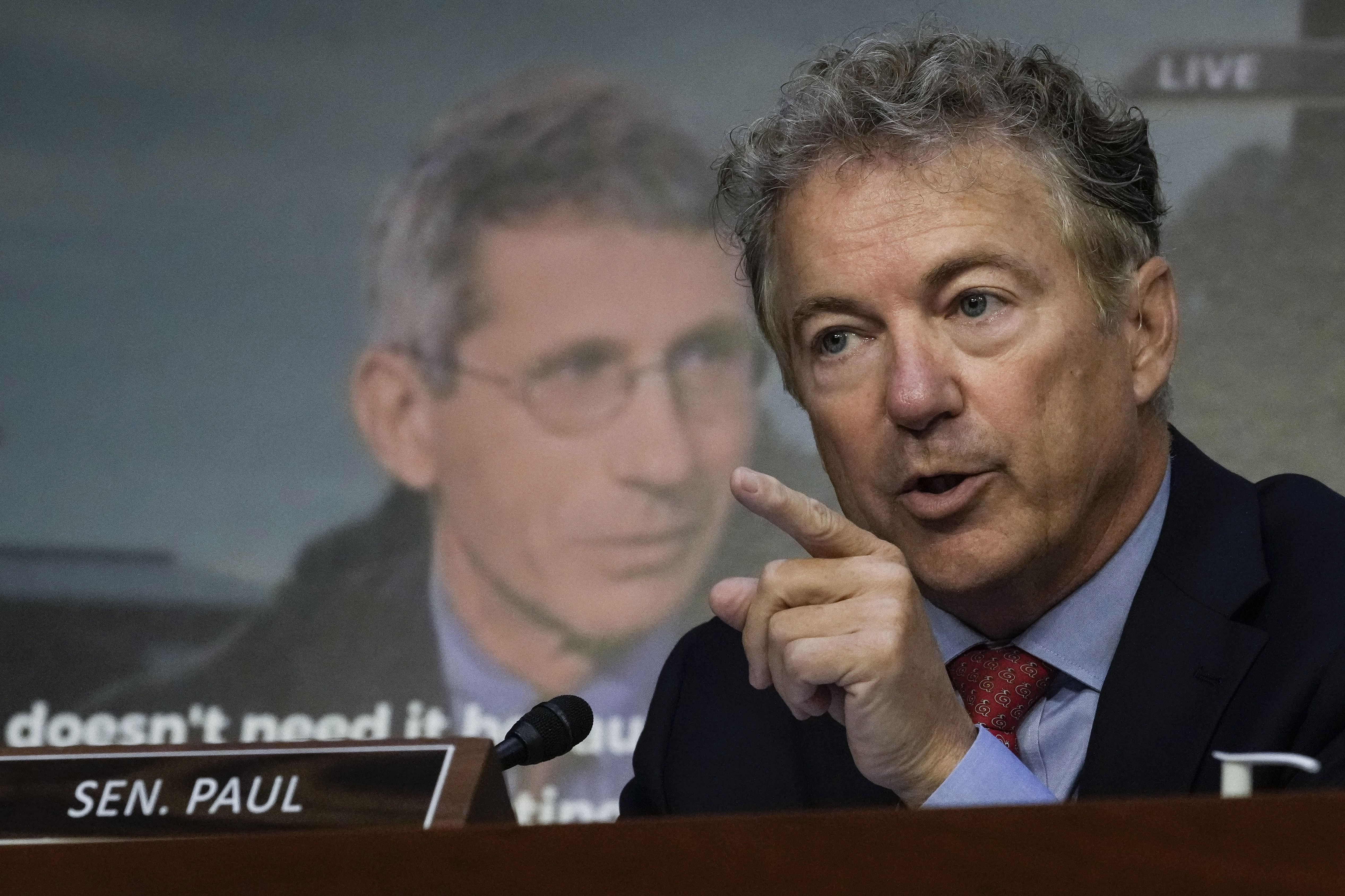
At a Senate hearing Wednesday, Anthony Fauci is likely to face questions from Sen. Rand Paul related to the origins of the COVID-19 pandemic. Here's what you need to know (Image credit: Drew Angerer)
Sen. Rand Paul (R-KY) questions Dr. Anthony Fauci during a Senate committee hearing about the federal response to monkeypox in September 2022. Fauci is set to appear before a different Senate committee on Wednesday to answer questions about the origins of COVID-19. Drew Angerer/Getty Images hide caption
Anthony Fauci declined to answer any questions before a Senate committee focused on the coronavirus pandemic Wednesday morning.
"Although it pains me to do so, because of the respect I have for the legislative branch of government, and my decades-long record of cooperating with Congress, under the advice of my attorneys, I will invoke my right under the Fifth Amendment of the Constitution to refrain from answering your questions," Fauci said in front of the Homeland Security and Governmental Affairs Committee.
Fauci, who was subpoenaed to appear by Kentucky Senator and committee chair Rand Paul, has long sparred with the senator over the origins of the coronavirus that caused the pandemic. Days before Wednesdays' hearing, Paul released over 1,000 pages of Fauci's private writings, accusing him of covering up origins of COVID-19.
At the hearing, Fauci pointed out that he has responded to similar questions in previous testimony. And Fauci accused the senator of being obsessed with trying to get him behind bars.
The hearing comes days after Paul released diary entries he says were written by Dr. Anthony Fauci – the country's leading infectious disease specialist during the COVID-19 pandemic – that chronicle Fauci's daily life between December 2019 and December 2022.
The over 1,100 pages of entries span the final years of his tenure as director of the National Institute of Allergy and Infectious Diseases (NIAID). He retired in December 2022.
Goats and Soda
Virus Researchers Cast Doubt On Theory Of Coronavirus Lab Accident
Sen. Rand Paul, R-Ky., posted the documents over the weekend, took them down on Monday evening and reposted them by Tuesday morning with redactions. Paul also released a 465-page " prequel ," a collection of Fauci documents including records and email exchanges from 2001 to 2015.
This was all in advance of Wednesday's Senate hearing, where Fauci will testify.
For the latest stories on the science of healthy living, subscribe to NPR's Health newsletter .
Debate that won't abate
The hearing follows years of debate about the pandemic's origins, and whether the virus that causes COVID-19 emerged from a Chinese laboratory.
Goats and Soda
Why The U.S. Government Stopped Funding A Research Project On Bats And Coronaviruses
Paul chairs the Senate Homeland Security and Governmental Affairs Committee, and subpoenaed Fauci as the latest move in the pair's public disagreement about the origins of coronavirus.
In a thread on X over the weekend, Paul wrote that the diary entries show what Fauci "wrote privately and what he told the country are two different stories."
A spokesperson for Fauci sent a document fact-checking Paul's claims and a letter written by Fauci's legal team to Paul last month. In that letter, Fauci's lawyers wrote Paul was waging a "years-long public crusade" against Fauci.
Shots - Health News
Trump restricts funding for 'gain-of-function' research — calling it dangerous
"You are single-mindedly fixating on seeing Dr. Fauci prosecuted for imaginary crimes, and you are so invested in that outcome that you have created a personal brand around it," says the letter, which NPR reviewed.
Paul did not respond to NPR's requests for comment in time for publication. It is also unclear how Paul obtained the Fauci diary documents, though a video posted Tuesday on X by Health Secretary Robert F. Kennedy Jr. mentions digging them "out of 11 separate servers."
Shots - Health News
Scientists Debate If It's OK To Make Viruses More Dangerous In The Lab
What Fauci's notes reveal
At first glance, Fauci's notes show him dealing with his increasing fame: including references to new security details, police guarding his home, celebrity encounters and "becoming an international celebrity" himself. The notes have the sentence fragments and typos of someone quickly recording their thoughts.
"Big front page article abut me appeared in the Washington Post," Fauci writes on May 21, 2020. "Very flattering. The situation with my national and international fame is explosive and really unimaginable. It is not hyperbole to say that today I am the most famous and talked about person in the country and one of the most recognizable peson in the world."
Shots - Health News
NIH Lifts Ban On Research That Could Make Deadly Viruses Even Worse
But the entries also show Fauci reacting with increasing alarm to case counts and the death toll and wrestling with questions about how the virus spread.
Consensus for natural origin
The current scientific consensus is that the virus is likely natural in origin. That means many scientists think the available data suggests COVID-19 started when someone in China was infected by an animal carrying the virus.
However, another theory popular with some researchers and President Donald Trump suggests SARS-CoV-2, the virus which causes COVID-19, spread from a Chinese government lab in Wuhan that was working with bat coronaviruses.
Goats and Soda
What does the science say about the origin of the SARS-CoV-2 pandemic?
Paul alleges Fauci's notes show he covered up evidence supporting this "lab leak" theory.
On Paul's website, he points to Fauci's entry from Feb. 1, 2020, detailing a conference call between Fauci and prominent scientists.
In his notes, Fauci writes "there was not total agreement" about the virus' origins during the call.
Science
Physical evidence indicates that the coronavirus emerged at Wuhan seafood market
Later in his entries, however, Fauci writes he "is almost certain that the virus evolved naturally from a species jump, even though… I keep an open mind about the possibility of a lab leak," and "that just because two alternatives are possible that does not mean that they are equally probable."
Many scientists say this thought process reflects how their consensus changed as the understanding of COVID-19 evolved.
Felicia Goodrum , a virologist at Dartmouth College who spoke to NPR on Monday from the American Society for Virology meeting in Minneapolis, says the questions in the early days of the pandemic about the lab leak were "normal scientific questioning," when scientists knew very little about how the virus spread.
Science
New Analysis Reveals Fresh Clues About The Origins Of COVID-19
"I think that's what we acknowledge that Fauci was doing, that there's of course a plethora of unanswered questions," she said of the early days of the pandemic. Now, though, she says those questions are presented as "some sort of signal of guilt that they knew that this was happening."
Gigi Gronvall , a biosecurity expert and immunologist, similarly says these kinds of questions are part of scientific exploration.
Coverage from 2 sources
Coverage by lean
- Unknown2
Comments
Sign in to join the discussion.
Sign in with SpryLogin