
A teen was killed at a Seattle protest. New video evidence shows what really happened
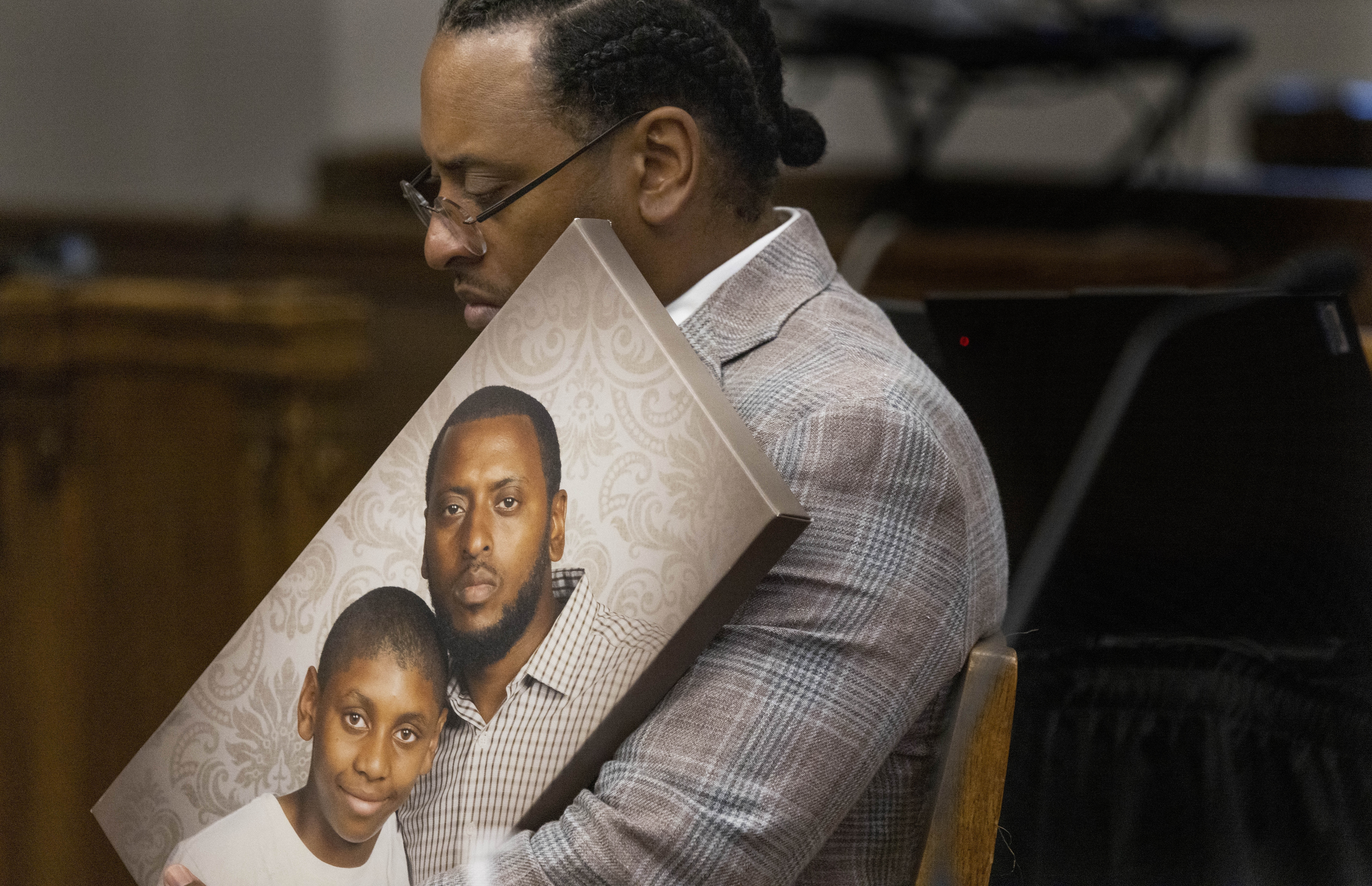
An 18-month investigation by The Seattle Times, KUOW and NPR's Embedded podcast and a review of more than a dozen videos from the night of the shooting reveal the most comprehensive view to date of how the chaotic scene unfolded. And they show how a Black teenager who came to join the civil rights movement of his generation — in a zone abandoned by police — ended up killed by a protest movement that thought he was a threat. (Image credit: Ellen M. Banner)
Antonio Mays Sr. holds a picture of himself and his son, Antonio Mays Jr. in Superior Court at the King County Courthouse in Seattle on Dec. 10, 2025. Ellen M. Banner/The Seattle Times hide caption
It is shortly before 3 a.m. on June 29, 2020, and racial justice demonstrators at an encampment in Seattle are tracking a stolen white Jeep that's driving erratically.
A few dozen tents are spread around Cal Anderson Park, where protesters had set up a zone called the Capitol Hill Occupied Protest, or CHOP. Some people at the camp had been armed and on high alert for weeks, after a car drove into a crowd of protesters and several shootings in the area. As the Jeep slowly loops around a turf playfield, it comes within 10 feet of a tent and sparks a wave of fear that quickly sweeps the camp.
Embedded
Episode 1: Who Killed Antonio Mays Jr.?
CHOP existed for 23 days in 2020, an eight-block collection of tents, graffiti and 24-hour protests that emerged after Seattle police abandoned a precinct in the heart of the city. Police left after 10 days of mass protests ignited by the murder of George Floyd. Nearly every night of the standoff had ended with police blanketing the neighborhood with tear gas. After they retreated, it felt like detente. Protesters held movie nights and set up mutual aid stations and stages for speeches and music.
But on this night, three weeks after the birth of CHOP, the air is filled not with songs, chants and demands for justice, but with paranoia, menace, gunshots. In the absence of police, an armed, voluntary security force emerged, set up by protesters themselves.
"There's shots, shots fired I think," a livestreamer says, capturing the moment in a dark, shaky video broadcast live to Facebook. Then the sound of gunshots. "More shots fired, more shots fired. It's that white car that's been circling around."
Livestreamer Diaz Love's video was one of the first to announce that shots had been fired at CHOP. (Credit: "Thoughts Uncensored" YouTube channel )
The implication is clear: people in the white Jeep are shooting at protesters in CHOP.
Less than 10 minutes later, armed people guarding the protest zone — in the absence of police — shoot all three occupants of the Jeep.
Antonio Mays Jr., age 16, was killed. Robert West, 14, was critically injured. Another teenager, whose presence in the Jeep has never been previously reported, was grazed by a bullet before he ran and disappeared into the night.
"When you come in shooting, I don't think it's that much of a surprise when you get shot back," said Colby Williams, a protester, on the morning after the shooting.
This narrative — that whoever was in the Jeep was attacking racial justice protesters and that protesters or their allies fired back in self-defense — was echoed in social media posts and throughout the encampment. It would linger for years.
The shootings and the aftermath were all caught on video — by surveillance cameras, citizen journalists, livestreamers. And yet, six years later, Antonio Jr.'s killing remains unsolved. There have been no arrests, no charges, no named suspects. Seattle police say the case remains active and ongoing but will not say more.
An 18-month investigation by The Seattle Times, KUOW and NPR's Embedded podcast and a review of more than a dozen videos from the night of the shooting reveal the most comprehensive view to date of how the chaotic scene unfolded. And they show how a Black teenager who came to join the civil rights movement of his generation — in a zone abandoned by police — ended up killed by members of a protest movement who thought he was a threat.
CHOP demonstrators fearing the police returning to take back the E. Precinct of the Seattle Police Department, stage a drill outside the building, on June 22, 2020. Ken Lambert/The Seattle Times hide caption
A Journey to Seattle
On June 23, 2020, less than a month after George Floyd was killed, Antonio Mays Jr. left his Southern California home and set out for Seattle, a city where he had never been and had no known connections.
He liked fantasy novels and hip-hop and worked in his family's barbecue business. He looked after his little sister. He left to join the racial justice protests that were sweeping the nation but in Seattle had taken on a unique form. Before he left, he wrote his father a note:
"I am not running from home. I am fighting for a cause," Antonio wrote to his father. "One day I want my sister to live in a world where her skin won't be the cause of any pain for her, physically or emotionaly [sic]."
How he got to Seattle remains a mystery. But he would resurface three days later at CHOP, standing shoulder to shoulder with protest leaders and addressing a city official and a crowd of onlookers.
"The police, their purpose is to serve and protect, right?" he says in a video clip recorded in 2020 by an independent journalist but discovered only late last year. "I wish that the police would have more supervision when it comes to their training to make sure that they're actually following their training. Because when they're on these streets, they disregard all of it."
Antonio Mays speaking publicly at CHOP. (Credit: Omari Salisbury/Converge Media)
Three days after Antonio Jr. gave that speech at CHOP, he was dead, shot seven times in the pre-dawn hours at one of the nation's most prominent protest zones.
He was killed in a stolen white Jeep. It's unclear whether he was involved in the theft of the Jeep.
Protesters and members of CHOP security were aware a car had been stolen just as the white Jeep appeared near the tents on the playfield.
Soon, panicked calls went out over the livestream.
Panic at the Barricade
A security camera captures the white Jeep leave the park and drive onto a small side street. It is headed straight toward another SUV, driven by a medic for CHOP security, who immediately throws it in reverse and backs away to avoid the white Jeep, which is coming at it head on.
Then a silver Nissan Pathfinder appears. Someone inside starts firing at the white Jeep.
Security camera footage from inside CHOP shows people in a Nissan Pathfinder firing gunshots at the white Jeep. (Credit: King County Superior Court)
A person wearing dark gray with a black bandanna over their face reaches out of the front passenger window and fires what looks like a rifle at the white Jeep.
The Jeep approaches the Pathfinder. As it drives by, a person wearing a bright white sweatshirt reaches out the window of the Pathfinder and over the roof and fires a handgun at the Jeep.
The Pathfinder, with shooters still firing, chases the Jeep down the street, toward downtown Seattle and into the night.
A forensic analyst, hired years later by the City of Seattle to examine videos from that night, did not identify any gunshots coming from the white Jeep. The only shots he identified were fired at the Jeep.
For just over three minutes, the white Jeep carrying Antonio Mays Jr. disappears from view. It's headed west toward downtown Seattle.
Back at CHOP, webcams record how the panic has spread back to the camp. A neighbor, from his fourth floor apartment, had stuck cameras to his windows that livestream the scene outside the abandoned police precinct.
"Everybody down, everybody down!" someone shouts.
It is clear from the shouts that there are multiple people with guns at the barricades outside the precinct, and they are preparing to defend themselves.
"Anyone with weapons, I want them behind this barrier."
"Security, eyes up. We're looking for a stolen Jeep, multiple shots fired."
"I need eyes on every single intersection."
"Everybody who is not armed, I need them on the ground, stay low."
A webcam recording from an apartment in the Capitol Hill neighborhood captured the panic that spread through CHOP on the night Antonio Mays Jr. was shot. (Credit: Marcus Kulik)
The teens in the white Jeep loop back toward CHOP. Around 2:59 a.m., they make a left and turn toward the precinct and the encampment.
Three shots ring out. The Jeep crashes into a barricade. Six more shots.
The Jeep tries to back up, tires squeal. Then it drives forward and crashes into the barricade.
Two 911 callers would later describe someone walking right up to the passenger side of the crashed Jeep and firing into it at close range.
A shadow appears, just outside the Jeep's passenger side. And then, a voice.
Coverage from 1 source
Coverage by lean
- Unknown1
Comments
Sign in to join the discussion.
Sign in with SpryLogin