
They're a world leader in using drones for healthcare. But drones can't do it all
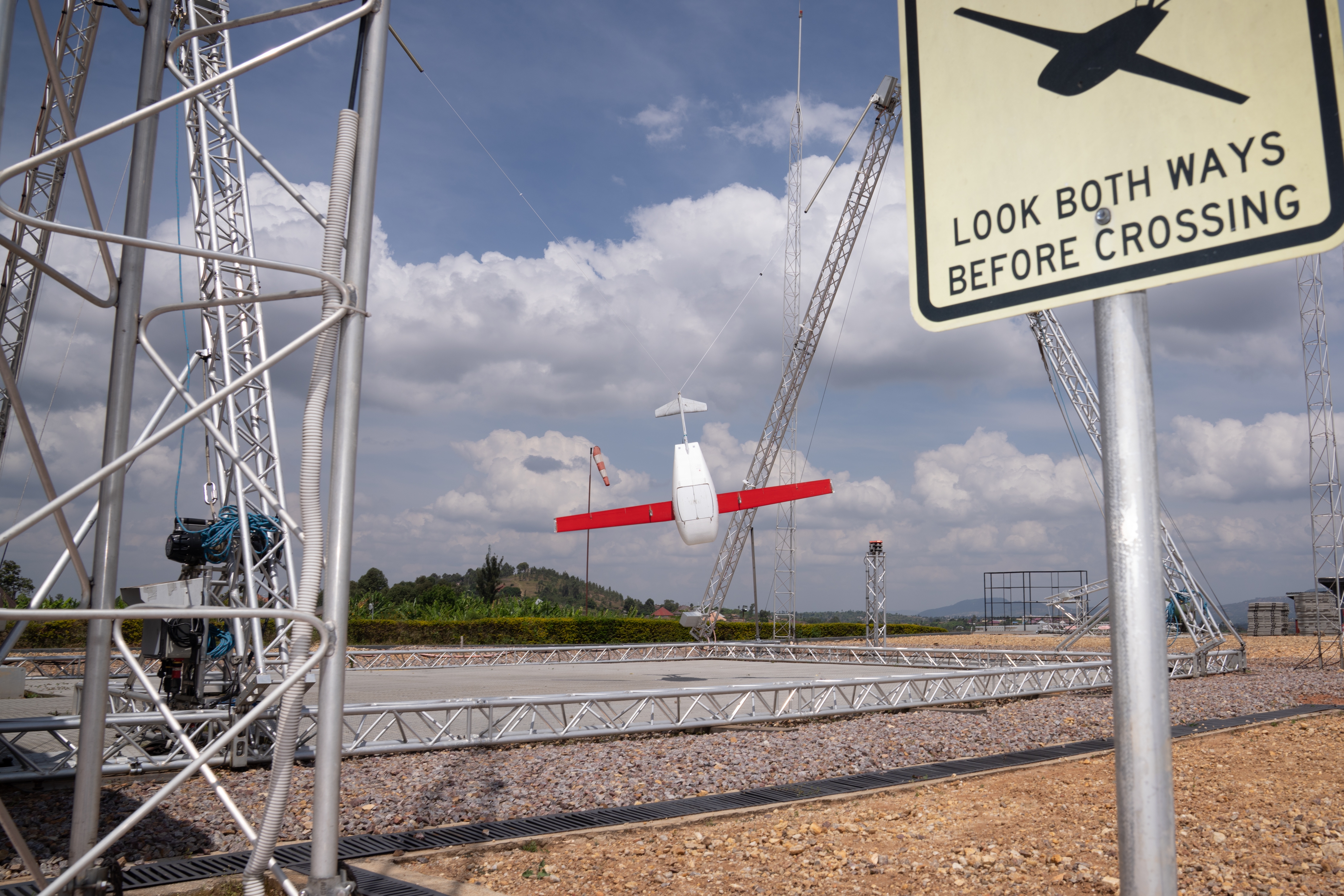
Drones carrying medical supplies constantly crisscross the skies of Rwanda. The Trump administration is giving a major grant to the effort — and at the same time cutting aid to the country. (Image credit: Claire Harbage/NPR)
A drone, just returned from a delivery, swings into the landing mechanism in Muhanga, Rwanda. The country's government has contracted with American robotics company Zipline to deliver emergency blood through drones since 2016. Claire Harbage/NPR hide caption
MUHANGA, Rwanda — Noella Mukanoheli was nine months pregnant and bleeding out.
It took her three hours to see a doctor.
First, she made a 50-minute trip to the clinic that serves her village, riding on the back of a friend's motorbike. There was no doctor on staff so they called an ambulance to take her to the nearest hospital. It was only about 10 miles away but took two hours to get there because of the country's challenging roads.
Her husband, who was with her, says she lost consciousness en route. When she arrived, doctors said she needed 5 liters of blood. That's considered a "massive transfusion" in medical terms — an emergency measure to replenish virtually all the blood in a human body.
But the hospital didn't have her blood type, so doctors had to order it.
The method of transport: two drones, which dropped their precious packages in the Muhanga hospital courtyard.
When Mukanoheli awoke hours later, her hand immediately went to her belly.
"My doctor said I had given birth and the baby was alive, but I would have died without the drone," says the 42-year-old, who experienced the traumatic event in April.
Noella Mukanoheli, 42, lost 5 liters of blood while she was in labor with her child. After a three-hour journey to the nearest hospital, she learned they didn't have her blood type. Minutes later, a drone dropped off the blood — a lifesaving delivery. Claire Harbage/NPR hide caption
This harrowing story shows the promise of drones in a country where it's famously hard to get around. Rwanda is known as the land of a thousand hills, and when drivers get stuck behind a slow-moving truck on winding and narrow roads, there's no way to pass.
In 2016, seeking an immediate solution for emergency blood deliveries, the Rwandan government contracted with American robotics company Zipline for drone shipments. Today, drones play a critical role in ferrying all kinds of medical supplies to those in need.
But the drone success story is only part of the healthcare landscape in Rwanda — a landlocked country of nearly 15 million people in East Africa. The majority of the population lives in rural areas.
In the three decades since the Hutu genocide against the Tutsi in 1994, the country has sought to reduce poverty, improve healthcare and lift itself from lower-income to upper-middle income status, and has championed high-tech solutions.
Yet its a complicated and costly task that includes expanding electricity and building and maintaining roads on hilly terrain.
A narrow dirt path leads to Noella Mukanoheli's village, which isn't accessible by car. Many people walk or take motorcycles to get to health facilities. Claire Harbage/NPR hide caption
In 2025, the Trump administration announced a $150 million grant to expand Zipline's work in Rwanda and four other African countries . It has caught the attention of others too: Zimbabwe sent a delegation to Rwanda in June to look at their drone program.
At the same time, Trump has cut about $200 million in funding for aid organizations that provide food and health aid to rural communities in Rwanda. This reflects the administration's new strategy favoring American businesses for global health work over nongovernmental organizations.
NPR reached out to the State Department for comment on the funding cuts and the drone program but did not receive a response. A statement announcing the grant to Zipline in November 2025 said:
"The Trump Administration, in partnership with U.S. and African innovators and policymakers, is advancing cutting-edge technologies that are strengthening health outcomes and enhancing emergency responses to infectious disease outbreaks."
A sky full of drones
A Zipline drone drops a package filled with medicines at Kabgayi Hospital in Muhanga. Claire Harbage/NPR hide caption
The drone story in Rwanda is nothing short of remarkable.
To see the impact, all you have to do is look up at the sky, where drones are constantly zipping across the country.
The drone itself resembles a tiny airplane. It has a white Styrofoam body and red wings. A battery sits where a cockpit would be; the package rides in its belly.
On average, a drone carrying medicine, vaccines, blood and diagnostic tests for humans and animals is dispatched every 50 seconds, according to Pierre Kayitana, the company's country director. Zipline now manages virtually all of Rwanda's pharmaceutical supplies and deliveries.
The drones that saved Mukanoheli's life launched from a facility in the rural town of Muhanga.
"This is actually the very first Zipline distribution center in the world," says Kayitana. "It started here in 2016. This place, just so you locate yourself, this is the exact center of Rwanda."
Andrew Sekuye, a fulfillment operations specialist at Zipline, gathers supplies and packs them into boxes to be flown via drone across Rwanda. Claire Harbage/NPR hide caption
The Muhanga location is one of two distribution centers operating in the country. A third is set to open soon, funded by the grant from the United States.
"Rwanda will be the first country in the world to be fully covered with drone technology," Kayitana predicts.
At the Muhanga facility, orders pour in from medical workers across the country, through phone, text message and on WhatsApp, and are fulfilled from a small warehouse full of pharmaceuticals.
"It's the highest standard of a medical warehouse by FDA [standards]. Anything you may need in a hospital, you can find in here," Kayitana says. The supplies themselves belong to the Rwandan government; Zipline manages the logistics, delivery and inventory.
The call center in Muhanga where Zipline employees monitor requests for deliveries of medical supplies. Claire Harbage/NPR hide caption
In one corner of the warehouse, half a dozen technicians assemble outgoing orders. There's a minimum weight requirement of 1 kilogram, or 2.2 pounds, Kayitana explains, because anything lighter risks being blown off course by the wind.
When the package is placed in the drone, an engineer carries it to a launch pad, and with the press of a few buttons, the drone slingshots into the sky.
"The drone is embedded with AI software," Kayitana says. "It knows where to go and can make its own decision on how to avoid the wind, how to reach the hospital faster depending on what it sees."
They can fly at a speed averaging 64 miles per hour and reach an altitude of 400 feet — about as tall as a 35-story building.
"We can reach any point of Rwanda in under 30 minutes [with a drone]," Kayitana says. By contrast, the same trip could take up to seven or eight hours by vehicle.
Many of the drones from Muhanga are bound for Kabgayi Hospital, the largest hospital in southern Rwanda and the one that treated Mukanoheli. The 4-mile drive from Zipline's center takes 30 minutes; the drone makes it in four, dropping its cargo by paper parachute.
A Zipline employee prepares a drone for takeoff (foreground) while other staff meet a drone at the landing mechanism. Claire Harbage/NPR hide caption
"We are lucky, it takes like five minutes to bring blood here," says Dr. Evariste Ufitihirwe, deputy director general of Kabgayi. "It's faster than telling a person to go in stock to bring blood."
A decade ago, before the drones, he says, doctors had no choice but to manually clamp blood vessels to slow bleeding in emergency cases while they waited, sometimes for hours, for blood to arrive from a bank in the capital city Kigali, about 30 miles away.
"A decade of transformation"
The drones represent a major part of a government plan to improve overall healthcare and reduce maternal mortality rates that includes policies like universal healthcare and investing in midwives.
"Every time a mother dies, it triggers everyone's attention, we investigate, and we find the root causes," says Rwanda's health minister, Dr. Sabin Nsanzimana . "There is, of course, accountability, there are lessons learned, there's adaptation of the systems and supplies are a critical aspect of that."
The benefits of this multipronged approach are reflected in government statistics . Twenty-six years ago, Rwanda recorded roughly 1,000 maternal deaths for every 100,000 births. Today, that figure has fallen to 87, according to Nsanzimana.
The hilly terrain in Rwanda and lack of road maintenance make access to rural areas difficult. Claire Harbage/NPR hide caption
"It has been a great decade of transformation," he adds.
Coverage from 1 source
Coverage by lean
- Unknown1
Comments
Sign in to join the discussion.
Sign in with SpryLogin