
How deep-rooted medical bias creates deadly consequences for addiction patients
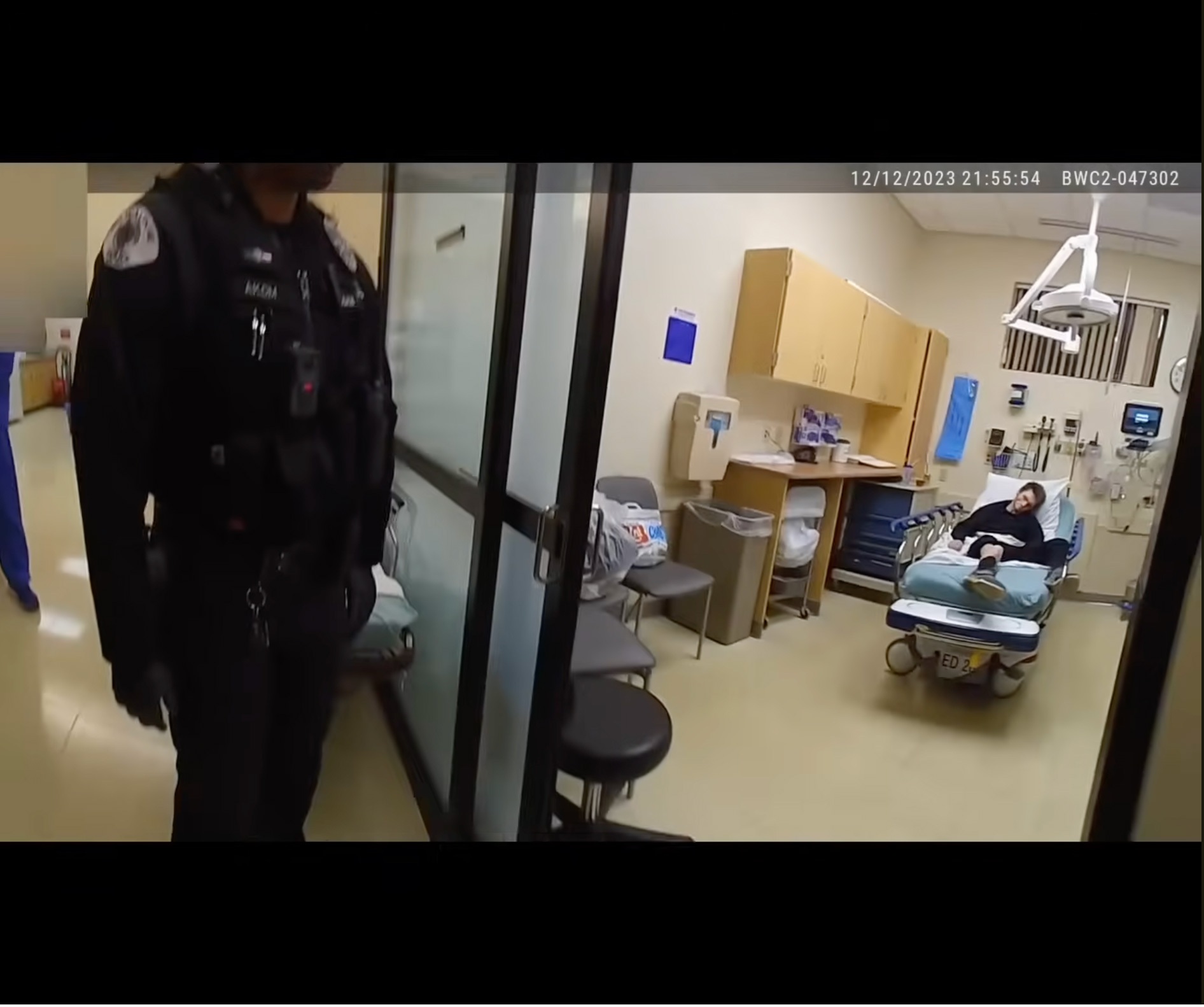
Addiction treatments are safe, effective — and rarely offered to patients. That's because many doctors and nurses still view people with alcohol or drug addiction with suspicion and hostility. (Image credit: Milwaukie Police Department)
In bodycam footage released by the Milwaukie Police Department, 26-year-old Jean Descamps can be seen in a hospital bed at the Providence Milwaukie Hospital emergency room in Milwaukie, Ore., in December 2023. Soon after he was discharged by the hospital, Descamps died from drugs already in his system. Milwaukie Police Department/Screenshot by NPR hide caption
On a cold December night in 2023, the staff at Providence Milwaukie Hospital in Milwaukie, Ore., called local police. They wanted help getting one of their patients, a 26-year-old man named Jean Descamps, out of the emergency room.
"He's been evaluated medically. There's no medical problems for him," a member of the hospital team, who NPR has not been able to identify, told police. The moment was captured on an officer's body camera.
Health
Trump administration extends opioid emergency as fentanyl deaths drop
Records show the hospital's medical staff believed Descamps — emaciated, covered in feces, and often unresponsive — was experiencing symptoms of chronic street drug use, a leading cause of death for young Americans.
After Descamps arrived in an ambulance earlier that day, hospital staff cleaned him up and administered naloxone, a medication that reverses opioid overdoses. But now they wanted him gone. "He's not thriving chronically, but there's no medical reason for him to be here anymore," one hospital staffer can be heard saying.
Video released by the Milwaukie Police Department shows Descamps sprawled in a hospital bed, his body limp, moaning and drooling, while medical staff stood nearby. After determining Descamps was too unwell to spend the night in jail, police officers challenged the hospital's decision to discharge him.
"He can't be on his own," one officer said. "Why is he being released? We have no place to take him."
"A bus station is fine," a hospital worker replied. Another member of the hospital staff told police Descamps was faking the severity of his illness: "It's not really a medical problem, it's malingering."
Officers eventually complied, rolling Descamps' limp body in a wheelchair into the dark parking lot, where they covered him with a blanket against the winter cold. Police who gathered around Descamps can be heard voicing fear for his safety.
In video footage released by the Milwaukie Police Department, an officer can be seen rolling Descamps in a wheelchair to exit the hospital emergency room. "Do you feel at all comfortable with anything that's going on right now?" one police officer asked. Another officer answered, "No." Milwaukie Police Department/Screenshot by NPR hide caption
"Do you feel at all comfortable with anything that's going on right now?" one police officer asked. Another officer answered, "No."
Their fears proved justified. A short time after being discharged, Descamps would be dead of an overdose from street drugs already in his system. A spokesman for Providence Milwaukie Hospital declined NPR's repeated requests for an interview about Descamps' case and didn't respond to detailed questions about his treatment.
In a statement issued to the media after Descamps' death, the hospital expressed regret and acknowledged the care he received was inadequate. "In this case, we fell short of our goal of providing safe, reliable, compassionate care to our patient," it said.
But in interviews with more than a dozen doctors, scientists, federal officials and addiction activists, along with a review of research and government data, NPR found that what happened that night in Oregon is part of a troubling national pattern.
National
'Not dead but ... not OK.' As fentanyl kills fewer people, survivors need help
People with serious alcohol or drug addiction in the U.S. regularly go to doctor's offices, clinics and hospitals, only to leave after receiving insufficient or no treatment , often with devastating consequences.
"I think we should be outraged every single time someone dies from any condition that has treatment available that someone isn't getting," said Dr. Judy Chertok, who treats addiction patients and teaches medicine at the University of Pennsylvania. "We would not allow, as a society, people with heart attacks to come to a hospital and not get appropriate treatment. This is as serious as that."
Most addiction patients get little or no treatment
Chertok is among the growing number of critics who say efforts to bring addiction treatment into the mainstream of American medicine have fallen short.
Shots - Health News
One doctor's experience shows the battle for the future of addiction medicine
Addiction is widespread in the U.S., affecting more than 40 million people, according to the latest federal data released last month . While drug overdose deaths have dropped in recent years, alcohol- and drug-related disorders still kill more than 250,000 people every year. Meanwhile, research shows alcohol-related deaths have doubled over the last 20 years , while nonfatal overdoses from fentanyl are rising.
Despite that toll, the federal data released last month shows that in 2025 more than 80% of people who need help get no medical treatment of any kind for their addiction.
"Much of what I do is scream back at that," Chertok told NPR. "Many who ultimately die from their [addiction-related] illness have had significant contacts with healthcare and social services agencies in the few months leading up to their deaths."
In the case of Jean Descamps on that winter night in Oregon, death came much faster, after Milwaukie police decided to transport him to an emergency behavioral health center in nearby Portland.
On the body camera recording, officers can be heard growing increasingly alarmed by his condition as he sat in the back of a police cruiser. "Hey Jean, hey Jean!" one officer shouted, after searching for signs Descamps was breathing. "Boy, I don't know. Look at his eyes, I don't know."
In bodycam footage released by the Milwaukie Police Department, Descamps is seen in the hospital parking lot, unresponsive to surrounding officers. Milwaukie Police Department/Screenshot by NPR hide caption
Efforts to revive Descamps failed. An investigation by a local prosecutor in Oregon found hospital staff failed to give him a toxicology test to evaluate drugs in his body before discharging him.
While this kind of catastrophic outcome is rarely caught on camera, federal data suggests similar moments may be common. One study by the Centers for Disease Control and Prevention found more than two-thirds of Americans who died from fatal overdoses in 2024 had "at least one potential opportunity for intervention" but didn't receive help.
"When it comes to substance use disorder, we have not decided as a country this is an illness we actually can treat," said Beth Meyerson, an expert on addiction care at the University of Arizona's College of Nursing.
Addiction treatments are safe, effective — and rarely offered
According to Meyerson, the problem isn't just in hospital emergency rooms. It's still the norm for doctors and nurses across U.S. healthcare settings to avoid treating patients with alcohol- and drug-related disorders.
"If I'm at my own general practitioner and it's suddenly clear I'm addicted to an opioid, my doctor will likely send me somewhere else," Meyerson said. "Versus [saying], I can treat that here, just like I can treat your diabetes or any other chronic disease you might have."
This happens despite the fact that safe and affordable medications for treating the deadliest forms of addiction have been available to U.S. clinicians for decades. "We have good tools. Methadone and buprenorphine are gold standards," Meyerson said. "Access to treatment would reduce opioid overdose by 60%. In some studies, I saw 80%."
In 2022, Congress lowered regulatory barriers , making it far easier for nonspecialist clinicians to prescribe buprenorphine, a medication that reduces opioid cravings. But most doctors still don't . It's even rarer for doctors to offer naltrexone , a medication that helps patients by reducing the desire for alcohol.
Many doctors carry a strong bias against addiction patients
The obvious question is why? If addiction is common and deadly but treatments are available, why don't more clinicians help these patients?
There's consensus that this is, in part, a legacy of America's drug war . Addictions are now considered treatable disorders, but for decades substance use was seen by many as a criminal or moral issue, with access to treatment often heavily regulated . Some forms of addiction still involve illegal drugs.
Trump's Terms
In one year, Trump pivots fentanyl response from public health to drug war
Research suggests this history led to fear and hostility in the general public and among medical professionals toward people with addiction. Chertok said despite efforts to change attitudes, many of her fellow doctors still view people experiencing these disorders with suspicion.
"I have observed or heard people talk about someone with addiction in the healthcare setting in a way that is not tolerated for any other group," Chertok said. "It's so jarring that that is accepted by so many."
It may seem inconceivable, 30 years after the first wave of the opioid crisis made addiction a life-or-death issue for many families across the U.S., that the vast majority of clinicians still actively opt out of treating vulnerable patients because of personal bias.
A patient displays his Suboxone prescription following his appointment at the substance use disorders Bridge Clinic at Massachusetts General Hospital in Boston on April 27, 2018. The patient takes Suboxone, a medicine that contains buprenorphine and naloxone, to treat his substance use disorder. Craig F. Walker/The Boston Globe via Getty Images hide caption
But studies show stigma among healthcare workers remains deep-rooted. One study published in the Annals of Internal Medicine in 2020 found only 1 in 5 American physicians "have interest in treating a patient with opioid use disorder."
A report issued earlier this year by the American Medical Association, the nation's leading physician trade group, identified stigma among health workers as a significant hurdle for patients needing treatment. Bias is so widespread that many doctors believe their patients will abuse addiction medications to get high, even though, for instance, studies show misuse of buprenorphine is rare .
Coverage from 2 sources
Coverage by lean
- Unknown2
Comments
Sign in to join the discussion.
Sign in with SpryLogin