
How a road could change West Africa's urban future
A 600-mile journey along the shores of Nigeria, Togo, Ghana and Ivory Coast reveals one of the world's most consequential transformations.
A 600-mile journey along the shores of Nigeria, Benin, Togo, Ghana and Ivory Coast reveals one of the world’s most consequential transformations.
A set of coastal interconnected cities — between Lagos, Nigeria, and Abidjan, Ivory Coast — is expanding at an unprecedented rate.
Africa is the world’s youngest and fastest-growing continent.
By 2050, the Lagos-Abidjan region will be home to more than 50 million people.
But the vast potential of this region is barely being realized. This has led urban experts to question whether this growth is creating prosperity or new extremes.
For two weeks, NPR traveled along the Lagos-Abidjan corridor — a coastal region spanning Nigeria, Benin, Togo, Ghana and Ivory Coast — documenting the pressures and possibilities reshaping everyday life.
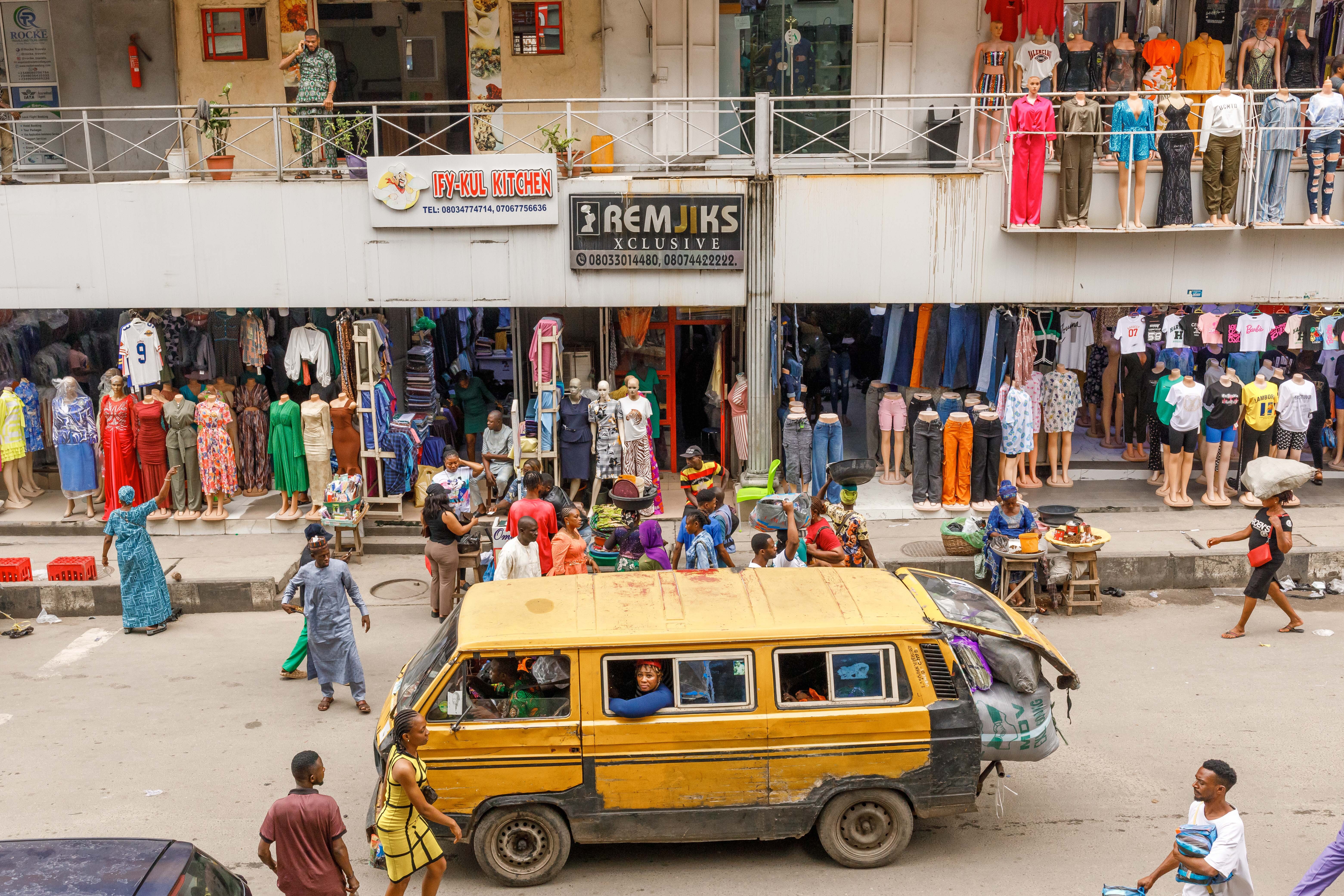
For decades, the Mile 2 bus station in Lagos has been a gateway to West Africa’s coastal corridor. Buses and taxis here have linked cities across the region, with drivers calling out destinations from Benin to Ivory Coast and Burkina Faso. It is a place defined by motion: arrivals, departures and the constant churn of cross-border trade and travel.
But the swarm of activity masks a stillness. Many vehicles bound for cities along the coast sit empty for days. Drivers like 43-year-old Foly Amatsuitsu wait for passengers who no longer come in the same numbers.
“You can see for yourself,” he says, leaning on the trunk of his beige Toyota Camry and pointing at a row of empty cars with drivers sleeping inside, their feet stretched out through the windows.
Lagos has long been an integral part of this urban corridor, shaped by historical trade and cultural ties. The cities along the Atlantic coast are linked by a coastal road that is being gradually developed into a $15 billion superhighway.
The project is led by the Economic Community of West African States (ECOWAS), a regional bloc of 12 countries, and is intended to unlock the economic potential of the region.
Yet over the last decade, as Nigeria’s economy faltered, the spending power that once fueled trade across the region weakened, affecting traders and transport workers not only in Lagos but throughout the interconnected coastal corridor.
So the number of traders hauling an array of goods, from electronics to cosmetics to fabrics, from ports to many of the major markets in the region, has declined.
The road itself compounds the problem. The Lagos-Badagry highway, which runs west from Lagos to the border with Benin, is under reconstruction. Deep potholes and a succession of checkpoints make the journey slow and costly.
Along the way, NPR passed through more than 30 checkpoints over a less-than-10-mile stretch of the road.
Immigration officials, police and soldiers man the checkpoints. Plainclothes men and boys carrying clubs wave down cars and search passengers.
Drivers say they are routinely forced to pay officers to be allowed to pass. One motorist, 40-year-old Peter Uche, says more than half of the 40,000 Nigerian naira ($28) he earns per trip is spent at checkpoints. Nigerian customs and immigration officials did not respond to NPR’s request for comment.
For many travelers, the road has become a defining image of Nigeria’s dysfunction and corruption.
After dozens of checkpoints, the road winds to an end at western Nigeria’s border with Benin.
While it’s much smaller than many of its neighbors, new enterprise, tourism and coastal development are transforming its major cities. At the heart of it is the commercial capital, Cotonou, a bustling city of about 800,000 people.
Cranes dot the coastline from Cotonou to the historical city of Ouidah, a 25-mile stretch where new restaurants, waterfront bars and tourism are emerging. New concrete paths and even pebble walkways for barefoot, therapeutic walks have been built along the shore.
Young artists work through the day, painting a mural along a half-mile “graffiti wall” running through the commercial capital.
Major markets across Benin are also being reconstructed, with what the government calls new “eco-modern” structures, inspired by Indigenous and climatic architectural traditions.
In December 2024, the government opened the newly rebuilt Marché de Ganhi in Cotonou, a two-story structure with hundreds of stalls and celebrated as a model of how commercial spaces can be developed in West Africa.
Benin’s economy has benefited from its proximity to much larger countries. But in recent years, it has moved to become more self-reliant.
New trade zones prioritizing local manufacturing, as well as new hospitals, schools, museums and markets, are the result of a major investment drive under the recently departed government of former President Patrice Talon.
He oversaw what some economists describe as a modest transformation of the small West African country, which newly elected President Romuald Wadagni has vowed to continue.
But amid the growing development, international human rights groups have decried a government clampdown on critics, in one of the region’s more stable democracies.
An increasingly authoritarian environment, according to human rights groups, has muted public frustration with the government. Igniting anger have been increased taxes on Benin’s informal economy, which accounts for about half the country’s gross domestic product, according to the International Monetary Fund.
While frustration with the government is rarely discussed openly, it bubbles below the surface of daily life.
Antoinette Hudou, 45, sells groceries on the upper floor of the market, at the Marché de Ganhi. “People are struggling,” she says. “I’ve been here since 7 a.m. — it’s 3 and no one has come,” she says. She also laments the higher cost of imported goods she sells, like pasta and tomato puree.
While the major structures in the country undergo a face-lift, many Beninese quietly bemoan the lack of spending power. More than a third of its 15 million people still live in poverty.
And even the new infrastructure and development in Cotonou and other cities come at a cost.
New structures have displaced thousands of residents, especially the city’s poorest people.
On a drive along the Atlantic coast from the rapidly developing outskirts of Cotonou to Ouidah, NPR witnessed hundreds of destroyed beachfront structures that communities said were illegally demolished that week, including a clinic.
Benin’s government did not respond to NPR’s requests for comment.
Scores of residents were still searching the debris, salvaging personal belongings. Others gathered broken cement blocks from destroyed structures, carrying them on their heads, to rebuild elsewhere.
The site is at the heart of government plans for beachfront tourism, in the form of new restaurants and bars along the route to Ouidah.
Benin has positioned itself as a premier destination for Black visitors from countries like the United States, as they explore their African heritage and the brutal history of the trans-Atlantic slave trade. More than a million Africans were held and taken to the Americas for slavery from Ouidah’s port.
Like scores of ports along the coast, from Ghana’s Cape Coast to Badagry in Nigeria, the former port in Benin is today a site of pilgrimage and tourism. And it is now being reconstructed into a landmark national project, La Marina, to both preserve its legacy and leverage its growing commercial potential. But the project, to be completed this year, is not without controversy.
The resort is complete with tours of monuments to the slave trade — some preserved, some renovated or remade into new structures — along with a five-star hotel with pools, spas and waterside restaurants.
Dominique Somda, an anthropologist at Kalamazoo College in Michigan, grew up in Benin and has done research on African slavery forts. She says the Marina project is an example of the “Disneyfication” of former slavery sites and monuments.
“They should not just attempt to provide emotions and, let’s say, entertainment, as with this Disneyfication as we’ve seen in Ouidah, but it should also attempt to educate us profoundly, because slavery has so many legacies and inequalities that we’re living with today,” she says.
Lomé, a city of 2.5 million people, is rapidly expanding along the tiny strip of Togo’s 35-mile, palm-lined coast.
At the country’s independence in 1960, the population was just 80,000, but at a similar rate to cities like Lagos, it has rapidly multiplied.
For decades, Lomé has positioned itself as a portal to much of West Africa and as a key economic hub, in close proximity to larger connected economies like Ghana, Ivory Coast and Nigeria. Its enterprises, like its people, are intimately tied to the region.
Togo’s president, Faure Gnassingbé, has been in power since 2005, longer than a majority of the young country has been alive. “We’ve been ruled by just one family for a lifetime. People are exhausted,” says Pastor Edoh Komi, a former deputy mayor in Lomé and the president of the Martin Luther King Movement, a civil society group inspired by King’s nonviolent legacy.
In recent years, young people have organized pockets of protests, defying brutal clampdowns. “They’re seeing what is happening in other countries like Nigeria, Ghana, Senegal, which have elections, which have a form of democracy, and they want that too,” he says.
If a story could capture the declining promise facing millions of Togo’s people, it could be the rise and fall of the Nana Benz: working-class women and fabric traders who shot to fame in the 1950s by importing Dutch wax fabrics that exploded in popularity.
It propelled the women who dominated the market into new wealth. They became an example of how working-class enterprise could lead to genuine prosperity.
Coverage from 1 source
Coverage by lean
- Unknown1
Comments
Sign in to join the discussion.
Sign in with SpryLogin