
ICE uses controversial program to boost deportations. Here's how it works in 1 county
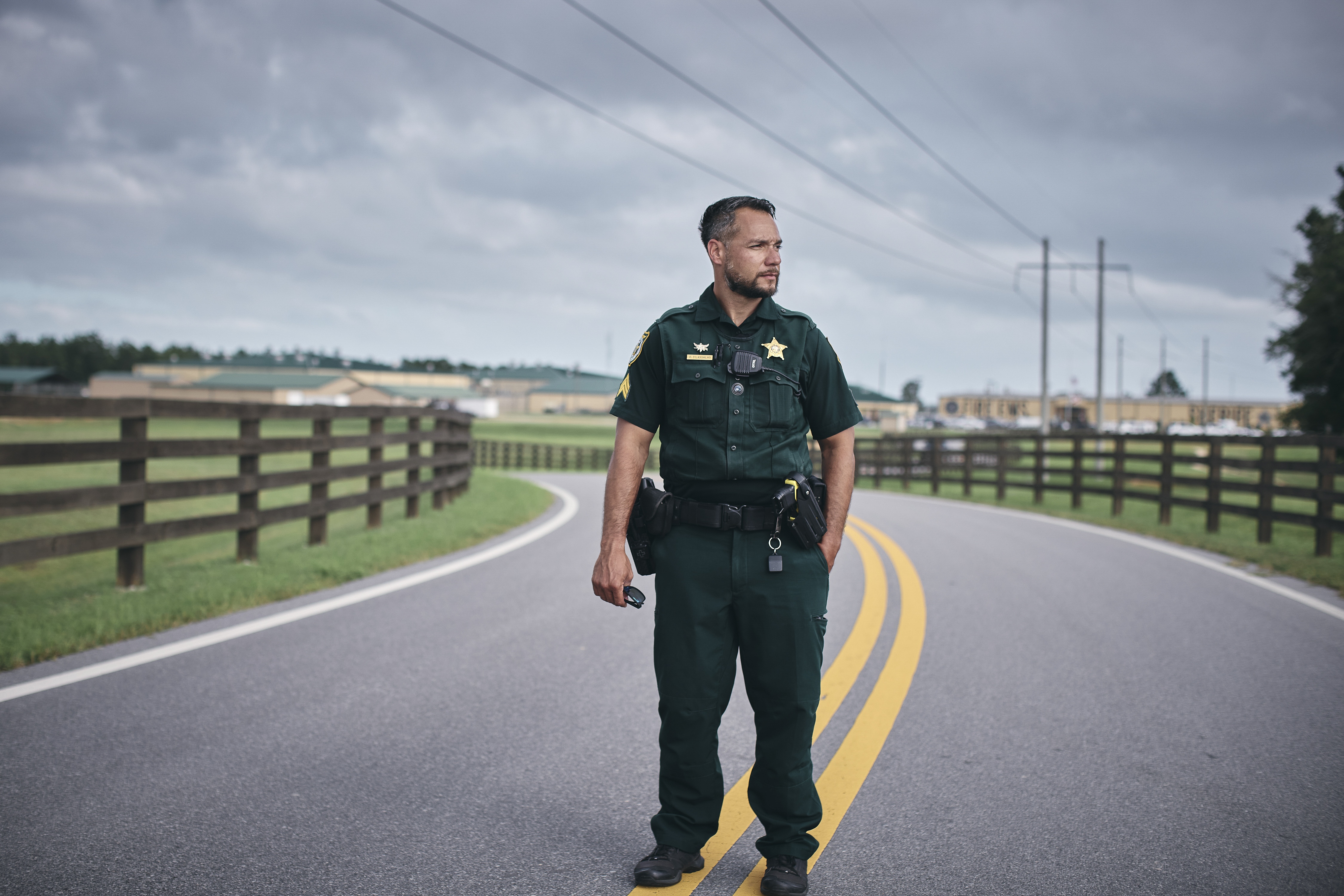
Details on how ICE cooperation agreements work in practice have been hard to come by. NPR took a close look at how sheriff's deputies in Walton County, Fla., approach immigration-related arrests. (Image credit: Nicky Quamina-Woo for NPR)
Walton County Sheriff's Office Sgt. Oscar D'Lassalas, 40, an officer certified to enforce federal immigration law, stands on the road to the jail where undocumented people are held for federal Immigration and Customs Enforcement agents to pick up. The sheriff's office in this Florida Panhandle city has partnered with ICE. Nicky Quamina-Woo for NPR hide caption
Oscar D'Lassalas' pride is obvious when he speaks of his family.
"I got four boys and a girl living with me. The baby's going to be 3 in December. She runs the house," he says with a laugh.
Photos of his wife and children are pinned above the driver's seat of his sheriff's office-issued vehicle, which is packed with rifles, a fire extinguisher and bulletproof vests.
D'Lassalas, 40, is a sergeant with the Walton County Sheriff's Office in Florida. He also leads the office's SWAT team. Last year, he became a certified 287(g) task force officer, which allows him to enforce certain parts of federal immigration law in the field.
The sergeant completed 40 hours of training online to get certified. The Trump administration recently accelerated the training , which used to require a monthlong in-person commitment, as it sought to expand the number of law enforcement agencies participating in the 287(g) program.
"To me, it was just another way to help out as much as I can in my community," D'Lassalas says.
The Trump administration has embraced the 287(g) program as a way to boost its mass deportation effort. It's a controversial program that has led to civil rights lawsuits alleging racial profiling and complaints that it drains local resources.
The interior of D'Lassalas' SUV, on the road to the jail where undocumented people are held for ICE agents to pick up. Nicky Quamina-Woo for NPR hide caption
In this fast-growing Florida Panhandle community — a county heavily reliant on immigrant labor for construction and tourism — the sheriff's office insists its role in the program is narrowly focused.
National
A look at 'Operation Country Roads,' West Virginia's ICE operation
"We're certainly not out doing immigration raids. That's not what we do," Walton County Sheriff Michael Adkinson says. "But if we come across those individuals who are committing a crime or endangering someone else, in the state of Florida, then we're certainly going to do that."
Still, many immigrant workers are terrified.
"In Florida, it's … more insidious"
The 287(g) program has been around for 30 years. It has been used in Democratic and Republican administrations to varying degrees. But the Trump administration has significantly expanded it.
Under a task force agreement, a version of 287(g) that Walton County signed onto last year, officers are deputized to perform specific types of immigration enforcement in the field. This can include interrogating someone suspected of being in the U.S. illegally, collecting evidence or making immigration arrests.
Sam Lester, an immigrant rights attorney with the ACLU (American Civil Liberties Union) of Florida, says immigration enforcement in the state is different from the aggressive and very visible operations seen elsewhere.
La Guerrerense is a common hangout and family-owned shop that features Mexican groceries and ready-to-eat dishes in downtown DeFuniak Springs, Florida. The store doesn't have as many customers lately, according to one of the store clerks, because more and more immigrants are afraid to venture out in public due to fear of law enforcement. Nicky Quamina-Woo for NPR hide caption
"In Florida, it's much more under the radar and in many ways more insidious," he says. "By far, the vast majority of immigration enforcement is done by local and state law enforcement who are deputized under 287(g)."
Florida leads the nation with the most local law enforcement agencies with 287(g) agreements. As of last year, all 67 counties had signed cooperation agreements with Immigration and Customs Enforcement (ICE), according to the Florida Sheriffs Association.
Training is a component of those agreements. But Lester says that the training is insufficient. As a result, Lester says, "we hear of instances of U.S. citizens and lawful permanent residents who are Latino who speak with accents, and they're being profiled. And they're being asked about their immigration status and, in some cases, even arrested."
Law
She protested ICE raids. Then agents showed up at her door
D'Lassalas says that's not something he would do.
"Being pulled over by a trooper and he starts asking me just for my status simply because of my complexion. I think that's unfair to ask," he says.
Adkinson, the sheriff, says his office prioritizes professionalism and respect.
Sheriff Michael Adkinson, in his Walton County office. His office partnered with ICE, and he says he thinks of this cooperation on immigration enforcement as he would any other duty. Nicky Quamina-Woo for NPR hide caption
"There's a big difference between what you can do and what you should do," he says.
Cooperation with ICE pays off
The Trump administration is offering billions of dollars in incentives to law enforcement agencies willing to work with ICE.
Outside of its 287(g) work, the Walton County Sheriff's Office signed a deal last year with ICE that turned a portion of its jail, about 48 beds, to be used as a 72-hour hold facility for immigrant detainees. Under that deal, the federal government reimburses Walton County $72 per inmate per day.
A visitation room at the Walton County Jail, where undocumented immigrants are held for ICE pickup. The room is typically used by lawyers and bondsmen. Nicky Quamina-Woo for NPR hide caption
Florida is kicking in its own grant money as well. The State Board of Immigration Enforcement approved more than $9 million in grants this summer for the Walton County Sheriff's Office for its work as an ICE holding facility.
Walton County's approach
Walton County sits along the Florida Panhandle, halfway between Pensacola and Tallahassee. It touches the border with Alabama to the north, where it's largely rural and home to many middle-to-lower-income residents. Its southern border meets the Gulf of Mexico. There, pastel multimillion-dollar homes line wealthy beachside communities like Santa Rosa Beach and Seaside.
Long stretches of road separate the two communities. Construction sites dot either side of U.S. 331, as builders try to meet the demands of a growing population.
Two homes in Walton County. The sheriff's office in Defuniak Springs sits between the rural, largely lower-income communities in the north and the more affluent communities in the south, bordering the Gulf of Mexico. Nicky Quamina-Woo for NPR hide caption
The sheriff's office sits in the middle of these two disparate sides in Defuniak Springs. It's from here that D'Lassalas drives out for his daily patrol.
In between constant cellphone pings and squawks from his dispatch radio, D'Lassalas discusses how 287(g) works on the ground.
"Generally, nothing much has changed," he says.
This Walton County compound holds the senior leadership staff of the sheriff's office, firefighters and the jail where undocumented immigrants are detained as they wait to be picked up by ICE. Nicky Quamina-Woo for NPR hide caption
If a person is pulled over for a traffic violation, D'Lassalas says, he runs the person's name through a local and national database. Doing so checks the name for any active charges or warrants, including those that are immigration related. But he says he never assumes anyone's legal status beforehand and doesn't ask about their status when he requests identification.
National Guard deployments
In Memphis, an 'anti-crime' task force quietly turned into an ICE crackdown
If a driver is pulled over for a minor infraction and has no warrant, "I'll cut them loose," D'Lassalas says. If they do have a warrant for their detention, he is clear: "I have no discretion. I have to take them to jail."
When the sheriff's office is called to assist on immigration issues by other agencies or federal officers, D'Lassalas says, it's usually for interpretation — he speaks Spanish fluently — or help transporting people already in custody.
"We're just a group of people that have been given an additional task," he says.
"This country feels like jail"
Coverage from 1 source
Coverage by lean
- Unknown1
Comments
Sign in to join the discussion.
Sign in with SpryLogin