
Billions of sea stars have died. A Northwest tribe is trying to save the species
Billions of sea stars have died. A Northwest tribe is trying to save the species How a Northwest tribe and an endangered sea creature are helping each other On a spring morning so blustery that the National Weather Service issued a small craft advisory, a Samish Indian Nation research boat, called the Chinook (Yómech), set out from Anacortes, Washington, just east of the San Juan Islands. A team of divers crammed into the cabin as the small craft bounced and slammed across Rosario Strait. They w
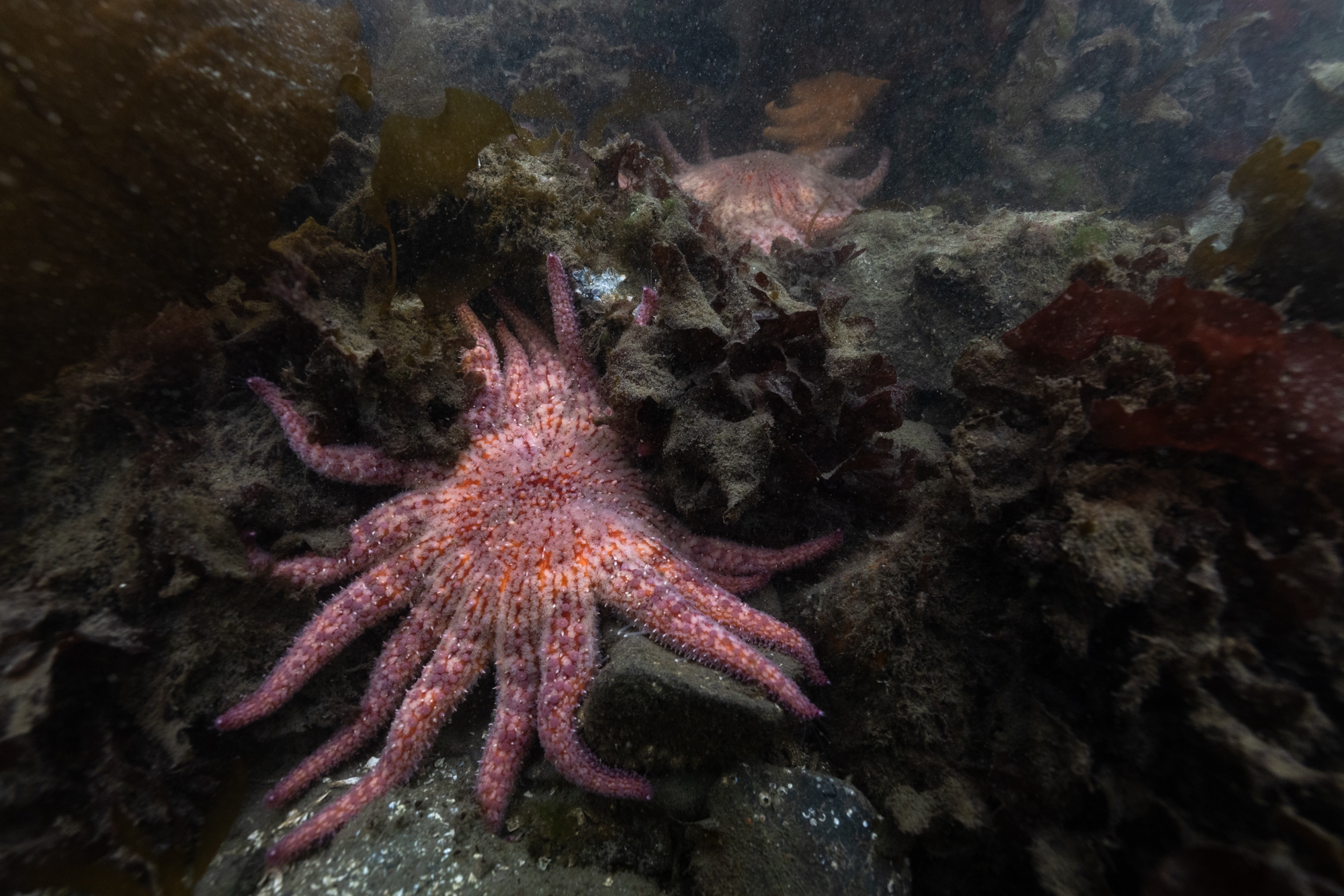
Three-year-old sunflower stars explore the kelp forest for the first time. They come in a rainbow of colors but are all the same species. The stars in this cohort are called the "snack pack," so they all have snack names, from Cheeto and Noodles to Sweet Potato. Jennifer Adler hide caption
On a spring morning so blustery that the National Weather Service issued a small craft advisory, a Samish Indian Nation research boat, called the Chinook (Yómech), set out from Anacortes, Washington, just east of the San Juan Islands.
A team of divers crammed into the cabin as the small craft bounced and slammed across Rosario Strait. They were on their way to pick up precious cargo: 20 endangered sunflower stars, raised by hand in a lab at Friday Harbor on San Juan Island.
Sunflower stars are one of the Pacific Ocean's most endangered sea creatures. For the past year, University of Washington researchers have worked closely with the Samish Indian Nation to bring this 24-armed creature back from the brink of extinction after a vast underwater pandemic nearly wiped it out.
The choppy waters of Rosario Strait were only the latest obstacle in the tribe's effort to bring sunflower stars back to traditional Samish territory.
"I've had dreams about this day. I've had nightmares about this day," said Samish Nation biologist Sam Strauss. "Many things have already gone wrong that I didn't anticipate, and I'm sure there will be a couple more."
The stars were supposed to be turned loose last October. Then divers found the deadly sea-star wasting disease — the cause of the species' near-annihilation — surging throughout the San Juans. They called off the release. Six months later, it was back on.
A deadly outbreak
Sunflower stars can grow more than 3 feet wide and are the fastest of all sea stars. They cruise the seabed at up to 5 feet per minute in search of sea urchins or sea cucumbers to grab for a meal.
State of the World from NPR
Pacific marine monuments lose environmental protections
They're considered a keystone species, whose presence or absence can reshape a whole ecosystem.
But the speedy predators have been unable to outrun a wasting disease that's killed billions of sea stars. It took researchers a decade to pinpoint the Vibrio bacteria behind the disease that dissolved sea stars into goo.
Researchers say ocean heat waves, amplified by climate change, helped the bacteria grow.
"We definitely have lost a lot of sea stars," University of Washington research scientist Jason Hodin said. "We've lost 90% of our sunflower stars, we think."
Hodin runs the sea star lab at the university's Friday Harbor Laboratories.
"This was a really, really big outbreak," Hodin. "It spread from northern Mexico all the way to Alaska, affecting dozens and dozens of sea star species."
Jason Hodin, a research scientist at the University of Washington and Scott McIntosh lower a box of 3-year-old lab-reared sunflower sea stars into the sea at Decatur Island in the San Juans, Wash. Jennifer Adler hide caption
No species was harder hit than the sunflower star.
International scientists declared the once-common species critically endangered , and Canada declared it endangered.
The Biden administration proposed protecting sunflower stars under the Endangered Species Act, but the Trump administration has not taken action on that proposal. A spokesperson with the National Oceanographic and Atmospheric Administration, which is responsible for protecting ocean species, said the agency was prioritizing other "mission critical" work.
In June, the nonprofit Center for Biological Diversity sued to protect the sunflower star.
Underwater charisma
Inside the sea star lab, tanks of filtered seawater harbor hundreds of sunflower stars, from microscopic larvae up to adults as big as stop signs.
The researchers have figured out by trial and error how to breed these little-studied animals. They've also cured some of them when wasting disease got into the lab.
"It's not a pretty death," explained research assistant Chloe Schwab, "and it's really sad to see."
It was an emotional day for the researchers as they prepared to send some of the lab's three-year-olds — each a bit larger than a human adult's outstretched hand — off into the world.
They loaded four sloshing tubs of stars onto the Samish boat.
Scott McIntosh and Willem Weertman carry a box of 3-year-old lab-reared sunflower sea stars down to the dock at Friday Harbor Labs to be released at a nearby island. McIntosh works for the Samish Nation and Weertman is a PhD candidate in Jason Hodin's lab at University of Washington studying sunflower stars. Jennifer Adler hide caption
"I really am close to them," said research assistant Julia Knopf.
She and others in the lab have given each sunflower star a name. Nacho, Baby Carrot, and Pluot were inside the tubs, among other stars named after snack foods.
Climate
Millions more people are in the path of rising seas than previously thought
"I do feel like a parent," Knopf said. "You raise them, you take care of them, you want the best for them, but then you know the best for them is letting them go out in the wild, just like letting your kid go out into the world."
These invertebrates have no faces, blood, or brains, yet they have personalities, according to their caretakers.
"They're very charismatic," said research assistant Tess Chapman. "They have little eyespots at the end of their arms. They're always looking at you."
The stars usually cuddle up with their tank neighbors. Some are feisty. Some are docile.
"They don't have a centralized brain," Knopf said, who calls the animals "amazing."
"They're also so beautiful that it's hard not to love them," she said.
Protecting a kelp goddess
Sunflower stars were never a big part of Samish culture, unlike salmon.
"We're the salmon people, for sure," said Samish tribal chair Tom Wooten.
But the stars have played a supporting role in Samish culture by protecting kelp. Many kelp forests on the West Coast have been stripped bare by sea urchins. Sunflower stars prey on urchins, which protects kelp.
"That's why those starfish are so important, because they munch those green urchins!" Wooten said. " You need those predators."
A 24-foot cedar pole looms above Wooten at Rosario Beach in Deception Pass State Park in traditional Samish territory. The carving depicts a female figure holding a salmon above her head: a Samish deity named Ko-Kwal-Alwoot.
Rosario Beach in Deception Pass State Park in traditional Samish territory. VWPics/Universal Images Group via Getty Images hide caption
On one side she is human. On the other, she is a sea creature, her hair turned to long fronds of bull kelp.
In Samish legend, Ko-Kwal-Alwoot was a young woman from Rosario village who married the king of the sea and became immortal.
"If you look into the water, you'll see the bull kelp swirling around in the tide. That's her out there," Wooten said. "That's her hair, letting us know that she's still there."
Coverage from 1 source
Coverage by lean
- Unknown1
Comments
Sign in to join the discussion.
Sign in with SpryLogin