
Car problems? No childcare? How an app is helping people get to work
Car problems? No childcare? How an app is helping people get to work Sign up for the Planet Money newsletter. The world is confusing. Economics can help MORNINGSIDE, Md. — At 10 a.m. on a Tuesday, the drive-through at a McDonald's just off the Capital Beltway is still busy with the late breakfast crowd. Inside the window, Ebert Velasquez Ramos takes an order for a sausage, egg and cheese McGriddle, cheerfully asking the customer if they want to make it a meal. The new high school graduate has be
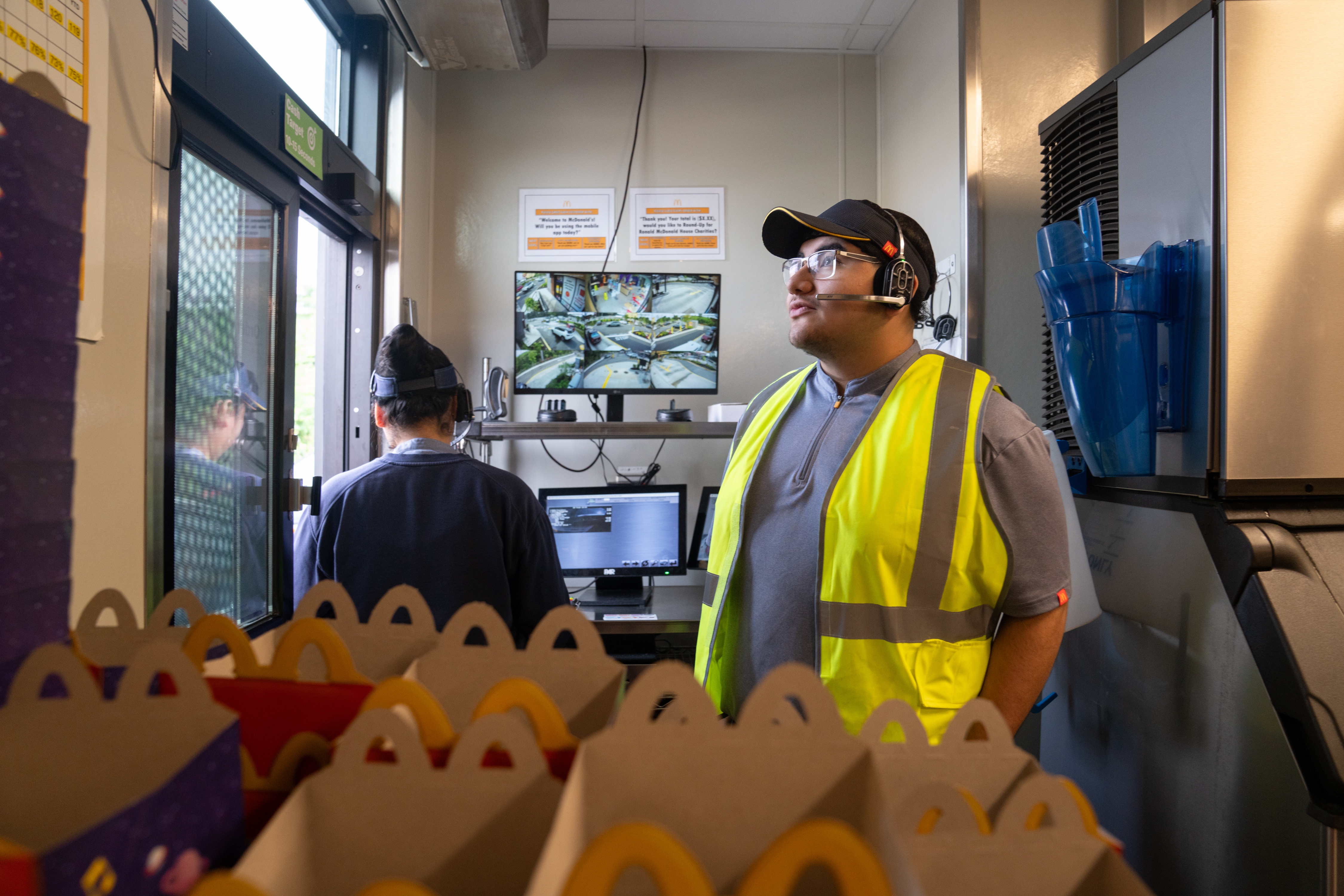
Ebert Velasquez Ramos (right) works at the drive-through at a McDonald's in Morningside, Md. He doesn't have a car so he sometimes turns to Escalate, a startup that provides Uber vouchers for workers who need last-minute rides among other support. Claire Harbage/NPR hide caption
Sign up for the Planet Money newsletter. The world is confusing. Economics can help
MORNINGSIDE, Md. — At 10 a.m. on a Tuesday, the drive-through at a McDonald's just off the Capital Beltway is still busy with the late breakfast crowd.
Inside the window, Ebert Velasquez Ramos takes an order for a sausage, egg and cheese McGriddle, cheerfully asking the customer if they want to make it a meal.
The new high school graduate has been at this job for about a month. It's his first job ever — and so far, so good. The bosses like how personable he is. And he's been reporting for his shifts on time, every day, something he worried could be a challenge.
Velasquez Ramos doesn't have a car, and getting here by bus isn't easy. Some days, he's able to catch a ride from a friend or a family member. But when no one's been available, he's turned to Escalate, a startup that began piloting its employee support app at seven McDonald's restaurants in suburban Washington, D.C., late last year. Through the app, he's been able to quickly get a voucher for an Uber, which gets him to work on time.
"I don't know if any other jobs really have that option, so I'm glad this one does," he says.
An app created by veterans of nonprofits
Sienna Daniel and Sean Segal started Escalate after working together in nonprofits. hide caption
Escalate is the brainchild of Sienna Daniel and Sean Segal, two veterans of the nonprofit world.
For years, they focused on helping unemployed and underemployed people gain the skills needed to land jobs and launch careers. They ran bootcamp-style training, hoping to open up new pathways to work.
But they saw that workers kept battling the same practical problems. Cars broke down. Childcare fell through. Absences piled up, and people could not hang onto their jobs.
"Opportunities might be there, but if they aren't stabilized and they don't have what they need to be able to get to where they need to go, there's a problem," says Daniel.
Understanding AI
This lawyer believes in second chances. Now AI is providing a boost
She has seen this phenomenon play out among her own family members in Ohio, who have struggled with poverty and work. "My dad, who is 73 years old, and my grandmother, who is 94 years old, still support them every day," says Daniel. "Driving them to work. Picking them up. When they get evicted, helping them to find housing. Food is a big challenge. Childcare."
But so many others? They have no such safety net.
Segal says through their nonprofits, they've seen that people really want to work. And they need the paychecks — even when they're only making minimum wage.
"It can be viewed as not a quality job and not a living wage, but it's the job they can get and they have right now. And it's the way they're supporting their families, so it's really important," he says.
Kitchen manager Jason Guevara prepares hash browns during a morning shift. Claire Harbage/NPR hide caption
Feeling as if they were pushing a rock up a hill, Daniel and Segal began to think anew about their work. What if they could help the population they've been so passionate about, while also solving an absenteeism problem that can cost companies tens of thousands of dollars a month? After all, when employees call out on short notice, businesses pay for it — in longer lines, less efficient service and overtime for fill-in staff.
That was the genesis of Escalate, a name they gave to both their startup and its app. If businesses could give people what they need to get to work, exactly when they need it, callouts will drop, they posited. Maybe they could get workers and employers to show up for each other.
A McDonald's pilot
In 2025, Escalate received a grant from the state of Maryland to run a pilot with Hopkins-Navies Ford Management, a McDonald's franchise with seven locations in Prince George's County, Md.
For six months, employees would have access to Escalate's app, through which they could request last-minute help with emergencies: An Uber voucher when transportation is the problem. A grocery gift card if a worker was short on food. A Visa gift card they could use to pay a family member or neighbor to watch their kids. (Daniel found people prefer that kind of arrangement over a voucher for a backup daycare service they haven't used before. "They want the kids to be with someone they know, and that they're familiar with," she says.)
Mary Hopkins-Navies (left) and her daughter Imani Ford sit inside one of seven McDonald's restaurants they own in Prince George's County, Md. Claire Harbage/NPR hide caption
Like so many employers, the McDonald's franchise had struggled with callouts across its restaurants, so its owners were enthusiastic from the start.
"Having that app, and having our employees make it to work, has been crazy beneficial for us," says Imani Ford, who operates the franchise with her mother, Mary Hopkins-Navies.
Chantel Johnson is the human resources manager for the franchise. She's been with the company since 1993. Claire Harbage/NPR hide caption
They haven't calculated the exact cost of a missed shift at one of their restaurants, but in the fast-food industry, it's estimated to be at least $300 per shift. It's easy to see why. Customers will, at times, abandon the drive-through. "If it's taking too long, they'll pull out of line," says Hopkins-Navies, who's been in the business for 35 years. "If they come in here and it takes too long to get service, they're going to walk out the door."
Sometimes the company pays people overtime to stay past the end of their shifts, which is costly. More often, the work gets redistributed, putting stress on those who did make it to work. "So it's just a trickle-down effect," says Ford.
For years, to avoid callouts, the franchise's longtime human resources manager Chantel Johnson would intervene herself.
"A number of times, I've just picked employees up," she says. "It's challenging because that keeps me from doing what I need to get done. But I realize how important it is to get these restaurants staffed."
Family
More people are juggling work and kids — and finding they can't give 100% to both
A winter storm jumpstarts use of the app
Initially, employees were skeptical of the Escalate app.
"Nobody really believed it, so no one was using it," says Johnson.
Realizing that a majority of the franchise's employees were Spanish speakers, Escalate translated the app into Spanish.
"That was a limit for some people," says Jason Guevara, a kitchen manager who has used the app to get to work. "Now that it's in English and Spanish, it's very helpful."
The real turning point came in late January, when a winter storm hit. Snow quickly turned to ice. Getting to work became a monumental challenge. Johnson remembers checking the cameras outside their stores and seeing workers battling the elements to make their shifts.
"We could see people just, you know, footing it to work, just trying to make it to work," she says.
Veronica Allmon was among those who didn't want to miss a shift. But her primary mode of transportation is an electric scooter. The roads and sidewalks were treacherous.
Veronica Allmon uses an electric scooter to get to work, but in bad weather, she has turned to the Escalate app for help. She was recently promoted to crew trainer, a management position. Claire Harbage/NPR hide caption
"I would have called off until, you know, the snow's melted, the ice is not there anymore," she says.
Instead, she used the Escalate app to get an Uber. And she made it to work that day. And the next day.
A couple months ago, Allmon was promoted. She's now a manager, training new employees in the kitchen. For her, this safety net has been key. "No other job that I've worked at ever went this far for their employees," she says.
Ford is equally grateful for the difference the app has made for the business. "We really aren't seeing a lot of callouts," she says. "It's absolutely helping with retention."
Safeguarding against abuse
Coverage from 2 sources
Coverage by lean
- Unknown2
Comments
Sign in to join the discussion.
Sign in with SpryLogin