
D.C.'s IndyCar race will zoom past museums. Some worry it could harm the art inside
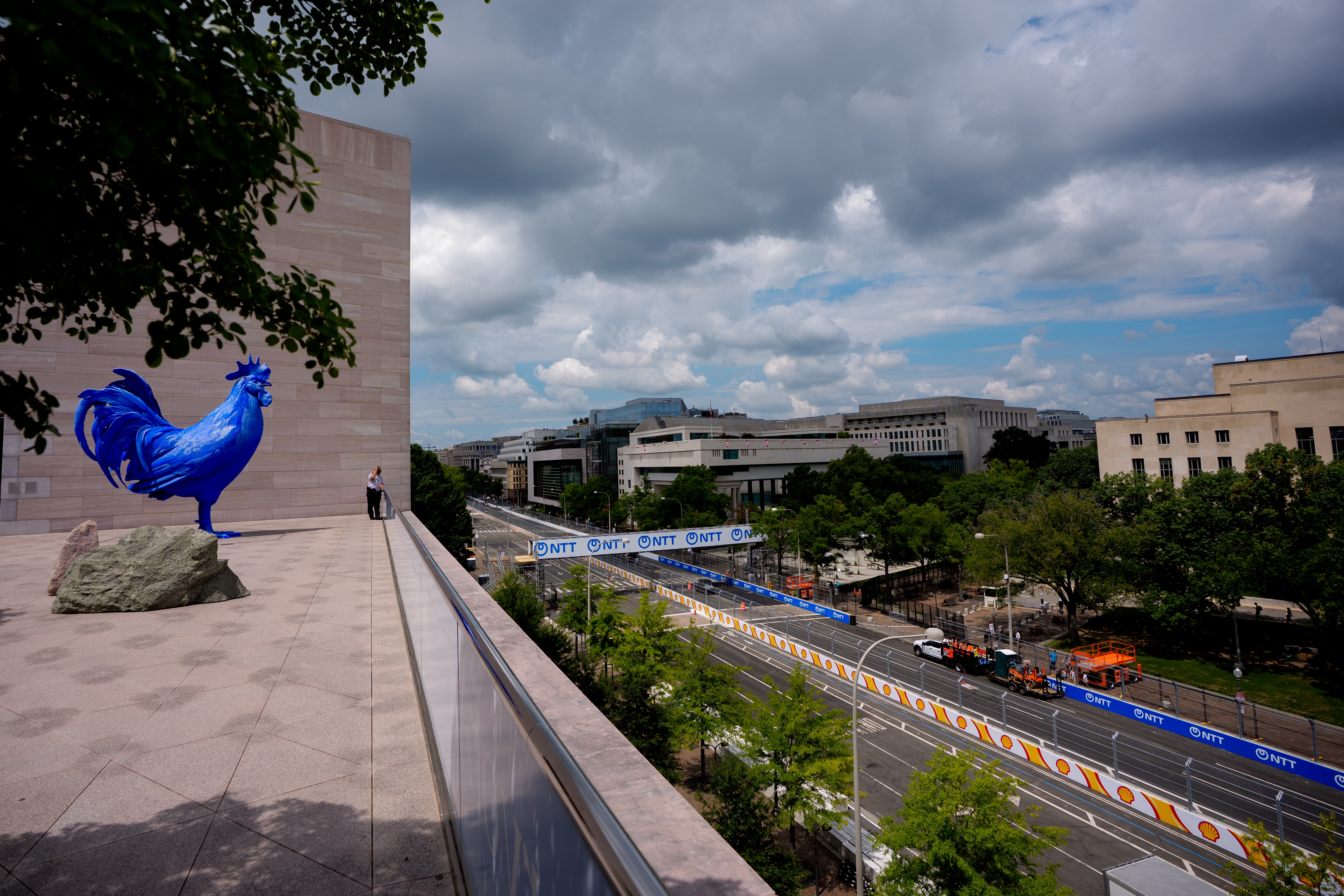
Sunday's course takes high-speed cars right past the National Gallery of Art and three Smithsonian museums. Art experts worry about the works inside, but organizers say they don't expect damage. (Image credit: Andrew Harnik)
A 14-foot-tall blue rooster sculpture overlooks the racetrack from the roof of the National Gallery of Art's East Building in Washington, D.C. Andrew Harnik/Getty Images hide caption
More than two dozen IndyCar drivers will race 147 laps around Washington, D.C.'s National Mall this weekend for the Freedom 250 Grand Prix, celebrating the country's milestone birthday.
The two-day event includes practices, qualifiers and warmups, culminating in the 250-mile race on Sunday afternoon. Cars will fly — at speeds up to 180 mph — around a 1.7-mile irregularly-shaped track smack-dab on the National Mall.
History
How America has celebrated milestone birthdays, from world fairs to the World Cup
Along the route, they will zoom past cultural institutions including the National Gallery of Art, the National Archives Building and the Smithsonian's National Air and Space and Hirshhorn Museums.
And that has raised questions about the safety of the art and artifacts inside. Namely: Could they be damaged by vibrations from the cars whizzing by?
The National Gallery of Art, whose sculpture garden is along the course, has boarded up some of its outdoor works.
Spokesperson Chris Abanavas told NPR over email that it "conducted an extensive vibration study and based on the results we have implemented a set of measures to ensure the safety of our staff, visitors, collection, and facilities during the race."
Neither the National Archives and Records Administration nor the Smithsonian Institution answered NPR's questions about preparations or concerns. Race organizers — the White House and IndyCar, which is owned by Penske Entertainment Corp. — say they are taking proper precautions and don't anticipate any damage.
The 1.7-mile course will take high-speed cars right past cultural landmarks including the National Gallery of Art and three Smithsonian museums. Organizers emphasize that it takes place in the heart of the National Mall, within view of the Capitol building. Freedom 250 Grand Prix hide caption
"The White House and Penske have followed all appropriate protocols and been in close coordination with all relevant agencies to ensure this is also the safest and most secure race for all visitors to enjoy," White House spokesperson Davis Ingle told NPR over email.
IndyCar officials point to the success of other races in sensitive areas, like one in Detroit's historic Belle Isle Park, and another that goes directly past the Dali Museum in St. Petersburg, Fla. Beth Bell, chief marketing officer of The Dalí Museum, told NPR that the museum — which was designed to withstand a Category 5 hurricane — has "remained safe and secure throughout the event's history."
"With this excellent track record and the thorough preparation we have done for this event, working closely with all the appropriate local and federal agencies, we do not anticipate any impact on the structures surrounding the circuit as a result of the race," IndyCar spokesperson Alex Damron told NPR in a statement.
But critics say the National Mall is different: Speed limits are generally around 25 mph. A race like this has never been held there before (other than centuries-old horse races , a favorite presidential pastime in the country's early days). And organizers had less than a year to plan the event.
National
In Portland, this soap box derby combines downhill speed with extreme pageantry
"For several hours of racing cars, we might be risking … the access to these extraordinary works for future generations," art historian Mary Okin told NPR.
Okin is the assistant director at Living New Deal, an organization devoted to documenting New Deal-era art and public works. She is a longtime advocate for one landmark along the route: the Wilbur J. Cohen Federal Building, formerly known as the Social Security Administration Building. It's a protected historic site both for its architecture and its murals inside.
Okin is concerned that buildings and artifacts could be damaged by vibrations associated with course construction and the race itself, plus worst-case scenarios like fires and flying debris, as she wrote in a late-July letter to the National Park Service (which issued permits for the event).
More broadly, Okin says that the planning and permitting process did not adequately explore that question or prepare for those possibilities.
National
Trump allies vote to weaken protections for historic sites — not just in D.C.
"The fact that there is an insistence that it has to go by and around major collections of art — whether or not those collections get damaged — is absolutely ridiculous and foolish and indicates a lack of care about the things that belong to the American people," Okin said.
Neither the White House, the Department of the Interior, the Department of Transportation, nor the National Park Service answered NPR's questions about safety and process concerns.
Okin sees the race as part of a bigger pattern of the Trump administration disregarding historic preservation in its pursuit of anniversary celebrations and construction projects . At the same time, it is working to permanently weaken protections for historic sites around the country.
"If this is how the federal government treats something this significant, what's to stop it from treating the rest of our cultural heritage nationally as poorly?" she asked.
An IndyCar racing vehicle is displayed at a Freedom 250 Grand Prix showcase in July between the West Wing of the White House and the Eisenhower Executive Office Building in Washington, D.C. Win McNamee/Getty Images hide caption
The race was planned in less than a year
Even organizers agree that the turnaround time was less than ideal.
"Instead of having two-and-a-half years to plan this thing, I've had seven months," said Bud Denker, chair of the Freedom 250 Grand Prix. "So it's been a tough one."
Denker, who is also president of the Penske Corporation (the parent company of Penske Entertainment), told NPR that he and Fox Sports CEO Eric Shanks had the idea for a race in D.C. over a post-board-meeting beer last year.
Politics
The Trump administration wants $10 million more to cover its July Fourth celebrations
They couldn't get congressional support to build a course around the Capitol building, so President Trump authorized one around the National Mall through an executive order in late January. Denker has been living in D.C. on and off ever since.
"I love the city, I love the vibe, I love the history, I love the people I've met," he said. "And as a result of that, we are going to stage the most incredible celebration that we've seen this summer."
Beyond building the course, pit lane and viewing structures, preparations include standing up fences, closing off roads and temporarily welding shut hundreds of manhole covers on the route. Denker says Penske is covering all the costs except security, which comes from both district and federal funds.
Denker said he's been in close contact with the Smithsonian, National Gallery of Art and National Archives along the way and provided them with studies about things like noise, vibration levels and peak particle velocity.
IndyCars only weigh 1,750 pounds, Decker added, which is lighter than passenger vehicles or buses.
"There's no vibration," he said. "Our decibel levels are lower than those of a siren that goes up and down these streets, that I've heard a lot of over the last few months."
Consider This from NPR
How Trump is leveraging sports and sports culture for his political brand
Okin has repeatedly asked the National Park Service to commit to installing vibration monitors ahead of the race. Neither she nor NPR got a response to that question.
Vibration monitors would provide some objectivity, said Leila Sauvage, a paper conservator at the Rijksmuseum in Amsterdam who specializes in the impacts of vibration on art.
She said measuring and documenting the exact impact of the race on collections can help museums define — and communicate — their vibration threshold for future events. And it would be a valuable addition to the vast documentation of each object's life.
"For our colleagues in 200 years, I think they will appreciate if we have a report that says, 'Ok, there was this race and this was the level,' because maybe in 200 years the objects will show some damage … I think they will value that we would have measured this in 2026," she said.
I.M. Pei's glass atrium skylights at the Smithsonian National Gallery of Art were among the outdoor structures boarded up ahead of Sunday's race. Kent Nishimura/AFP via Getty Images hide caption
How to measure — and mitigate — the risks
The impact of vibrations — whether from nearby traffic, construction or concerts — has become an increasingly hot topic in the museum world.
Coverage from 1 source
Coverage by lean
- Unknown1
Comments
Sign in to join the discussion.
Sign in with SpryLogin