
How the AIDS crisis helped create a multibillion-dollar death-speculation market
Investors will buy your life insurance policy today — and collect the payout when you die.
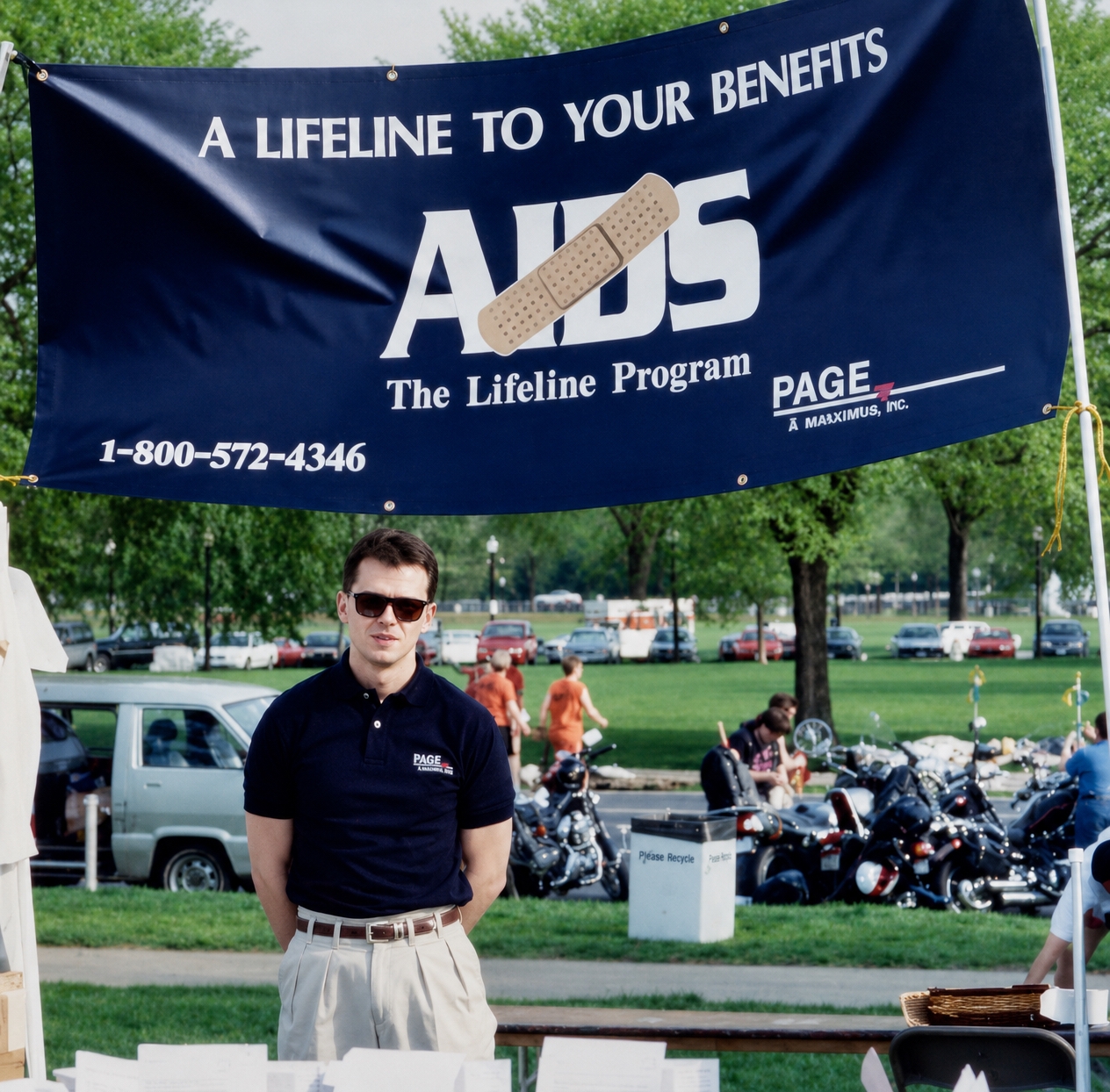
Scott Page, pictured in the 1990s. Scott Page hide caption
Listeners of our August 14 Planet Money episode may recognize some of today's newsletter. We got such a response, and so many questions, we wanted to go a little deeper with this follow up.
Frank Sierawski didn't set out to discover a multibillion-dollar market for speculating on when people with life insurance policies will die. He stumbled on it by accident, after getting the worst news of his life.
Over a decade ago, Sierawski got diagnosed with a rare form of Stage IV lung cancer.
He has a wife and three kids, and he's thinking about all the time together he's going to miss out on. So he sets what he thought then was an ambitious goal: live seven years.
"That's when I was 35," Sierawski said. "The five-year survival rate is 20%. That seems like I'd be beating the odds. That'd be a big win. I'll take that."
He was obviously worried about how his death would impact his family emotionally, but he was less worried about the financial impact. Because, before his diagnosis, he'd taken out two life insurance policies.
Back then, he understood the basic value proposition of life insurance like many of us do: you pay an annual premium to your insurance company, and if you die while your policy is in force, the insurer pays a big chunk of change to whomever you tell it to. In this case, the money would go to his family.
Sierawski is 47 now. Luckily, his life insurance never had to pay out. He got on a new drug that put his cancer into remission. But he kept paying into those two life insurance policies.
Then, just over a year ago, Sierawski was scrolling through a Facebook group for cancer survivors when he stumbled across a post that would change his whole idea of what life insurance even is. And what it can do.
The post was about a deal where you don't have to actually die to get some of your life insurance money. It's called a life settlement.
Here's how it works: You sell your life insurance policy to an investor for a fraction of the face value of the policy, maybe 20 to 30 cents on the dollar. The company pays the premiums to keep it in force, and when you die, they get the full payout instead of your beneficiaries.
In other words, Sierawski realized his life insurance was more than just a contract between him and his insurer. It was something he could sell.
"It's an asset I didn't know I had," Sierawski said. "Which was like, whoa, mind-blowing."
This is when he gets curious. Because he's a finance guy. He knows these companies want their returns as fast as possible. They make the most money when someone dies the day after they sell their policy. So he suspects his cancer history might net him a better offer.
He fills out some forms online. And that's when his phone starts ringing off the hook.
Sierawski's journey down the life settlement rabbit hole is the subject of a recent episode of Planet Money , which also follows the journey of the market from its desperate origins as loose handshake deals during the AIDS crisis to the abstract financial asset it is today.
He didn't know it at the time, but he'd stumbled into a multibillion-dollar market where policyholders like him were line items in massive investment portfolios. Binders upon binders of policies on people like him that Wall Street was waiting on to die to reap their returns.
Wait, how is this even legal?
Back in the early 1900s, a man sold his life insurance policy to his doctor for $100 to pay for an operation. And when he eventually died, his insurance company went to the courts to figure out who it should pay: the doctor or the dead man's estate?
It was a tricky question. Because on the one hand, the Supreme Court didn't want people to take out policies on strangers. That, it wrote , would be "a pure wager" that would give anyone who took out a policy on a stranger a huge perverse incentive for the person named in the policy to die. (Sound familiar ?)
There's a foundational principle in life insurance that's meant to prevent this. Something called "insurable interest." The basic idea is that you can only take out a policy on someone whose death would hurt you financially or emotionally by blood or family relation.
It's similar in the way other forms of insurance guard against moral hazard, the idea that you might take more risks in a way that might jack up costs for the insurer. You can't take out a policy on a stranger's car or house. Losing what you're insuring has to hurt you. Otherwise you'd be tempted to torch the house for the insurance money.
But say you take out the policy on yourself, a family member, or someone whose death would hurt you financially … what then?
This is where the Supreme Court found some middle ground. It ruled in 1911, essentially, that as long as you followed the rules when you took out the policy, it was yours to do with as you please. It was like a piece of property. You could sell it to whomever. Even your doctor. Or investors.
And so the seed of an industry was sown.
Dying broke
But this abstract legal principle didn't immediately create a market. It took until the late 1980s, when this idea at long last found a real, flesh-and-blood human need. With a man named Scott Page.
Page had moved across the country to be with his partner, Greg, who was dying of AIDS. Greg worked as long as he could muster as a carpenter, but as his illness progressed, it wasn't long before he could no longer work. And they were desperate for money.
They had a ritual sorting through their mail to figure out which bills they had to pay and which they could ignore. And one day, shuffling through the stack of envelopes, Page found a letter from Greg's life insurance company, saying it was time to pay the annual premium to keep it in force. Greg had a policy worth $100,000.
"And I remember that moment thinking, 'Wait a minute, I'm starting to see the signs of you dying. I gotta figure out how to pay this premium,'" Page said.
Greg had told Page he would make him his beneficiary, partly out of gratitude for Page taking care of him at the end of his life. At an HIV support group, Page explained their dilemma. They had a life insurance policy that they knew would pay out soon enough. But they couldn't pay the premium.
After the group, they were approached by a wealthy benefactor who wanted to help. So Page worked out a handshake deal with him. The benefactor agreed to pay the premiums and loan the couple money in installments of $10,000. In exchange, when Greg died, Page would repay the benefactor with the insurance payout.
The money transformed their lives. They moved into a new house. They used the money to pay for Greg's medical care, and eventually, for his hospice.
"The oxygen company came and wouldn't leave oxygen until I gave them a check," Page said. "And if I wouldn't have had the money, I wouldn't have been able to write them a check to give him the oxygen that he needed to help keep him alive."
Soon enough, other people with life insurance policies in Greg's HIV support groups wanted Page to help them make similar deals. His beneficiary agreed to loan more money until so many people asked for these deals that he ran out of money. So Page started a business, started seeking investors. He became a licensed insurance agent and started acting as a kind of broker.
The pitch to investors goes something like this:
Life insurance premiums are priced, in large part, based on life expectancy. The insurance company pools a ton of policies and the people who die sooner than expected essentially pay for the people who die later than expected.
So if someone takes out a policy when they're healthy, their policy is priced based on being healthy. Now say they fall terminally ill. If they took out a policy now, their premiums would be much more expensive because the insurer would expect them to die sooner. But the premiums largely aren't updated after a new health event, like HIV. So from an investment perspective, these policies suddenly were mispriced. Cue interest from investors.
Some people thought the whole thing was ghoulish, but Page viewed turning to investors as a necessary evil for his ultimate goal, which was to help his clients alleviate the second, hidden epidemic sweeping through the HIV community: the financial hardship of dying of AIDS.
"I've had people call me and say I'm a vulture," Page told a local newspaper in 1992. "But my customers never had anything to live on and now they will."
After Greg died in late 1993, Page tried to offer these deals to as many AIDS patients as he could. He'd seen how much the money had helped Greg toward the end of his life.
By the late 90s, Page had helped broker more than 3,000 of these deals, which had since been named "viatical settlements" — from Latin meaning, roughly: money for a long journey.
The long journey
The miracle that was a new drug intervention to treat AIDS extended lifespans for decades. Page said that was obviously a miracle. But investors would now be paying premiums for much, much longer than they expected. The "mispricing" seemed to vanish overnight.
It seemed like it would be the death knell for this weird, nascent industry. But the wheels of finance soon latched onto another clientele: old, rich people.
A new suite of companies sprung up after the millennium offering to buy up policies from retirees who otherwise might have let their policies lapse. People who didn't necessarily need the money but just wanted to cash out for financial planning reasons.
These companies send out salespeople across the country to pitch these deals to financial planners. Jonah Kahn worked for one of these companies in the early aughts as a wholesaler. They coined a new, glossy, anodyne name: life settlements.
Coverage from 1 source
Coverage by lean
- Unknown1
Comments
Sign in to join the discussion.
Sign in with SpryLogin