
Inside the Democratic task force preparing for if Trump interferes in the midterms
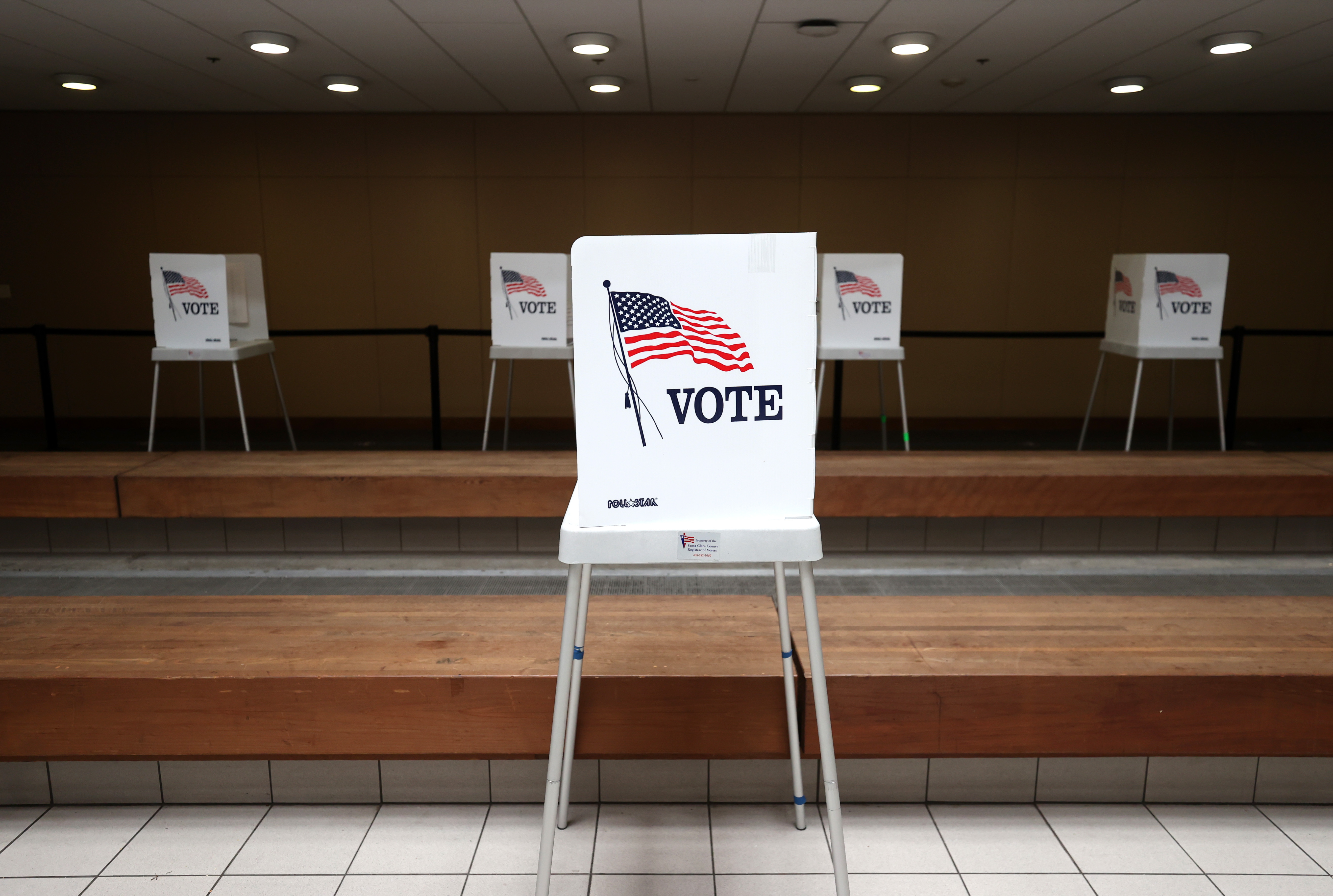
As Election Day draws nearer, Democrats are preparing for a range of scenarios, intent on avoiding what they see as the failure of imagination that kept lawmakers from anticipating the Jan. 6 attack. (Image credit: Justin Sullivan)
A view of voting booths at the Santa Clara County registrar of voters office in San Jose, Calif. Justin Sullivan/Getty Images hide caption
Stay up to date with our Politics newsletter, sent weekly .
Congressional Democrats are preparing for a new kind of midterm challenge: the risk that President Trump will attempt to undermine November's elections by claiming fraud or interfering in the voting process.
At the center of their effort is a task force of at least 11 senators, as well as staff and a constellation of outside experts and groups convened by top congressional Democrats to protect against what Senate Minority Leader Chuck Schumer, D-N.Y., describes as "direct threats posed by President Trump and MAGA Republicans."
"The goal of our task force is to ensure that every vote counts, and every American can participate in our democracy without coercion, intimidation or threats from Donald Trump or anyone else," Schumer said in April while announcing the initiative.
Members have already played a central role in challenging preelection maneuvers by the administration — including efforts to obtain state voter rolls and limit mail-in voting — even as they collectively prepare for an array of scenarios they fear could unfold over the coming 10 weeks. Senate task force staff have a list of roughly 100 possible threats, including the prospect of a national election emergency declaration from the White House and the presence of federal troops and law enforcement at polling locations.
Elections
Judge issues a new order blocking Postal Service's plan for Trump's mail voting order
This account of that effort is based on interviews with more than a dozen people involved in those preparations, including Democratic lawmakers, their staff, election litigators and experts in academia and at nonpartisan good governance organizations.
Those conversations reveal a Democratic establishment intent on avoiding what multiple people described as a "failure of imagination" that prevented lawmakers from anticipating the Jan. 6 attack on the U.S. Capitol, but also Democratic lawmakers limited by both a lack of Republican buy-in and a shortage of legislative maneuvers to address the risks they see.
Even as task force members acknowledged there is no magic "protect democracy" button tucked away in a Capitol cloakroom, they each emphasized the power of legislators as messengers and organizers, able to prepare the public and their state and local counterparts to act when necessary to ensure a legitimate election.
Trump and the playbook his critics see
It remains to be seen how the president may choose to wade into the midterm voting process in the coming months, but since returning to office, Trump has focused deep attention on the way U.S. elections are administered.
"We have very important elections coming up," he said in a July address from the East Room of the White House. "We want those elections to be honest."
Trump used the speech to call on Congress to pass the SAVE America Act, a package of changes to election law that would, among other measures, require voters to show proof of citizenship when registering to vote and a photo ID before they can cast a ballot.
"How easy is that to do, unless you want to cheat? The only reason you wouldn't do it is you want to cheat because your policies are so bad, and your candidates are so pathetic that you can't get away or can't get elected any other way," he said.
President Trump speaks in the East Room of the White House on July 16. Trump used the speech to press for passage of the SAVE America Act. Saul Loeb/AFP via AP hide caption
Members of the Democratic task force say the remarks should be understood alongside his executive order seeking to restrict voting by mail and federal investigations into 2020 election ballots as an effort to make voter fraud — which studies and investigations have found to be vanishingly rare — seem plausible.
Among them is Justin Vail, a leader at Protect Democracy, a cross-ideological group that says it uses litigation, advocacy and research to protect American elections. He previously served as a special assistant to President Joe Biden, working on democracy issues.
Elections
Trump keeps sabotaging legislation over a voting bill. Here's what's in it
Vail says Trump's speech was an effort to sow doubt in November's elections, a first step in what his organization characterizes as a three-step playbook: deceive, disrupt and deny.
"First, he deceives Americans, manufacturing false claims about voter fraud and the security of our elections," Vail said. "Second, he seeks to disrupt the normal state and local management of elections," he continued, "in an attempt to coerce them to enact policies that threaten the eligible voters' access. And if that's all not enough, Trump is prepared to outright deny election results that he doesn't like."
"Every American should be asking why Democrats are fighting against the SAVE America Act which includes commonsense election integrity measures, like Voter ID, that are strongly supported by the vast majority of Americans," White House spokeswoman Lauren Bis said in a statement to NPR. "This legislation will make sure Americans, and Americans only, decide our elections. President Trump has been clear and he is absolutely right: we fix this now, or we lose our country."
The initial front: the fight in courts
Marc Elias, the prominent election litigator and a member of the task force, describes the election protection effort on a continuum.
"It begins with voter registration, then you have people voting, then you have Election Day," Elias said. "You have tabulation of ballots, you have local certification, and ultimately you have seating."
"History has shown that Donald Trump is willing to weaponize power against all points of that process," Elias said. "This is not something that we wait until election subversion has taken place."
Elias' firm has been at the leading edge of election-related litigation against the administration. He said his team has been combating what he views as the early stages of an election interference effort across 87 lawsuits in 43 states.
Staff from the office of Sen. Alex Padilla, D-Calif., pointed to court fights over state voter roll data and mail-in balloting as the initial front in what they expect to be an ongoing effort to shape the election.
One of the most high-profile court battles ahead of Election Day has revolved around an executive order signed by President Trump in March to restrict mail-in balloting. Alex Brandon/AP hide caption
Trump has ordered the Department of Homeland Security to develop state lists of adult U.S. citizens and for the Postal Service to deliver mail-in ballots only to registered voters on those lists. A tally by the State Democracy Research Initiative at the University of Wisconsin-Madison notes 31 federal lawsuits from the administration seeking state voter data. States have largely refused to comply, citing privacy laws and the Constitution, which expressly delegates election administration to the states subject to congressional oversight.
Only on NPR
Voting officials fear DHS may actually be a threat to elections this year
According to the program's tally, all 23 district courts that have ruled on the cases have dismissed the administration's lawsuits.
The Department of Homeland Security said in a statement that it "is continuing to review voter records to determine whether the evidence supports a criminal investigation and, where appropriate, refers the matter to the Department of Justice (DOJ) for prosecution."
Earlier this week, the administration secured an interim win in the Supreme Court related to the president's push to limit mail-in balloting, though court challenges are ongoing.
The limits of Congress
Democrats are in the minority in Congress, with limited ability to act legislatively on election matters.
"There is nevertheless a role that I think that Congress can play," said Eric Holder, who served as attorney general under President Barack Obama and now consults with the task force in his role as chair of the National Democratic Redistricting Committee.
More specifically, Holder said, lawmakers can play an important role in "organizing, consciousness raising, being ready to fight that which the Trump administration is going to do both legally and then tactically, all in service of fairness."
Limited in their ability to exercise hard power, lawmakers are preparing to bring to bear the influence in other ways. Primarily, elected Democrats are focused on being the connective tissue between their state and local counterparts involved in the mechanics of administering elections and the good governance groups involved in ensuring the integrity of that process.
"We recognize that elections are run at the local level, at the state level, and we want to be able to partner — and continue to partner — with our state authorities as they carry out their duties," said Sen. Lisa Blunt Rochester, D-Del. "But we also know that, especially at this moment, there are civil society organizations, there are attorneys, there are community leaders who are all coming together and saying we're each going to do our part to ensure that this election is safe, reliable, strong, that workers at the polls are protected, that our voters can get out there and vote."
Roughly 30 Democratic Senate staff affiliated with the task force have been meeting weekly to coordinate their efforts and update their list of election threats. Multiple people remarked with surprise and relief about the success of the coordination effort, given the Senate's reputation as a group of independent-minded legislators leading separate fiefdoms.
Sen. Chuck Schumer, D-N.Y., joined by fellow Democrats, announced the launch of the Senate Democrats' elections task force at the U.S. Capitol on April 29. Kevin Dietsch/Getty Images hide caption
As the midterms draw closer, Democratic lawmakers and nonincumbent candidates are also expected to become more involved as parties in election-related litigation. Elias said voters will see the role of good governance and nonprofits that have played a prominent role in preelection litigation ebb as candidates and their parties take on a more central role in cases specific to individual races.
Still, Elias believes Congress itself could play a larger role in protecting elections if it was able to speak with a unified, bipartisan voice, but "it's not doing that because Mike Johnson and John Thune aren't doing it," he said, referring to the top Republicans in the House and Senate, respectively.
"Imagine," Elias said, "a brief that was submitted by the House of Representatives itself, the U.S. Senate itself, telling the courts that Congress was jealously guarding its authority" over elections. "That, I think, would frankly be an incredibly useful thing and would have a real impact."
GOP legislators broadly echo the president's election fraud narratives, and leaders have shown little desire to push back on his election-related actions. Congressional Republicans have instead focused much of their attention on trying to pass the SAVE America Act.
Elections
Coverage from 1 source
Coverage by lean
- Unknown1
Comments
Sign in to join the discussion.
Sign in with SpryLogin