
Arizona's taps won't run dry, but water bills will go up under federal plan for Colorado River
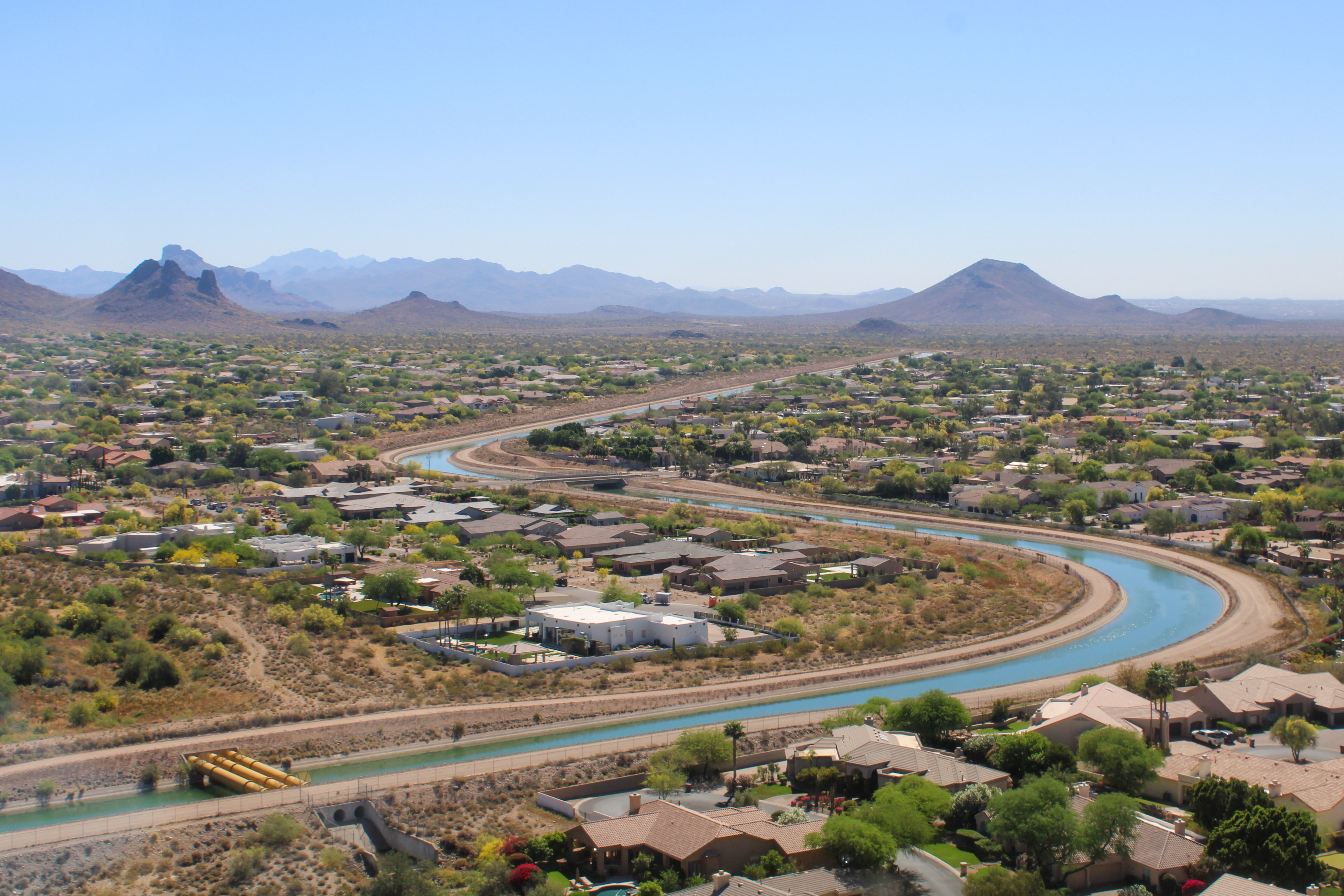
New federal rules mean Arizona will be getting a lot less water from the Colorado river. City leaders say they've been planning for years and no one will run out, but keeping taps flowing is expensive. (Image credit: Alex Hager)
The Central Arizona Project canal winds through Phoenix on March 26, 2026. The 336-mile canal system pumps water from the Colorado River to the Phoenix and Tucson areas. Water supplies for the canal's users will be cut under a new plan for managing the Colorado River. Alex Hager/KJZZ hide caption
Under the searing desert sun, Max Wilson watched water flow through a canal in north Phoenix. This unassuming strip of blue next to a busy road is the city's lifeline to the Colorado River. Soon, there will be less water in it.
Wilson, who is the water resources management advisor for the City of Phoenix, has to make sure cuts to this canal's supply don't cause taps to go dry for more than 1.7 million people who depend on his system.
He is confident water will keep flowing out of kitchen sinks, showers and sprinklers across the nation's fifth-largest city.
"Arizonans have been solving water problems for our entire history, and we didn't forget how to do that overnight," Wilson said. "We're going to do it again now."
National
How the city with the most to lose in the Colorado River crisis is trying to adapt
The cuts, which kick in on Jan. 1, are the result of a new federal plan for managing the Colorado River . After more than 26 years of drought and climate change sapped the river's supply, the nation's two largest reservoirs — Lake Powell and Lake Mead — are at record lows. The seven states that use the river's water spent years trying to agree on a plan to rein in demand. Those negotiations failed, and the federal government had to step in with its own.
The result is a strategy that includes mandatory cuts of 27% to Arizona's Colorado River supplies each year through 2028, with an option for steeper cuts after that .
Now, Central Arizona cities are charting a course through a future with less Colorado River water. Water managers across the Phoenix metro say they have robust backup plans in place to keep taps flowing , thanks to years of preparation and huge construction projects. Those upgrades, though, come with a big price tag, and will carry the area into a future that is still rife with uncertainty.
The sun sets on the Phoenix skyline on April 26, 2026. The nation's fifth-largest city will get less water from the Colorado River, but groundwater, another nearby river system and expensive technology will help it adapt to those cuts. Alex Hager/KJZZ hide caption
The Central Arizona Project — a system of canals and pumps which carry Colorado River water 336 miles across the desert to the Phoenix and Tucson areas — will be hit the hardest by new cuts. Colorado River water makes up 40% of the supplies Phoenix feeds to its customers.
"The cuts that we're talking about today will not threaten water deliveries to homes," Wilson said. "There will never be a moment where you go into your house, you turn on your faucet and no water comes out the other side."
The very fact that Phoenix and its neighbors can receive water from the Colorado River is a feat of engineering. The canal system that carries it from western Arizona is a gravity-defying product of 1960s optimism and more than $4 billion in building costs.
Soon, with less water in that canal, it will take more feats of engineering to survive. The steep costs of those projects will likely be passed along to residents.
"All those solutions are here, and we know what they are, and we're working on implementing them," Wilson said, "They are going to be very expensive. And ultimately, our customers are going to be the ones who have to pay that bill."
A man runs along the Eastern Canal in Gilbert, Arizona on August 26, 2026. The canal carries water from the Salt River Project. Those supplies are a major part of cities' response to smaller allocations from the Colorado River. Alex Hager/WJZZ hide caption
Decades of planning
National
Top California negotiator on federal proposal to manage Colorado River water
Cities say the main reason they can survive Colorado River cuts is the simple fact that they have diverse water portfolios.
When one source is short, they can lean harder on a different one. In the Phoenix area, that is most often the Salt and Verde River system and groundwater.
You wouldn't know it driving around Phoenix, but the city is built on the banks of a major river.
In the city today, the Salt River is mostly reduced to a wide, dusty trough that passes unceremoniously under freeway bridges. That's thanks to more than a century of planning and construction stretching back to some of the area's earliest waves of white settlement.
The Salt River's first major dam, Roosevelt Dam, was completed in 1911 in an effort to tame erratic flows and wrangle its water for the nascent farming communities downstream. In the century-plus since, Roosevelt was joined by other dams, which now form a chain of reservoirs in the foothills east of Phoenix.
As farming ebbed, the water stored in those reservoirs helped the area's cities and suburbs become one of the nation's fastest growing urban areas. Now, it will help keep them afloat during epically dry times.
Water from the Verde River fills Bartlett Reservoir in the mountains east of Phoenix on April 23, 2026. Water managers say they will be able to weather big cuts to Colorado River supplies partially because they can draw water from other nearby reservoirs. Alex Hager/KJZZ hide caption
Roosevelt Dam holds back water from the Salt River on April 23, 2026. The dam was originally built to help tame the river and redirect its water to farming communities. More than a century after its construction, water managers around Phoenix say it will help them adjust to a future with less Colorado River water. Alex Hager/KJZZ hide caption
The cuts to Phoenix's Colorado River allocation are survivable partially because the city gets so much water from the Salt and Verde Rivers, which supply about 58% of the water sent to customers.
Early settlers of the Valley constructed the Salt River's first dams and laid the groundwork for the area's future. Throughout the 20th century, water managers built on top of it. In the 1990s, a $430 million project raised the height of Roosevelt Dam and increased its storage capacity by 20%.
Now, 21st century water managers have to invest hundreds of millions more to make sure they can get water from the Salt River system to the places it's needed. The City of Phoenix spent about $300 million building a "drought pipeline," which was completed in early 2023 and carries water from the south side of the city to the north.
Before the pipeline, north Phoenix was largely dependent on water from the Colorado River. Phoenix has legal access to Salt River water that it can use to help keep taps flowing for more than 400,000 people in that area, but that water flowed into the south side of the city. The 12-mile pipeline fixes that, but came with a large price tag.
Still, Wilson said it was necessary and, in the future, might look like a bargain.
"Three hundred million dollars seemed like a lot of money at the time," he said. "I think many of the projects that we're talking about moving forward are not in the hundreds of millions, but are rather in the billions of dollars."
Doug Dunham, associate director of water resources for EPCOR USA, agrees.
On a recent August morning in Anthem, a master-planned community on the far northern edge of the Phoenix metro, water bubbled up into a large storage pond at a water treatment plant owned by EPCOR, a private utility company.
Dunham explained the system would keep working normally, despite the cuts, for a number of reasons.
"This isn't new headlines to us," Dunham said. "Across the Valley, across the state, from Tucson on up, there have been people who've been thinking about this and planning for these kinds of things for a long time."
Water from the Colorado River fills a holding pond at the EPCOR water treatment plant in Anthem, Arizona on August 20, 2026. The private utility company built a system of interconnected pipes that keeps disparate water treatment plants working if one source of water can't supply enough. Alex Hager/KJZZ hide caption
In EPCOR's case, that includes big, physical infrastructure — like a system of interconnected pipes that keeps disparate water treatment plants working if one source of water can't supply enough — along with on-paper access to a special share of Colorado River water.
The company's Anthem plant is plugged into the Central Arizona Project canal via a nine-mile pipeline. But the Colorado River water that flows there from the canal will not be cut like many nearby cities. Instead, access to that water is leased from the Ak-Chin Indian Community, which has deep legal protections on its water. It would only be cut off under much steeper reductions, the likes of which are not included in the next few years of Colorado River plans.
Lease deals can be a big part of some utilities' preparations for times of shortage. Essentially, if a utility's legal rights to water are on the chopping block, it can go out and buy access to somebody else's water that is more legally protected.
But the strategies that have worked so far, Dunham said, can only do so much.
"Eventually we're going to have to do harder, more difficult, and — read into that — more expensive things to make sure that water resources are brought in," he said. "The next buckets, so to speak, the next sources of water, those projects are going to be very expensive."
The steep costs of big, new infrastructure will primarily fall on the shoulders of the people who use the water those projects provide. Homes and businesses across the Valley have already seen some of those costs baked into water bills over the years, and they will likely see more increases.
And without a long-term strategy for spreading out those costs, rate hikes can be dramatic.
The town gets about 41% of its water from the Colorado River, and will lose 20% of that allocation under the upcoming cuts.
For decades, Gilbert has been building contingency plans that will keep water flowing to homes and businesses even during dry times.
In the late 1990s, it built a sprawling nature preserve structured around seven ponds that are designed to help treated wastewater seep underground, filling an aquifer that can provide a backup when there's not enough water from other sources. Now, it's nearly done building the wells to get some of that water back.
Coverage from 1 source
Coverage by lean
- Unknown1
Comments
Sign in to join the discussion.
Sign in with SpryLogin