
Colorado’s Republican governor nominee linked to controversial anti-sex-trafficking ministry
Marx’s All Things Possible Florida model uses private funds for cop pay and surveillance tools without public oversight The All Things Possible ministry (ATP) is an unusual, and critics say potentially dangerous, operation. It has in the last year funded surveillance equipment and salaries for out-of-state law enforcement agencies, hired a range of private security and intelligence contractors, and is connected to a network of other self-appointed sex-trafficking rescue groups whose leading figu
Marx’s All Things Possible Florida model uses private funds for cop pay and surveillance tools without public oversight
T he All Things Possible ministry (ATP) is an unusual, and critics say potentially dangerous, operation. It has in the last year funded surveillance equipment and salaries for out-of-state law enforcement agencies, hired a range of private security and intelligence contractors, and is connected to a network of other self-appointed sex-trafficking rescue groups whose leading figures have attracted significant controversy.
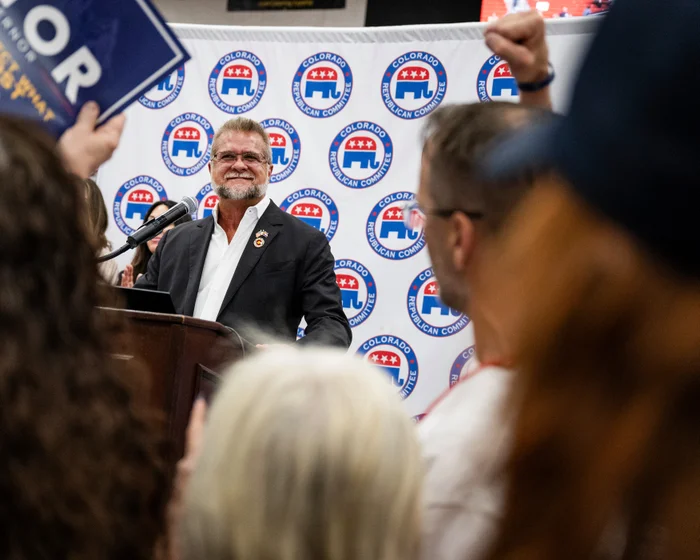
And its founder is the man who wants to be Colorado ’s next governor.
Victor Marx, the Republican gubernatorial nominee and until his campaign commenced last October was chair and president of ATP. Since then, his ministry and his political organization have overlapped. The man running Marx’s campaign, former US army intelligence operative Harry “Buddy” Jericho, has also been central to ATP’s effort to operationally merge its raid-and-rescue ministry with law enforcement agencies in Florida .
The ministry’s website says it exists to set sex-trafficked women and children free “Spiritually, Emotionally, & Physically” – work it says since 2003 has taken it to some of “the most menacing places on earth” including Afghanistan, Cambodia, Iraq, Nigeria and the West Bank. According to Marx’s 2024 memoir, rescue missions have often involved assembling paramilitary teams in foreign countries.
Since 2021, the ministry has increasingly run a domestic model, first with “Skull Games” events that “Special Forces (SF) intelligence operators or those equally qualified work alone or in teams” to crowdsource intelligence on alleged victims and offenders to pass on to police, and now by directly funding out of state law enforcement agencies.
According to tax and electoral filings, Jericho has earned hundreds of thousands of dollars as Marx’s campaign manager, as a paid director of ATP, as the director of the initiative funneling money and volunteer manpower to police, and as chief executive of an intelligence company the charity paid more than $100,000 in a single year.
As governor, Marx would have authority over Colorado’s large state police force. In Florida, his charity is already running a controversial model of how policing can be paid for: private donations from anonymous benefactors fund officer salaries and surveillance equipment outside any procurement process or public vote.
Elizabeth Joh, a law professor at the University of California, Davis, who has written on private influence over policing for two decades, said she had never encountered such an arrangement. “To whom are these dedicated sworn officers accountable?” she asked.
Even where a donor sets no formal conditions, she said, “the nature of the funding implies that straying from the donor’s expectations would threaten current and future funding.” What she wanted to know was what measures the Florida agencies had put in place “to assure that private wishes don’t influence public choices”.
The Guardian contacted Marx and Jericho for comment. Only Jericho responded. ATP’s chief executive, Chaz Yandall, answered separately on the ministry’s behalf. A subsequent email attributed to “The All Things Possible Team” said: “We wanted to clarify that All Things Possible Ministries is a completely separate organization from the Victor Marx 2026 campaign.”
Victor, son of Karl
Marx narrowly won the 9 July Republican gubernatorial primary in Colorado despite a campaign that saw him telling unverified stories about being forced to commit murder at 7 years old by an abusive stepfather, his refusal to say how many people he may have killed as an adult, his claim to have called in US airstrikes as a civilian, and his boasts of performing exorcisms over the phone.
Marx was known as Vaughn Victor Kennedy when he served as a US marine in the 1980s, according to posted images of service records he produced under questioning earlier in his campaign.
On a website dedicated to rebutting “public claims” about his earlier life, the candidate says he changed his previous last name (shared with the allegedly murder-inducing stepfather) “after reconciling with his birth-father, Karl Marx”, who on Marx’s earlier account had spent time as a “practicing warlock”.
Victor Marx set out ATP’s overseas missions in The Dangerous Gentleman, his self-published 2024 memoir. He recounts assembling “a paramilitary security team” of “experienced former CIA guys, Marines, Navy Seals, and Delta guys” and leading it into Iraq and Syria during the war against Islamic State.
According to Marx, his teams bought “military-grade vehicles, ammunition, guns” and kept “an armory of weapons” at a base of operations. On the Iraq-Syria border, a member of his security detail asked permission to shoot a man who was watching them, and on his own account, Marx replied: “Do it.” The whole operation, he wrote, was paid for by “Americans who gave money to support this sort of craziness”, and twice he states that the ministry never took US government money.
He has repeatedly given his anti-trafficking work a supernatural cast, telling a TPUSA-affiliated podcast in 2023, “I hunt pedophiles, but I also hunt demons.”
Taskforce
In 2025, however, a slide deck published to ATP’s website announced that the ministry would pivot from overseas rescue missions to close partnerships with domestic law enforcement agencies, with initial plans for ministry members to act as sworn officers. It would also pursue sponsorship deals “funded by ATP’s high net worth donors” which would procure surveillance equipment and software for local, state and federal agencies. The new initiative was to be called the Protecting Children’s Innocence taskforce (PCI-TF).
The deck, whose metadata indicates it was created on 5 March 2025, says that following internal discussions “ATP redirected overseas efforts to support U.S. law enforcement in improving arrest rates,” beginning with “a thinktank with experts, including legislative allies … to strategize U.S. child sexual abuse efforts”.
But the scope went well beyond a thinktank. “Task Force members are sworn by law enforcement agencies, working side-by-side with their teams,” the deck says. Members would support “warrant creation, suspect tracking, and case documentation to streamline the path to prosecution”. An organization chart names Jericho as director.
That model was not built according to Jericho. He said that “some early organizational documents contemplated models under which personnel might obtain appropriate status through a cooperating law-enforcement agency,” that it was “an early concept while the organization was being developed”, and that the taskforce “ultimately pivoted away from that model”. Yandall said no one acts as a sworn officer, auxiliary officer or special deputy on the taskforce’s behalf.
But memorandums of understanding signed with the Leon and Wakulla county sheriff’s offices (WCSO), obtained by the Guardian, show the ministry retained a say in how the operations it funds are staffed.
Both require the sheriff’s office to “designate an Assigned Person, following her/his approval by the PCI-TF GEB” – a government executive board on which each participating agency holds a single vote and which meets quarterly. The Wakulla agreement goes further, providing that the officer is “to be selected collaboratively by PCI-TF and Wakulla County Sheriff’s Office” and will “be evaluated at regular intervals based on performance standards that are both established and maintained by the GEB in collaboration with PCI-TF”.
Both agreements also ask the agencies to report back. Under a heading on performance evaluations, they list search warrants served, arrests and indictments, devices examined, media files reviewed and confirmed as child sexual abuse material, “number of convictions and sentencings associated with reported cases” and “total years of incarceration sentenced during the reporting period”. The same section states that the reporting “is not intended to direct, govern, or interfere with the agency’s independent operations”.
The 2025 proposal deck envisaged that PCI-TF would support “warrant creation, suspect tracking, and case documentation to streamline the path to prosecution”. The ministry would provide “funding for essential operational needs, including surveillance equipment, data analysis software, and training programs”, by “leveraging the generosity of high-net-worth donors to supplement agency budgets and expand their investigative capacity”.
PCI-TF’s current public description of its mission on its website is less detailed: among other things, the taskforce says: “We see the protection of innocent children as a gospel calling.”
Asked whether the taskforce is a separate legal entity from the ministry, Yandall said: “PCI-TF is not a separate nonprofit and does not have a separate EIN.” The Guardian could not find a separate entity of that name registered anywhere in the US, and the URL victormarx.com/pci redirects to atpministries.org/pci.
Agreements signed with Florida sheriffs say otherwise. The Wakulla memorandum opens by naming the parties as “the Protecting Children’s Innocence Task Force (PCI-TF), a 501(c)(3) nonprofit” and the sheriff’s office. A clause headed Authority adds that the taskforce “operates in accordance with all applicable federal and state laws and under its nonprofit charter”. Identical wording appears in the agreement signed by the Leon county sheriff, Walt McNeil, on 17 September 2025. All Things Possible is not named as a party to either.
At least one of the sheriff’s offices contacted by the Guardian is still operating under the assumption that PCI-TF is an independent organization. Geneva Stokely, a WCSO spokesperson, wrote: “The MOU identifies the Protecting Children’s Innocence Task Force as the entity providing funding to the Wakulla County Sheriff’s Office. The MOU identifies PCI-TF as a 501(c)(3) nonprofit but does not identify the sources of PCI-TF’s funding. WCSO does not have information identifying the sources of PCI-TF’s funding.”
Gainesville police department chief Nelson Moya wrote: “I am not aware of who funds the ministry or PCI.”
What ATP bought the police
The public debut came on 6 November 2025 at Cascades Park in Tallahassee, where the ministry launched the operation alongside five agencies including the sheriff’s offices of Leon, Wakulla and Jefferson counties, the Tallahassee police department and federal Homeland Security Investigations. Locally it was named the Big Bend Protecting Children’s Innocence taskforce, and it was reported that “the project is being sponsored by All Things Possible Ministries”.
A Leon county sheriff’s office budget amendment attached to the county commission’s agenda for 27 January 2026 records $210,000 arriving at the department. The agreement itself sets out what the money buys: salary and benefits for an internet crimes against children detective at $114,689.90 a year, training for seven detectives and supervisors, a $35,000 vehicle, an Intel Talion forensic workstation at $23,712, and a dedicated internet line at $1,200 a month. Spending on licences for GrayKey and Cellebrite, two commercial tools used to extract data from locked phones, is listed as “To Be Determined”.
In neighboring Wakulla county, the ministry funds an entire detective post. The agreement commits it to salary and benefits “not to exceed $132,050.36 a year”, and itemises the rest: a $30,000 Equinox, a Dell desktop at $3,509.11, a vest at $1,500, a Class A uniform with duty gear at $820, a filing cabinet, a desk, a desk chair and the detective’s firearms, a handgun at $481 and a rifle at $1,737. Colonel Chuck Whaley, of the sheriff’s office, reportedly said the arrangement came at no cost to taxpayers
On both agreements, the taskforce’s point of contact is Jericho, at an address on the Marx campaign’s domain. Asked why, he wrote: “I maintain several professional email accounts and receive correspondence across them. I do not recall why I used the campaign-domain address in that particular instance, and I will not invent an explanation years after the fact. The use of that email address did not mean the campaign was involved in the underlying ATP matter.”
Both agreements run three years and both require the sheriff’s office to “make a reasonable effort to obtain the required funding pursuant to the three-year schedule outlined above, particularly as PCI-TF funding phases out”. Leon’s schedule funds the post at 100% in each of the three years, to 14 September 2028. At the end of it, the counties are apparently expected to carry a detective, a vehicle and a forensic suite that were created outside normal county budgetary processes.
When asked about this aspect of the arrangement, Stokely, the WCSO spokesperson, said that this was not a commitment in the MOU, which she wrote “does not establish what will occur with the position following the conclusion or discontinuation of PCI-TF funding”.
Beyond Big Bend
The Big Bend agencies were not the only recipients. Reportedly on 18 September 2025 , seven weeks before the Tallahassee launch, the Gainesville police department announced its own partnership with the taskforce, 150 miles away in Alachua county.
Chief Moya said the taskforce gave it a server valued at $223,733.14 and that because it arrived as a donation, “it did not go through the city procurement process.” The ministry also paid for three Gainesville officers to attend one of its Guardian Retreats. Yandall said ATP has now run five, “assisting and training nearly 100 law-enforcement officers” in “mental, physical, and spiritual health protocols”. Asked for a total figure for what it has given each agency, he said only that the expenditure was “documented through ATP’s financial records”.
Sheriff’s deputies were working under the ministry’s banner before the public launch. In early October 2025, four weeks before the Tallahassee announcement, detectives in the criminal investigations division at the Wakulla county sheriff’s office “who are assigned to the Protecting Children’s Innocence Task Force (PCI-TF)” completed the arrest of nine registered sexual offenders and one sexual predator in an operation called Not-a-Fan , according to a statement issued under the sheriff’s office’s own byline. Eight of the 10, it said, were arrested “by authority of arrest warrants obtained by PCI-TF Detectives”.
Both the ministry and Jericho reject that description. Yandall said PCI-TF “does not prepare, apply for, or obtain arrest warrants”, and that warrants, arrests and other enforcement decisions rest with the agencies and the courts. Jericho said taskforce personnel had not participated in preparing or obtaining warrants in live criminal cases, applied to judges for them, or served them.
The Florida department of law enforcement’s own account of the same operation , published on 14 October 2025, lists the same 10 defendants and the same charges but does not mention the taskforce. It names FDLE, the sheriff’s office, Homeland Security Investigations and the state attorney’s office, says only that “arrest warrants were obtained”, and dates the arrests to 7 and 8 October.
Since then, the taskforce has been named as a participating agency in a series of north Florida operations that have produced dozens of arrests, several of them alongside federal agencies. Operation Safe Harvest in March, which produced 20 arrests, was credited in media reports to the Tallahassee police department, the Leon county sheriff’s office, FDLE, the FBI, Homeland Security Investigations, the US Marshals Service – and the ministry’s programme.
The Guardian contacted all the involved agencies for comment. In their response, Homeland Security Intelligence wrote that the taskforce was no longer active, and that: “Any financial contributions or equipment provided by the non-governmental organization in the form of a grant to support task force operations are managed exclusively between those organizations and the respective state or local law enforcement agencies. HSI is not a party to those arrangements, and its participation remains strictly focused on the federal law enforcement mission.”
None of the Florida money has yet appeared in an ATP tax return. The payments fall in the 2025 financial year, and that return is not due until 15 November 2026, 12 days after the election.
Buddy Jericho
Coverage from 1 source
Coverage by lean
- Unknown1
Comments
Sign in to join the discussion.
Sign in with SpryLogin