
Personalized mRNA vaccine for melanoma cut risk of cancer’s return in late-stage trial
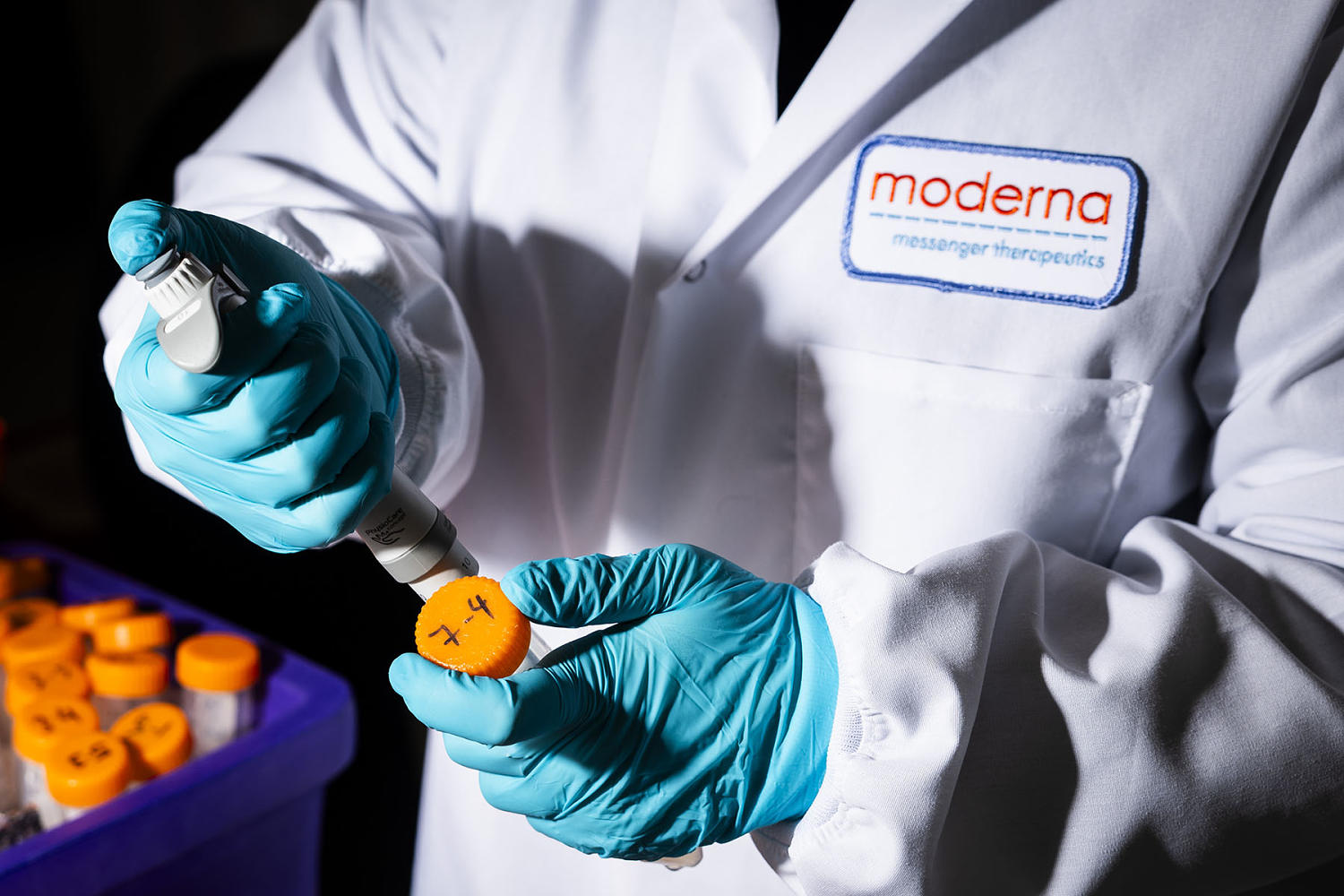
A researcher works in the lab at the Moderna headquarters in Cambridge, Mass.
A new personalized mRNA vaccine for melanoma is being hailed by some oncologists as a major breakthrough after it reduced the risk of cancer recurrence and death by 42% compared with standard treatment in a late-stage clinical trial.
Dr. Robert Vonderheide, director of Penn Medicine’s Abramson Cancer Center and president-elect of the American Association for Cancer Research, said the results are a “game changer.”
“It will be seen as the first step toward using cancer vaccines to their full potential,” said Vonderheide, who was not involved in the trial.
The experimental vaccine, called intismeran, was developed by drugmakers Moderna and Merck. Intismeran is personalized to each patient, using genomic data from the patient’s tumor. The new results will be presented Saturday at the annual meeting of the European Society for Medical Oncology in Madrid.
The trial included 1,137 Stage 3 melanoma patients. All of the participants had undergone surgery to remove their tumors and were being treated with Merck’s immunotherapy drug Keytruda .
In addition to Keytruda, 757 of the participants also got the personalized vaccine; the remaining 380 got a placebo. Two years later, 82% of the patients who received both the new vaccine and the immunotherapy hadn’t had a recurrence, compared with 70% in the immunotherapy plus placebo group.
In Stage 3 melanoma, the cancer has spread to nearby lymph nodes or other sites on the skin, but it hasn’t spread to distant organs. Cancer recurrence is the “dreaded event” for these patients, Vonderheide said. If it does return, spread to distant organs is more likely.
Dr. Georgina Long, co-medical director of the Melanoma Institute Australia who led the clinical trial, said that while scans might suggest that melanoma has been completely removed by surgery, invisible cancer cells may still be lurking.
“This treatment is about mopping up the cancer cells we can’t see,” Long said. “We know with [Keytruda] alone, that works really well, but not in everyone.”
Keytruda works by mobilizing immune cells called T cells to spot and destroy cancer. The vaccine also helps the immune system fight cancer. Each vaccine is created by taking the excised tumor, sequencing its genome and identifying a tell-tale fingerprint of abnormal proteins known as neoantigens, Long said. The vaccine trains the immune system to recognize and target these neoantigens, similar to how a standard vaccine is trained to recognize and target a virus or bacteria.
Intismeran uses messenger RNA technology, the same platform pioneered in the development of Covid vaccines that’s hailed for how quickly it can be rolled out. Each patient received their personalized vaccine in a little over nine weeks on average.
“They’re not on the shelf,” Vonderheide said. “They have to be made for that patient. Can that be done in a few weeks in order to have a timely treatment? Turns out, the answer to that is yes.”
Dr. Shirin Bajaj, incoming director of hHead and nNeck mMelanoma at Mount Sinai in New York, said that while Keytruda works by taking the brakes off the immune system and enabling it to recognize cancer cells, the new vaccine is likely enhancing its abilities by mobilizing additional immune cells called killer T cells.
“It essentially creates an army of killer T cells that are meant to recognize the tumor,” said Bajaj, who was not involved in the trial.
Side effects of the vaccine included pain around the injection site and a mild fever — similar to those seen with Covid vaccines.
For Dr. Gino In, an associate professor at the USC Keck School of Medicine Norris Comprehensive Cancer Center in Los Angeles, that is a major selling point. In some cases, Keytruda can result in serious organ inflammation, and previous attempts to combine the immunotherapies with other drugs have not only failed to improve cancer recurrence outcomes, but resulted in worse side effects.
For Subscribers
FOR SUBSCRIBERS Goldman Sachs CEO David Solomon is optimistic about AI. Most of America disagrees.
FOR SUBSCRIBERS MAHA votes may be up for grabs
FOR SUBSCRIBERS More than 500 ads about Jeffrey Epstein and pedophiles have run this election cycle
FOR SUBSCRIBERS ‘I would have never done that’: Vivek Ramaswamy supporters criticize his controversial ad
FOR SUBSCRIBERS Everything was going great — and then he got caught in Lori Vallow Daybell’s crosshairs
FOR SUBSCRIBERS The FDA says there’s no estrogen patch shortage. Women are struggling to fill prescriptions.
FOR SUBSCRIBERS Netflix bets on ‘La Bola Negra’ for best picture: On the Lot
FOR SUBSCRIBERS Six years and more than a thousand artists: Bringing ‘Wildwood’ to life without AI
FOR SUBSCRIBERS Democrats are dreaming of a 2018 repeat in a deep red Oklahoma district
FOR SUBSCRIBERS Republicans have been touting wins and a growing coalition — in Latin America
FOR SUBSCRIBERS Why baseball teams are replacing live stadium organists with modern music
FOR SUBSCRIBERS Analysis: Trump promised $2 gas and cheaper groceries. Here’s what voters got.
FOR SUBSCRIBERS He’s in the West Wing. He’s at the rally. He’s got Trump’s ear. Bill Pulte is everywhere.
FOR SUBSCRIBERS New AI tool for voters offers a specialized chatbot to explain your ballot
FOR SUBSCRIBERS GOP retreats from North Carolina as Trump admits Democrats likely to win Senate seat
“In prior trials, other drugs that were studied in combination with [this class of immunotherapies] led to significant, and eventually potentially permanent side effects, particularly side effects that triggered the immune system to attack our own body,” In, who wasn’t involved with the trial, wrote in an email.
Coverage from 1 source
Coverage by lean
- Unknown1
Comments
Sign in to join the discussion.
Sign in with SpryLogin