
Israelis have changed. Will they change their leadership?
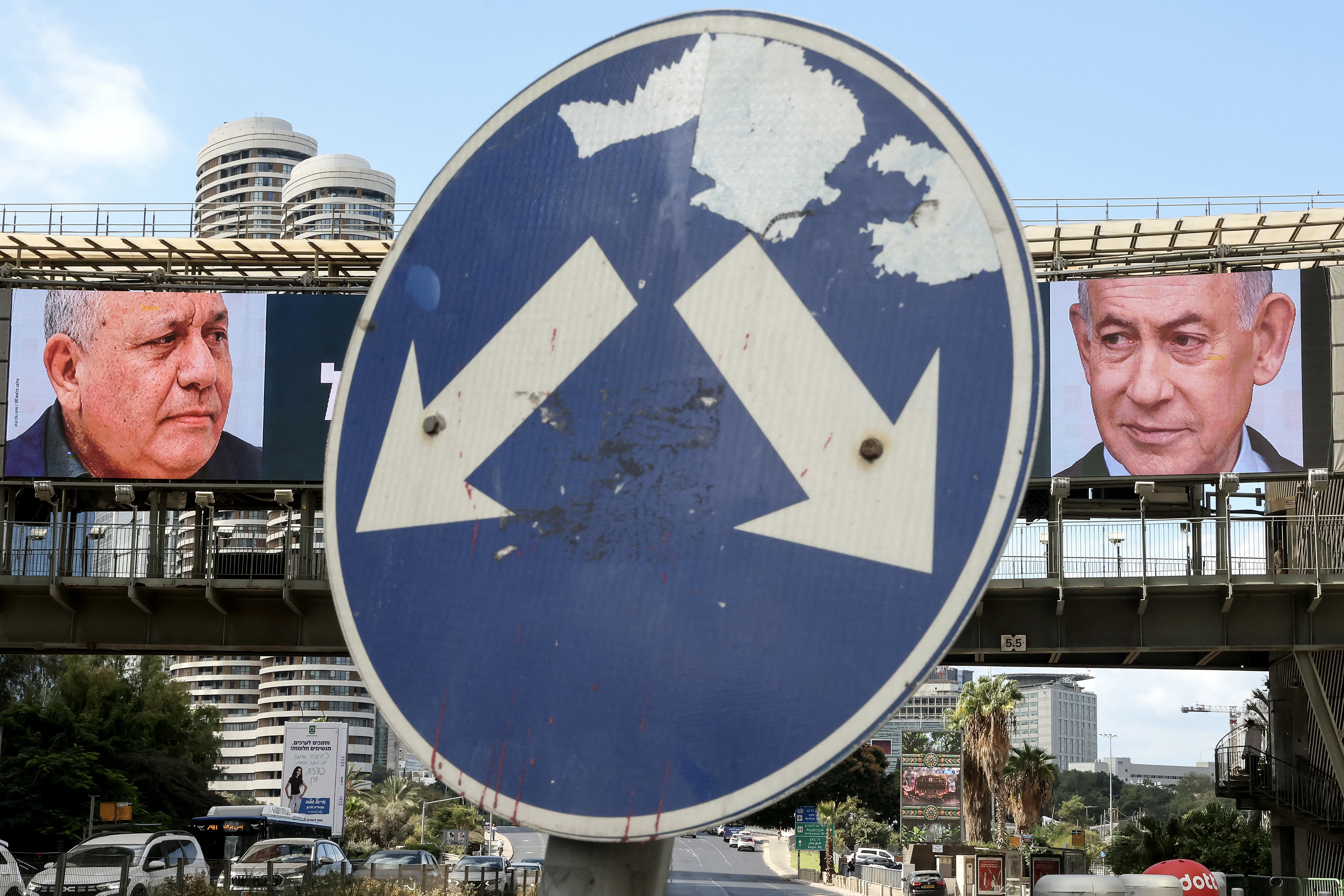
Israel is holding a general election this week after years of war. For many Israelis, shaken by the Oct. 7, 2023, attacks and years of war, it is the most consequential in decades. (Image credit: Jack Guez)
A road sign stands in front of a large billboard featuring Israel's Prime Minister Benjamin Netanyahu (right) of the Likud party and his main center-right opponent, former military chief Gadi Eisenkot, in Ramat Gan, Israel. Israel heads to the polls on Oct. 27. Jack Guez/AFP via Getty Images hide caption
TEL AVIV, Israel — Israelis are convinced that elections scheduled for Tuesday are the most pivotal in their nation's history.
Will they vote out Prime Minister Benjamin Netanyahu — and his coalition of far-right, ultranationalist and religious political parties — because he failed to prevent the Hamas attacks on Oct. 7, 2023, the deadliest day for Jews since the Holocaust?
Or will they reelect him to continue his campaign of retaliation, waging wars that aim to reshape the Middle East? His main challenger, former military chief of staff Gadi Eisenkot, leads a center-right opposition promising more diplomacy and less extremism.
It is Israel's first vote after these years of battle and bloodshed. Israelis are so concerned about their country's future that tens of thousands of expats are expected to fly back to cast ballots, since Israel does not allow absentee voting.
"We almost could have been destroyed on Oct. 7," said Israeli lawyer Shoula Romano-Horing, who flew in from Kansas City, Mo., to vote. "This is why I'm voting for Netanyahu, to make Israel so secure and so safe."
In the opposite corner are those Israelis distressed by the global backlash to the wars Netanyahu's government has waged.
"The actions of this government cause Israelis in general and Jews in general to be tagged as, you know, mass killers," said Yochai Ben-Haim, who works in renewable energy in California and is flying home to Israel for 36 hours just to vote. "This government is led by extremists that do not represent who we are, and we need to change it."
In conversations with dozens of Israelis over the last few weeks, a portrait has emerged of who Israelis are today.
A man stands in a destroyed building in the Jabalia camp for Palestinian refugees in the northern Gaza Strip on Oct. 20, 2026. Bashar Taleb/AFP via Getty Images hide caption
They are a people defiant, but also weary after three years of incessant war. They are enraged at their enemies, but also at their leaders.
Many are impervious to the pain of their Palestinian neighbors, but traumatized from the war they have wrought. They are resistant to Palestinian independence, but also revolted by the Israeli settlers pushing Palestinians off their land.
They are fed up with the world's rebuke over the Gaza war, but also fearful of their growing global isolation. They are a people in a tug-of-war with themselves.
"Israelis want to be feared and to be loved," said Israeli author Micah Goodman. "The problem is that you have two reputations you need to protect, but you can't."
What Netanyahu knew
Meir and Kati Zohar stand together at the memorial marker dedicated to their daughter, Bar Zohar, at the Nova festival memorial site in southern Israel, on Sept. 24, 2026. Their daughter was among the victims killed on Oct. 7, 2023. Erik Marmor for NPR hide caption
As elections near, Israelis are learning more about what led up to Oct. 7, 2023.
Only on NPR
3 years on, Israelis grapple with reports Netanyahu was warned before Oct. 7 attacks
Throughout that year, as Israelis poured into the streets to protest Netanyahu's far-right government and its plan to weaken the judiciary, Netanyahu's security chiefs warned that regional enemies could take advantage of the turmoil to attack.
Behind the scenes, Israel received direct warnings that Hamas was planning something big. Israel and Hamas had been holding secret talks for more than a year, Palestinian mediator Sufian Abu Zaida said. When the talks stalled, Hamas' leader in Gaza had Abu Zaida relay a message threatening an "earthquake."
What kind of earthquake was unclear, said Abu Zaida, but he insists he relayed the warning to Israeli intelligence. The leader of the United Arab Emirates and Egypt's intelligence chief relayed similar warnings, according to reporting by NPR and other media outlets . "All what happened in 7 of October is needless," Abu Zaida said.
Burnt out vehicles in Ashkelon, southern Israel, are pictured following a rocket attack from the Gaza Strip on Oct. 7, 2023. Ahmad Gharabli/AFP via Getty Images hide caption
Nearly 1,200 people were killed when Hamas attacked army bases, residential communities and an outdoor music rave — and 251 people were taken hostage back to Gaza. Netanyahu denies he was warned and has never admitted any kind of responsibility for the security failure.
"Within days, his PR people were trying to shape the public narrative about events," said Amos Harel, a defense analyst for the Israeli newspaper Haaretz and author of 06:29 – Anatomy of a Failure , which details the Israeli failures to prevent the Oct. 7 attack. (The attack began that day at 6:29 a.m.) Netanyahu's strategy, he said, was "to shift the blame" to the security services and the military.
Amos Harel, military and defense analyst for the Israeli daily Haaretz, is pictured inside the newspaper's archival library in Tel Aviv. Harel has extensively reported on Israeli defense strategy, military operations, and Middle East security for decades. Erik Marmor for NPR hide caption
For much of the Gaza war, Israeli protesters flooded the streets demanding that Netanyahu strike a deal with Hamas to release Israeli hostages and end the fighting. It would take two years, Israel's longest ever war, before a hostage deal was reached. Netanyahu said he was seeking the total defeat of Hamas, though former officials who worked with Netanyahu allege he prolonged the war for political reasons — a charge that Netanyahu has denied.
"I'm absolutely convinced that this is what happened," Harel said. "He felt that if this would move on too fast, then there will be more of a significant public demand for a national commission of inquiry."
There is a great demand among Israelis for an investigation into the attack, like the 9/11 Commission in the United States. Netanyahu has blocked one in Israel.
So Israelis grappling with Oct. 7 go to the spot of the day's deadliest attack, where hundreds of people were killed when Hamas attacked the Nova music festival. The memorial there is a dusty field of plaques and thin poles bearing the pictures of smiling young people who were partying when they came under attack.
Meir and Kati Zohar hold hands as they pose for a portrait beneath a tree at the Nova music festival memorial site in southern Israel on Sept. 24, 2026. Their daughter, Bar Zohar, was killed during the Hamas-led assault on the festival on Oct. 7, 2023. Erik Marmor for NPR hide caption
Meir Zohar points to documentary photographs at the Nova festival memorial site. The center photograph shows his wounded daughter, Bar Zohar, receiving emergency treatment in the final minutes of her life on Oct. 7, 2023. Erik Marmor for NPR hide caption
A memorial marker displaying the photo and biography of Bar Zohar stands among hundreds of tributes at the Nova music festival site on Sept. 24, 2026. Hundreds were killed at the site during the Hamas-led attack on Oct. 7, 2023. Erik Marmor for NPR hide caption
Meir and Kati Zohar display matching memorial tattoos featuring the birth year and zodiac sign of their daughter, Bar Zohar. Erik Marmor for NPR hide caption
Israeli soldiers visit a memorial commemorating security personnel who died defending those who came under attack at the Nova festival site. Erik Marmor for NPR hide caption
Kati and Meir Zohar, whose 23-year-old daughter Bar was killed there, helped build the memorial with other families. The Zohars say they received no government funding for the effort and no phone call from Netanyahu expressing his condolences.
She believes Netanyahu bears the responsibility for what happened to her daughter on Oct. 7 and, like other Israelis, hopes Netanyahu faces a reckoning for it on election day.
"It's a hope that something will change," Zohar said. "I hope that someone will come and take his place and be the one who [is] trying to keep this country together."
Who has fought the wars?
The Oct. 7 attack left Israelis in a state of shock.
"I think the general line of thinking — not only among decision-makers, not only among ministers of the government, but also among commanders in the field — was that something biblical has happened to us and that something biblical needed to happen in return," Harel said.
What happened in return was an Israeli military onslaught that has killed more than 74,000 Palestinians and left most of Gaza destroyed. Today, Israel is fighting back against charges of genocide. Netanyahu faces an international arrest warrant for alleged war crimes. Israeli soldiers who fought in the war risk arrest in some countries.
"I'm proud of what I did and I know what I did," said Lior, 34, who was one of those soldiers. "I don't mind to be in front of a judge."
Lior, 34, an Israeli reservist soldier who commanded a sniper unit during wars in Gaza and Lebanon, poses for a portrait at a farm in Udim, Israel where he plans to launch a horse therapy program for veterans with post traumatic stress disorder. Maya Levin for NPR hide caption
Lior spoke on the condition that his last name be withheld to protect his family overseas from harassment because of the nature of his role: he commanded an Israeli sniper unit in Gaza and Lebanon, serving over 500 days in uniform.
" When you're inside Gaza, your life is under danger 24/7. There is shooting, there is booming… sometimes you hear about Hezbollah, Hamas, what they are doing. So your body, your mind is under survival tension 24/7," Lior said.
The Picture Show
Photos: What a year of ceasefire in Gaza looks like
He is among the nearly 19,000 Israeli soldiers who have been newly diagnosed with post-traumatic stress disorder or related illnesses. It touches every part of his life: He imagines snipers on the streets. He sometimes breaks into tears riding the train. He struggles in his sex life. He and his fiancé broke up.
Lior said he often returns to one memory from Gaza: his order to shoot and kill a man he described as a Hamas terrorist, standing next to his child in a place where he shouldn't have been.
Coverage from 1 source
Coverage by lean
- Unknown1
Comments
Sign in to join the discussion.
Sign in with SpryLogin